
How to Find the Cheapest Medical School in Georgia (2026 Ultimate Guide)
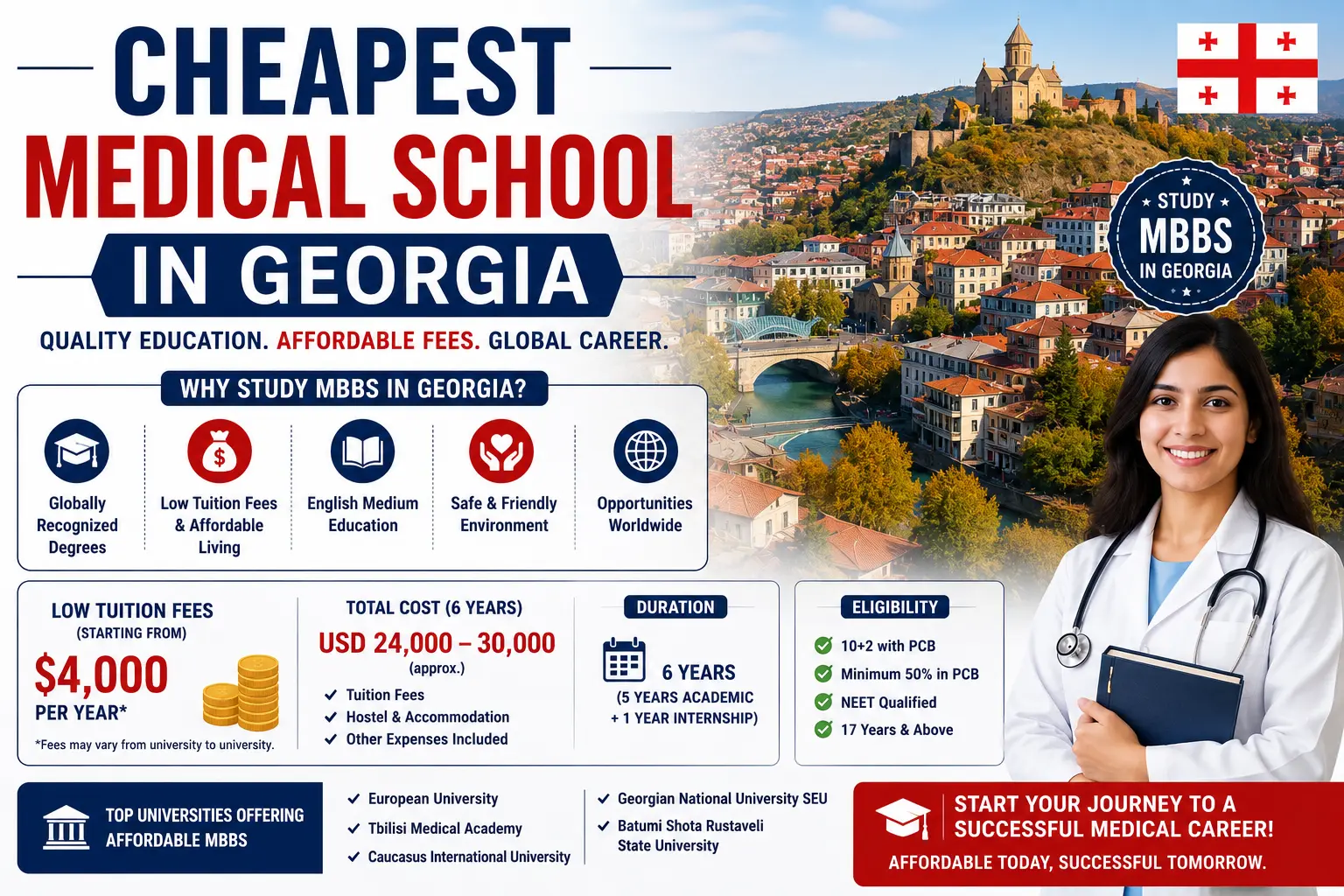
Looking for the “cheapest medical school in Georgia” here is The most affordable medical universities in Georgia for an English-medium MBBS program are Akaki Tsereteli State University and Batumi Shota Rustaveli State University. Tuition fees range from $3,800 to $4,000 per year, making them highly cost-effective options for international students.
These institutions are recognized by major global bodies like the WHO (WDOMS) and the National Medical Commission (NMC), keeping the total course fee highly competitive.
Other budget-friendly and fully accredited universities in Georgia to consider include:
- Georgian National University (SEU): ~$3,900 – $5,500 per year
- Tbilisi State Medical University (TSMU): ~$4,000 – $5,940 per year
- Caucasus International University: ~$5,000 per year
- David Tvildiani Medical University: ~$5,000 per year
Note: In addition to tuition, you should typically budget an extra $2,500 to $3,500 annually to cover your hostel accommodations, food, and living expenses.
Table of Contents
Why Choose an MBBS University in Georgia?
Is studying medicine in Georgia a good idea? The short answer is yes—if you pick the right university. Georgia sits squarely at the intersection of Eastern Europe and Western Asia, offering a uniquely safe, student-friendly environment.
But beyond the safety and the picturesque cobblestone streets of Tbilisi, there are hard, pragmatic reasons why over 10,000 international students are currently pursuing their MBBS (Bachelor of Medicine, Bachelor of Surgery) here.
- 100% English-Medium Curriculum: Unlike Russia or China, where you might be forced to learn the core sciences in the local language, top Georgian medical colleges teach the entire 6-year MBBS program entirely in English.
- Global Recognition (NMC, WHO, WFME): Degrees from recognized Georgian medical universities are accepted by the National Medical Commission (NMC) in India, the World Health Organization (WHO), and the Educational Commission for Foreign Medical Graduates (ECFMG) in the US.
- No Capitation or Donation Fees: Admissions are strictly merit-based. If you meet the academic criteria and hold a valid NEET-UG score, you secure a seat. There are zero hidden “donation” charges.
- Affordable Cost of Living: European living standards usually come with European price tags. Georgia is the exception. As a student, you can live comfortably on $250 to $400 a month.
The Top 5 Cheapest Medical Schools in Georgia
When we talk about the “cheapest” medical university in Georgia for MBBS, we have to filter out the unaccredited diploma mills. The following five universities offer the best balance of affordability, infrastructure, and NMC compliance for the 2026-2027 academic year.
1. Akaki Tsereteli State University (ATSU)
Located in Kutaisi (about 3 hours from Tbilisi), ATSU is consistently one of the cheapest public medical schools in Georgia. Because it operates outside the capital city, both tuition and living costs are significantly lower.
- University Type: Public
- Annual Tuition Fee: ~$4,000 to $4,500 (approx. ₹3.5 – ₹4 Lakhs)
- Total 6-Year Tuition: ~$27,000
- Best For: Students on the strictest budgets who don’t mind living outside the capital.
2. Geomedi Medical University
When students search for “geomedi medical university fees,” they are usually pleasantly surprised. Geomedi is a highly reputed private institution in Tbilisi that hits the sweet spot for affordability and clinical focus.
- University Type: Private
- Annual Tuition Fee: $6,000 (approx. ₹5.1 Lakhs)
- Total 6-Year Tuition: $36,000
- Why it Stands Out: Geomedi features strong tie-ups with local hospitals and boasts an incredibly diverse international student body. It is often cited as the cheapest medical university in Georgia that doesn’t compromise on lab infrastructure.
3. Georgian National University SEU
“Georgia medical college SEU” is one of the most searched terms by Indian students, and for good reason. SEU boasts one of the most modern, technologically advanced campuses in Eastern Europe.
- University Type: Private
- Annual Tuition Fee: $5,500 – $5,900 (approx. ₹4.6 – ₹5 Lakhs)
- Total 6-Year Tuition: ~$35,400
- Why It Stands Out: SEU recently spent more than $25 million on a brand-new campus. You get state-of-the-art robotic simulation labs and digital anatomy tables for a price lower than most Tier-2 private colleges in India.
4. European University
Do not let the generic name fool you; European University (EU) is a heavy hitter in the Georgian medical scene. It has fully compliant NMC status and one of the highest FMGE passing ratios among budget universities.
- University Type: Private
- Annual Tuition Fee: $5,000 – $6,500 (approx. ₹4.2 – ₹5.5 Lakhs)
- Total 6-Year Tuition: ~$39,000
- Why it Stands Out: Strong preparatory focus for international licensing exams (USMLE/PLAB/FMGE) baked right into the curriculum.
5. Tbilisi State Medical University (TSMU)
Okay, I hear you—TSMU isn’t technically the “cheapest” medical college in Georgia. However, it is the best Georgian medical university, and excluding it from this list would be a disservice to your research. When looking at “tbilisi state medical university fees for international students,” you are looking at the premium tier of Georgian education, which is still incredibly cheap compared to Western alternatives.
- University Type: Public (Flagship)
- Annual Tuition Fee: $8,000 (approx. ₹6.8 Lakhs)
- Total 6-Year Tuition: $48,000
- Why it Stands Out: TSMU is the grandfather of medical education in Georgia. It has the largest alumni network, the most extensive affiliated hospital network, and unparalleled global prestige.
The Real Cost: Tuition vs. Living Expenses
Understanding how much medical school is in Georgia requires looking past just the tuition fees. Educational consultants often highlight the “Total Course Fee” but conveniently gloss over daily survival costs.
Let’s break down the real “study medicine in Georgia fees” for a typical international student in 2026:
| Expense Category | Monthly Cost (USD) | Annual Cost (USD) | 6-Year Total (USD) |
|---|---|---|---|
| Tuition (Average Private) | N/A | $5,500 – $6,500 | $33,000 – $39,000 |
| Hostel / Accommodation | $150 – $250 | $1,800 – $3,000 | $10,800 – $18,000 |
| Food & Groceries | $100 – $150 | $1,200 – $1,800 | $7,200 – $10,800 |
| Transport & Utilities | $30 – $50 | $360 – $600 | $2,160 – $3,600 |
| Health Insurance & Visa | N/A | $200 – $300 | $1,200 – $1,800 |
| Total Estimated Budget | $280 – $450 | $8,860 – $12,200 | $54,360 – $73,200 |
Note: For an Indian student, the total budget usually amounts to between ₹30 and ₹45 lakhs over the course of six years.
The Accommodation Strategy
To keep your MBBS in Georgia genuinely cheap, you must manage your housing smartly. University hostels cost about $1,500 to $2,000 per year. However, many students find that renting a shared flat in Tbilisi with 2-3 classmates drops their monthly rent to around $150 per person, while offering significantly better amenities.
The Georgia MBBS Disadvantages (Honest Reality Check)
No destination is a utopia. If you are going to commit six years of your life to a foreign country, you need to know the Georgia MBBS disadvantages. Here is the unvarnished truth.
1. The Clinical Language Barrier
While the entire academic curriculum, lectures, and exams are in English, the patients in the hospitals speak Georgian. To take a patient’s medical history during your clinical rotations (Years 4-6), you must speak the local language. Universities mandate Georgian language classes during the first two years, but students who don’t take these classes seriously struggle immensely during clinicals.
2. The FMGE / NExT Passing Rates
The reality is that graduating from a Georgian university does not make you a doctor in India automatically. You must pass the Foreign Medical Graduates Examination (soon transitioning to NExT). While the pass rate for Georgian graduates hovers around 30-40%—which is higher than Russia or China—it still means that more than half of students fail on their first attempt. You must rely on self-study platforms (like Marrow or PrepLadder) alongside your university curriculum.
3. Lack of Cadavers for Dissection
Most cheap medical colleges in Georgia rely heavily on 3D anatomical tables (like the Anatomage table) and plastinated models rather than real human cadavers for anatomy lessons. While digital dissection is the modern standard, traditionalists argue that nothing replaces the tactile experience of a real cadaver. One of the few institutions still providing comprehensive genuine cadaveric dissection is TSMU.
4. Weather Adjustments
While not as brutally freezing as Russia, Georgian winters in Tbilisi still drop to 0°C to 2°C in January. For students coming from tropical climates, this requires a physical and psychological adjustment, not to mention the added cost of winter wardrobes and room heating.
Admissions 101: How to Apply
Applying to a Georgian medical university is remarkably straightforward compared to the high-pressure counseling rounds in India. However, the documentation process is strict.
1. Check Your Eligibility & Select University: Must meet NMC criteria.
Ensure you have a minimum of 50% in Physics, Chemistry, and Biology in your 12th-grade boards. Indian students must possess a valid, qualifying NEET-UG scorecard. Choose your target university (e.g., SEU, Geomedi, or TSMU).
2. Submit Initial Application: Takes 3-5 days for review.
Use an authorized representative or the university’s portal to apply directly. You will need to upload your 10th and 12th mark sheets, NEET scorecard, and a scanned copy of your passport.
3. Receive the Conditional Offer & Interview:
Most Georgian universities conduct a brief online interview via Skype or Zoom. This is a basic English proficiency check, not a grueling technical medical exam.
4. Document Apostille and Translation: Crucial government step.
Once accepted, your documents must be translated into Georgian and apostilled by the Ministry of External Affairs (MEA) in your home country. Without apostilled documents, the Georgian Ministry of Education will not recognize your high school diploma.
5. Get the Ministry Decree & Invitation Letter:
The university submits your apostilled documents to the Georgian Ministry of Education. Once the Ministry issues a decree approving your student status, the university generates an official Invitation Letter.
6. Pay the First Year Tuition Fees: Transfer directly to the university.
Pay your first year’s tuition fee directly to the university’s official bank account via wire transfer. Never pay tuition fees in cash to a local agent.
7. Apply for the Study Visa (D3):
Use your invitation letter and fee payment receipt to apply for a Georgian D3 student visa through the VFS portal or the Georgian embassy. Visa processing typically takes 30 to 45 days.
Expert Insights
To provide a deeper, on-the-ground perspective, we reached out to international medical education consultants and clinical faculty regarding the reality of studying in Georgia.
Dr. Rajesh Sharma, Chief Medical Admissions Consultant at EduMed Abroad:
“Georgia’s success isn’t only due to its affordable tuition. Indian students can actually take the USMLE thanks to the English-medium curriculum and WFME accreditation. However, I always warn students against chasing the absolute ‘cheapest’ option. Saving $500 a year isn’t worth it if the college lacks an affiliated hospital.If you can’t afford TSMU, stick to mid-tier private institutions like SEU or Geomedi.”
Dr. Elena Kakhiani, Former Clinical Dean in Tbilisi:
“The clinical years provide the largest obstacle for overseas students. Patients in our public hospitals speak Georgian. We mandate Georgian language classes in the first two years, but students who treat those classes as an afterthought struggle immensely during their internal medicine and surgery rotations. Medicine is communication; you cannot diagnose a patient you cannot understand.”
Vikram S., 5th Year MBBS Student at TSMU:
“The lifestyle here is amazing, and it is very safe. But regarding academics, you have to be a self-starter. The professors will teach you the concepts, but nobody is going to spoon-feed you to pass the NExT exam. I spend three hours a day on online medical modules just to ensure my Indian syllabus knowledge is up to par.”
Frequently Asked Questions
1. For Indian Students NEET required for studying MBBS in Georgia?
Yes. For Indian students, a qualifying NEET-UG score is legally mandated by the National Medical Commission (NMC). If you study abroad without passing NEET, you will not be allowed to sit for the FMGE/NExT exam, meaning you cannot practice medicine in India.
2. What is the total duration of the MBBS program in Georgia?
The MBBS program in Georgia is exactly 6 years long. This entails a mandated one-year clinical internship after five years of academic and clinical education.The NMC’s 2021 gazette criteria for foreign medical graduates are exactly in accordance with this.
3. Which is better: MBBS in Russia or Georgia?
Russia is generally cheaper (starting at ₹18 Lakhs total) and has a longer legacy of Indian students. However, Georgia has a distinct advantage: the entire 6-year program is in English.During clinical years, many Russian institutions move to bilingual education (Russian and English), which can be quite disruptive to learning.
4. Can I work part-time while studying medicine in Georgia?
Legally, your student visa allows for limited part-time work. Practically? Do not do it. Medical school requires 8-10 hours of study per day. Students who attempt to work part-time almost universally see their grades collapse, putting their degree in jeopardy.
5. Do overseas students have access to scholarships?
Direct tuition scholarships for international MBBS students are incredibly rare in Georgia, as the fees are already highly subsidized. However, some private universities (like Geomedi) offer small performance-based waivers (e.g., $500 – $1,000 off) for students who top their university exams in the subsequent years.
6. Do I need IELTS or TOEFL to get admission?
No, the vast majority of Georgian medical universities do not require IELTS or TOEFL. English proficiency is assessed during the university’s online interview process. You will pass the test if you can speak English fluently.
7. Is Georgia safe for female medical students?
Indeed, Georgia is frequently listed among Europe’s safest nations. Crime rates are very low, and the local police are responsive. It is generally safe for students to walk around Tbilisi at night, and the local population is welcoming to international students.