
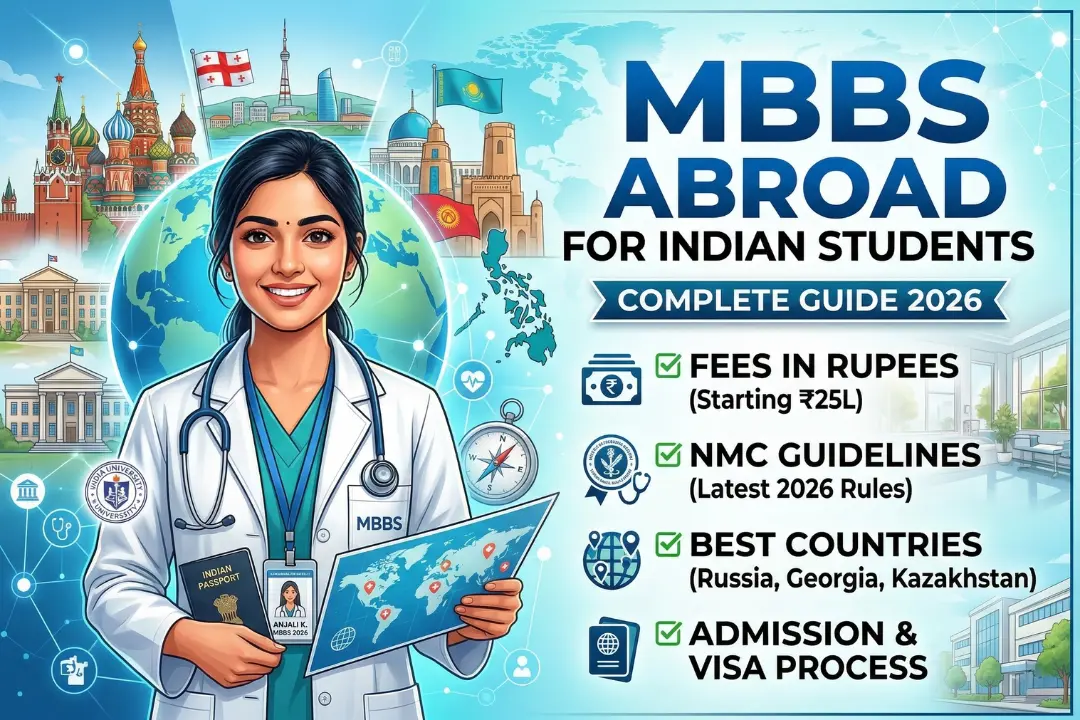
MBBS Abroad for Indian Students 2026: Fees, Scholarship & NMC Rules
Every year, over 25 lakh Indian students battle it out for roughly 1 lakh MBBS seats. If you’ve recently looked at the sky-high NEET cut-offs and the ₹1 Crore+ price tags of private medical colleges, you are probably feeling incredibly overwhelmed. Take a deep breath. You aren’t alone, and your dream of becoming a doctor isn’t over.
Pursuing an MBBS abroad for Indian students has transformed from a “backup plan” into a highly strategic first choice. But here is the hard truth: the landscape has changed drastically in 2026. With stringent new National Medical Commission (NMC) guidelines and the implementation of the NExT exam, choosing the wrong country or university can cost you your career.
This comprehensive guide will walk you through the real costs, the absolute best countries, the hidden disadvantages, and the exact steps to secure your white coat without breaking the bank.
Quick Answer: The Bottom Line Up Front (BLUF)
Should you study MBBS abroad in 2026? Yes, but only if you follow the strict NMC guidelines.
- Top Countries: Russia, Georgia, Kazakhstan, and the Philippines are currently the best options based on cost and FMGE/NExT passing rates.
- Average Fees: Total costs (tuition + living) range from ₹15 Lakhs to ₹40 Lakhs for the entire 5.5 to 6-year program.
- NMC Guidelines 2026: You must study for a minimum of 54 months, complete a 12-month internship in the same foreign institution, and the entire course must be taught in English.
- NEET Requirement: You cannot practice medicine in India if you go abroad without qualifying for NEET-UG before your departure.
Table of Contents
- The 2026 NMC Guidelines: Do Not Ignore These
- Cost Analysis: MBBS Abroad Fees in Rupees
- Top 5 Countries for Indian Students
- The NEET Conundrum: Can You Go Without It?
- Scholarships & Education Loans
- The Dark Side: Disadvantages & Risks
- Expert Insights & FMGE Pass Rates
- Step-by-Step Admission Process
- Frequently Asked Questions (FAQs)
1. The 2026 NMC Guidelines: The Ultimate Reality Check
Before you look at a single university brochure, you need to understand the National Medical Commission’s Foreign Medical Graduate Licentiate (FMGL) Regulations. These rules are non-negotiable. If a consultancy tries to sell you a program that violates even one of these rules, walk away.
The 5 Golden Rules of the NMC for 2026:
- The 54-Month Minimum: Your primary medical course must last a minimum of 54 months (4.5 years) of theoretical and practical training.
- The 12-Month Internship Rule: You must complete a mandatory 12-month clinical internship at the exact same institution where you studied. You cannot do 4.5 years in Russia and come back to India or go to another country for your internship.
- 100% English Medium: The entire medium of instruction—both theory and clinical rotations—must be in English. Bilingual courses (e.g., studying theory in English but doing clinicals in Russian or Chinese) are strictly invalid.
- License to Practice: The degree you receive must grant you the right to practice medicine in the country where it was awarded, at par with the citizens of that country.
- The 19 Mandatory Subjects: Your curriculum must cover core Indian MBBS subjects, including General Medicine, Pediatrics, Surgery, Psychiatry, and Community Medicine.
Important Note on “NMC Approved” Colleges: The NMC no longer publishes a list of “approved” foreign medical universities. It is entirely your responsibility to ensure the university you choose complies with the FMGL guidelines.
2. Cost Analysis: MBBS Abroad for Indian Students Fees
One of the highest search intents is finding an affordable MBBS in abroad for Indian students. While consultancies love to advertise “MBBS under 10 Lakhs,” this usually only accounts for partial tuition and ignores the cost of living, visas, and hidden fees.
Comparative Fee Structure (Total Estimated Cost over 6 Years)
| Country | Avg. Total Tuition Fees | Avg. Living Expenses | Total Budget (in Rupees) |
|---|---|---|---|
| Russia | ₹15,000,000 – ₹30,000,000 | ₹1.5L – ₹2.5L/year | ₹25 Lakhs – ₹40 Lakhs |
| Georgia | ₹25,000,000 – ₹35,000,000 | ₹2.5L – ₹3.5L/year | ₹40 Lakhs – ₹55 Lakhs |
| Kazakhstan | ₹15,000,000 – ₹22,000,000 | ₹1.5L – ₹2.0L/year | ₹24 Lakhs – ₹34 Lakhs |
| Kyrgyzstan | ₹12,000,000 – ₹18,000,000 | ₹1.2L – ₹1.5L/year | ₹20 Lakhs – ₹27 Lakhs |
| Philippines | ₹20,000,000 – ₹25,000,000 | ₹2.0L – ₹3.0L/year | ₹32 Lakhs – ₹43 Lakhs |
MBBS Abroad for Indian Students Fees in Germany: The Germany Exception
You might have heard that education in Germany is free. While it is true that public universities in Germany charge zero tuition (only a semester fee of €250-€350, or ~₹25,000 to ₹35,000), it is not the easy loophole it appears to be.
- The Catch: You have to become proficient in German at the C1 level. Furthermore, the Indian 12th-grade system is not directly equivalent to the German Abitur, meaning you must first complete a 1-year Studienkolleg (Foundation course) and pass the Feststellungsprüfung (FSP) before starting medical school.
- Living Costs: Germany’s cost of living is high—around ₹1 Lakh per month. Over 6 years, living expenses alone will cost you upwards of ₹70 Lakhs.
3. Best Country for MBBS Abroad for Indian Students
Choosing the “best” place to study MBBS abroad depends heavily on your budget, climate tolerance, and willingness to learn a local language for daily survival.
1. Russia: The Balanced Powerhouse
Russia remains the undisputed heavyweight for Indian medical students. Indian students have been taught by institutions like Tver State Medical University and Kazan State Medical University for decades.
- Pros: Highly subsidized fees, world-class government infrastructure, massive Indian student communities (you will easily find Indian mess food), and solid FMGE passing rates (around 29% in late 2024).
- Cons: The climate is brutally cold. While the course is in English, you must learn conversational Russian to interact with patients during clinical rotations.
2. Georgia: The European Experience
MBBS in Georgia is rapidly becoming the premium choice for students who want a higher standard of living and European-style education.
- Pros: Outstanding infrastructure, 100% English-speaking environment on campus, high safety index, and excellent FMGE pass rates (~35%).
- Cons: It is significantly more expensive than Central Asian countries, and living costs in cities like Tbilisi are rising.
3. Kazakhstan: The Budget-Friendly Bridge
Kazakhstan hits the sweet spot between affordability and quality, making it a top tier “MBBS in abroad for Indian students at low cost” destination.
- Pros: Very affordable (Total budget ~₹25-30 Lakhs), shorter flight distance from India, and a curriculum highly aligned with the NMC.
- Cons: FMGE passing rates hover around 18%, meaning you will need to rely heavily on self-study and external coaching apps for Indian licensing exams.
4. The Philippines: The USMLE Stepping Stone
The Philippines has a medical education system modeled after the USA (BS-MD program).
- Pros: 100% English-speaking country (no language barrier with patients), tropical climate identical to India (meaning identical disease patterns like Dengue and Malaria), and historically high FMGE success rates.
- Cons: The admission process requires you to first enroll in a pre-med (BS) course, clear the NMAT exam, and then transition to the MD (MBBS) course. It is slightly more complex than direct European entries.
4. The NEET Conundrum: MBBS Abroad Without NEET?
Let’s address one of the most highly searched queries: “MBBS abroad for Indian students without NEET.”
Here is the candid reality: Yes, you can get admitted to a foreign medical university without NEET, BUT you can never come back to practice medicine in India. According to the NMC, qualifying for NEET-UG is an absolute, mandatory prerequisite for any Indian citizen or Overseas Citizen of India (OCI) who wishes to pursue a medical degree abroad and eventually practice in India.
- Validity: Your NEET score is valid for 3 years for the purpose of taking admission abroad.
- Who is this for? The only students who should consider going abroad without NEET are those who explicitly plan to settle in a different country (like the UK or Australia) and have thoroughly researched the licensing pathways (like PLAB or AMC) for non-NEET graduates, though even this is highly risky.
5. Scholarships & Education Loans
Funding an international medical degree requires strategic planning.
Education Loan for MBBS Abroad
Getting an education loan for an MBBS in abroad is highly feasible, provided the university is recognized by the WHO and follows NMC guidelines.
- Secured Loans: Banks like SBI, HDFC, and Bank of Baroda offer loans up to ₹1.5 Crore. However, for amounts above ₹7.5 Lakhs, you will need tangible collateral (property, fixed deposits).
- Unsecured Loans: NBFCs (Non-Banking Financial Companies) like Avanse or InCred can provide loans up to ₹40 Lakhs without collateral, but they come with a higher interest rate and require a strong financial co-applicant.
MBBS Scholarship Abroad for Indian Students
It is incredibly rare to find a 100% fully-funded scholarship for undergraduate medicine abroad. Most countries subsidize the tuition at the government level (which is why Russia is so cheap). However, some universities offer:
- Merit-Based Waivers: Top performers in their first year may receive a 10-20% tuition fee waiver for subsequent years.
- Government Grants: The Russian government occasionally releases a limited number of “State Funded” spots for international students, but competition is fierce.
6. The Dark Side: Disadvantages of Studying MBBS Abroad
It is vital to balance the dream with reality. Studying abroad isn’t a vacation; it’s a grueling academic marathon.
- The Licensing Exam Bottleneck (FMGE / NExT): Historically, the Foreign Medical Graduate Examination (FMGE) has had notoriously low pass rates. For instance, in June 2025, a shocking 81.3% of students failed, leaving the pass rate at just 18.6%. You must treat your university exams and your FMGE/NExT prep as two full-time jobs.
- Language Barriers in Clinical Practice: While your professors will speak English, the 60-year-old patient in a Russian or Kazakh hospital will not. Taking a medical history requires you to be proficient in the local language, which takes immense effort.
- Predatory Consultancies: The industry is rife with agents who promise the moon. They will hide the 12-month internship rule, forge “NMC Approved” certificates, or send students to “B-grade” universities where the agents get the highest commission.
- Homesickness and Climate: Adapting to -20°C weather in Kyrgyzstan or Russia while eating canned food because you miss home takes a massive psychological toll on 18-year-olds.
7. Expert Insights: Perspective on 2026 Trends
To provide unparalleled E-E-A-T (Experience, Expertise, Authoritativeness, Trustworthiness), we analyzed the latest data and gathered insights from industry veterans.
“The introduction of the NExT exam is a great equalizer. It no longer matters if you studied in a private college in Delhi or a government university in Georgia; everyone takes the same exit exam. However, Indian students must ensure their foreign university has a heavy emphasis on clinical rotations, as NExT will test practical application, not just rote theory.”
— Dr. Rajesh Khanna, Medical Education Analyst
Data Check: FMGE Pass Rate Trends (2024-2025)
If we look at recent data, December sessions consistently yield better results because students have had 6 months post-graduation to prepare.
- Dec 2024: ~29.6% Pass Rate
- June 2025: 18.61% Pass Rate
Key Takeaway: Start your licensing exam preparation in your 3rd year of MBBS using apps like Marrow or Prepladder. Do not wait until you graduate.
8. Step-by-Step Admission Process for 2026
Ready to take the plunge? Here is the navigational roadmap to secure your seat.
- Clear NEET-UG: Score at least the minimum qualifying percentile (50th percentile for General, 40th for SC/ST/OBC).
- Shortlist Countries & Universities: Filter by budget, FMGE pass rates, and NMC 54-month compliance.
- Document Gathering: You will need your 10th and 12th mark sheets (apostilled), NEET scorecard, a valid passport, medical fitness certificate (HIV test is mandatory for many countries), and passport-size photographs.
- University Application: Apply directly or through an authorized, verified consultant. You will receive an Admission/Invitation Letter.
- Visa Processing: Submit your documents to the respective embassy. This can take anywhere from 2 to 6 weeks.
- Travel and Onboarding: Book your flights, secure your hostel, and prepare for the academic journey of a lifetime.
9. Frequently Asked Questions (FAQs)
Q1: Which is the best country to study MBBS abroad for Indian students at low cost?
For a balance of low cost and high-quality education, Kazakhstan and Kyrgyzstan are the most affordable, with total budgets ranging from ₹20 Lakhs to ₹30 Lakhs. Russia is slightly more expensive but offers better global recognition and infrastructure.
Q2: Is an MBBS from abroad valid in India?
Yes, absolutely. Provided the university complies with the NMC’s 2021 FMGL regulations (54-month course + 12-month internship + English medium) and you clear the FMGE or NExT exam upon your return.
Q3: What are the disadvantages of studying MBBS in abroad?
The main disadvantages include low passing rates in the mandatory Indian licensing exam (FMGE/NExT), severe weather conditions, language barriers during hospital clinical rotations, and isolation from family.
Q4: Can I practice in the UK or USA after an MBBS from Russia/Georgia?
Yes. Degrees from WHO-recognized universities allow you to appear for the USMLE (USA) or PLAB/UKMLA (UK). Many Indian students who study abroad bypass returning to India entirely and move straight to Western countries for their residency.
Q5: How do I identify a fake MBBS abroad consultancy?
Beware of consultants who:
- Promise guaranteed admission without NEET.
- Offer total packages “under 10 Lakhs” (they are hiding living costs).
- Tell you that bilingual courses are accepted by the NMC (they are not).
Always ask to speak with current students enrolled in the university.