
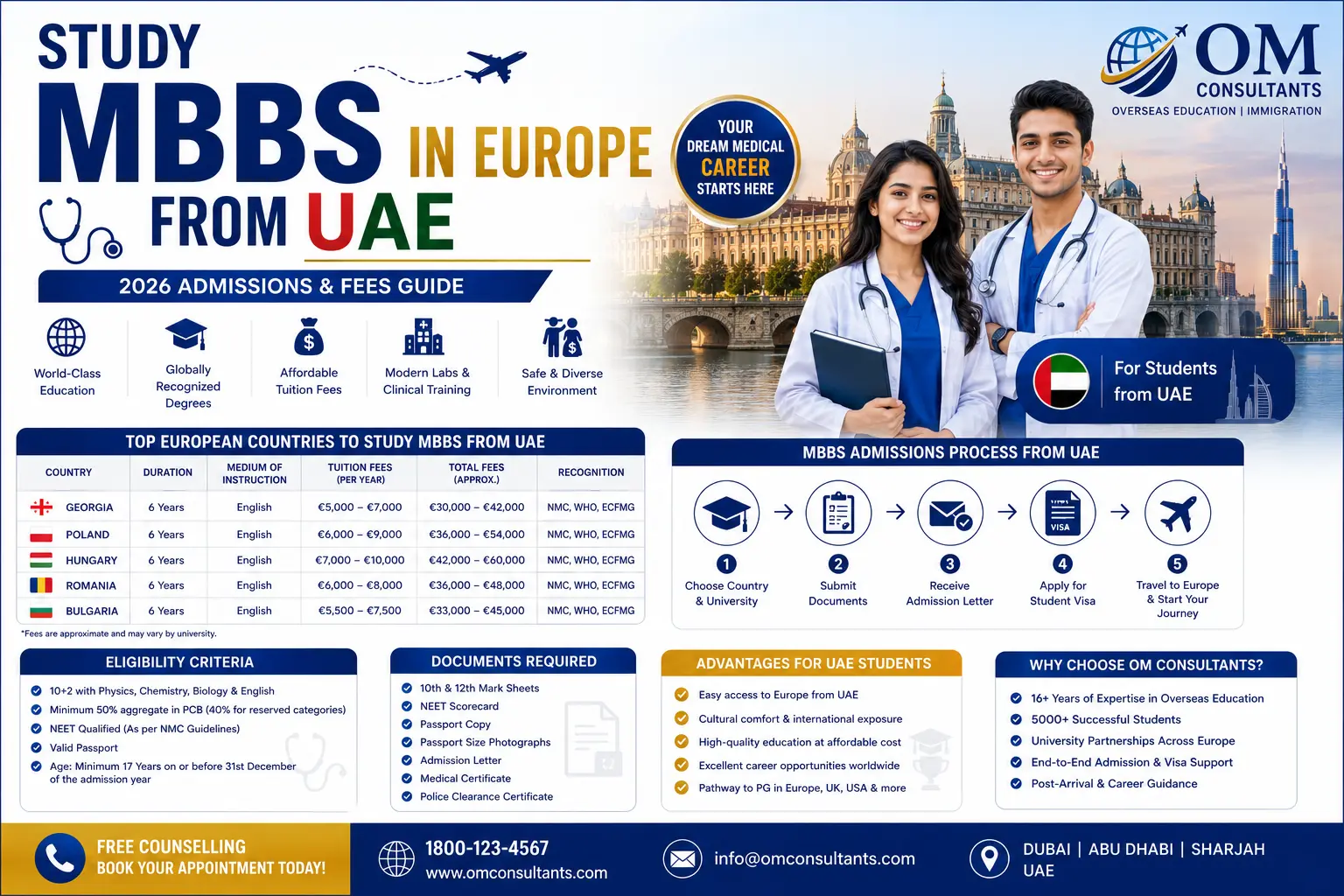
Study MBBS in Europe from UAE
Choosing where to study medicine is arguably the biggest decision of your academic career. If you’re based in the UAE—whether you’re an Emirati national or an expat—you’re likely staring down a bottleneck. Local medical colleges are highly competitive and notoriously expensive. Moving to the US or UK involves brutal acceptance rates and eye-watering tuition fees.
That’s exactly why studying MBBS in Europe from the UAE has become the gold standard for aspiring doctors. European medical universities offer globally recognized degrees, world-class clinical training, English-taught programs, and significantly lower tuition costs.
But let’s be real: navigating European medical admissions from Dubai or Abu Dhabi can feel like walking through a maze blindfolded. Different countries have varying entrance exams, contrasting NEET requirements for Indian expats, and widely different living costs. This guide breaks down everything you need to know for 2026 admissions—no fluff, just actionable insights.
Table of Contents
- Why Choose Europe for MBBS Over Other Destinations?
- Top European Countries for MBBS from UAE
- Complete Cost Breakdown (Tuition + Living)
- Eligibility Criteria for UAE Students
- Step-by-Step Application Process
- The Truth About NEET (Do you need it?)
- Global Recognition: USMLE, PLAB, & NExT
- Expert Insights & Student Experiences
- Frequently Asked Questions (FAQs)
Why Choose Europe for MBBS Over Other Destinations?
Let’s face it, the medical school scramble is real. You want a degree that opens doors globally, not one that traps you in red tape. Here is why the European route makes sense:
- 100% English-Taught Programs: You don’t need to speak Polish, Romanian, or Georgian to sit in a lecture hall. Across Eastern and Central Europe, universities run dedicated English-medium tracks designed specifically for international students.
- Affordability Without Compromise: Medical school in the US can easily top $250,000. In Europe, tuition can run as low as €3,000 to €16,000 annually. You are paying a fraction of the cost for an education that is heavily subsidized by the government.
- Global Recognition (WHO, NMC, WFME): Degrees from top European universities are fully recognized by the World Health Organization (WHO), the Educational Commission for Foreign Medical Graduates (ECFMG) for the US, and the National Medical Commission (NMC) of India. This means you can practice in the UAE, the UK, the US, or your home country after passing the required licensing exams.
- Clinical Exposure: European medical education leans heavily on early clinical exposure. Instead of being stuck in a lab for three years, you are walking the wards and interacting with patients much earlier in your degree.
- Lifestyle and Safety: Europe offers a high standard of living, exceptional safety records, and the ability to travel across 27 Schengen countries on a single student visa.
“We’ve seen a 40% year-on-year increase in students from the UAE opting for Central and Eastern Europe. The value proposition is just too strong to ignore—they get EU-standard clinical training at a third of the cost of British universities.”
— Dr. Tariq Al-Hassan, Overseas Medical Education Consultant, Dubai
Top European Countries for MBBS from UAE
Not all European medical degrees are created equal. The “best” country depends entirely on your budget, your high school grades, and where you want to practice eventually. Here is a deep dive into the heavyweight destinations for 2026.
1. Italy: The Prestige & Affordability Sweet Spot
Italy has disrupted the medical education market by offering world-class, English-taught programs at public universities with income-based tuition fees.
- Duration: 6 years
- Tuition Fees: €150 – €4,000 per year (depending on family income)
- Living Costs: €600 – €1,000 per month
- Top Universities: Sapienza University of Rome, University of Milan, University of Bologna
- The Catch: You must pass the IMAT (International Medical Admissions Test). It is fiercely competitive, but if you score well, you’re set.
2. Poland: The USMLE Launchpad
Poland is highly respected for its rigorous academic standards and its specific focus on preparing students for the USMLE (the US licensing exam).
- Duration: 6 years
- Tuition Fees: €10,000 – €16,000 per year
- Living Costs: €400 – €600 per month
- Top Universities: Medical University of Warsaw, Jagiellonian University, Medical University of Gdansk
- Why it works: Polish degrees grant direct access to practice across the 27 EU nations.
3. Romania: The Budget-Friendly Powerhouse
If you want an EU degree on a tight budget, Romania is your destination. The admission process is relatively straightforward, relying heavily on your high school grades and an English proficiency test rather than grueling entrance exams.
- Duration: 6 years
- Tuition Fees: €5,000 – €9,000 per year
- Living Costs: €300 – €500 per month
- Top Universities: Carol Davila University of Medicine and Pharmacy, Iuliu Hațieganu University, Grigore T. Popa University
4. Georgia: The Non-EU Favorite
While technically at the crossroads of Europe and Asia and not an EU member, Georgia is undeniably the most popular choice for Indian expats in the UAE due to its NMC-aligned curriculum and low cost of living.
- Duration: 6 years (5 years + 1-year internship)
- Tuition Fees: $5,000 – $8,000 per year
- Living Costs: $200 – $300 per month
- Top Universities: Tbilisi State Medical University, University of Georgia, European University
5. Czech Republic: The Historic Heavyweight
With universities dating back to the 1300s, the Czech Republic offers prestige that rivals Western Europe, though the tuition is slightly higher than its Eastern neighbors.
- Duration: 6 years
- Tuition Fees: €11,000 – €15,000 per year
- Living Costs: €500 – €700 per month
- Top Universities: Charles University (Prague), Masaryk University (Brno)
Complete Cost Breakdown
To truly understand your financial commitment, you have to look beyond tuition. When planning your budget from the UAE, factor in flights, residency permits, and daily living.
| Country | Annual Tuition (Approx) | Monthly Living Cost | Total 6-Year Cost |
|---|---|---|---|
| Italy (Public) | €150 – €4,000 | €600 – €1,000 | ₹20-45 lakhs / 80k-180k AED |
| Romania | €5,000 – €9,000 | €300 – €500 | ₹20-35 lakhs / 80k-140k AED |
| Bulgaria | €7,000 – €9,000 | €300 – €450 | ₹25-35 lakhs / 100k-140k AED |
| Poland | €10,000 – €16,000 | €400 – €600 | ₹35-55 lakhs / 140k-220k AED |
| Hungary | €14,000 – €18,000 | €500 – €700 | ₹45-65 lakhs / 180k-260k AED |
“Many parents in the United Arab Emirates fail to account for annual return flights to Dubai, health insurance, and clinical rotation materials when determining base tuition. Always add 15% to your budget to account for currency fluctuations and lifestyle improvements. ”
— Sarah Jenkins, Financial Aid Advisor for International Students
Eligibility Criteria for UAE Students
European medical universities are practical in their admissions. They care less about arbitrary extracurriculars and more about your fundamental grasp of core sciences. If you are applying from the UAE, you generally fall into one of three curricula: CBSE (Indian), British (A-Levels), or American (AP/High School Diploma).
Here is the baseline eligibility:
- Age: You must be at least 17 years old by December 31st of the admission year.
- Core Subjects: Physics, Chemistry, and Biology (PCB) are required core subjects.
- Minimum Grades:
- CBSE: At least 60% aggregate in PCB (50% is accepted in places like Georgia, but 60%+ is safer for the EU).
- A-Levels: Minimum BBC, with emphasis on Biology and Chemistry.
- American Curriculum: GPA of 3.0 or higher with strong AP scores in Bio/Chem.
- English Proficiency: TOEFL or IELTS (6.0 – 6.5).
Note: Some universities waive this if your high school medium of instruction was English.
Entrance Exams by Region
- Italy: Requires the IMAT.
- Poland/Czech Republic/Hungary: Require university-specific written exams (usually multiple-choice questions in Bio and Chem) followed by an oral interview.
- Romania/Bulgaria/Georgia: Mostly evaluate based on high school grades and a basic online interview to assess motivation.
Step-by-Step Application Process
1. Shortlist Universities and Verify Credentials: Must be done 8-10 months before the October intake.
Check the World Directory of Medical Schools (WDOMS) to ensure your target university is recognized. If you are an Indian expat planning to return to India, cross-reference the university with the NMC’s current approved list.
2. Prepare Your Documentation:
Gather your 10th and 12th-grade transcripts, passport copies, birth certificate, and a medical certificate (including HIV test results).
3. Apostille and Legalize Documents: Crucial for UAE applicants.
This is where many students trip up. Documents issued in the UAE must be attested by the UAE Ministry of Education, then the Ministry of Foreign Affairs (MOFA), and finally by the embassy of the destination country.
4. Submit Applications and Sit for Entrance Exams:
Pay the application fees (usually €100-€300). If applying to Italy, register for the IMAT. For Poland or Hungary, schedule your online entrance exams.
5. Secure Your Offer Letter and Pay Tuition:
Once you pass the interview or exam, you will receive a conditional offer. You must transfer the first semester or year’s tuition fee directly to the university’s official bank account to secure your seat.
6. Apply for a Student Visa:
Book an appointment at VFS Global or the respective embassy in Abu Dhabi or Dubai. You will need your university acceptance letter, proof of tuition payment, and bank statements showing you can cover living costs.
The Truth About NEET: Do You Need It?
If you are an Indian expat living in the UAE, the NEET exam is the elephant in the room. Here is the unvarnished truth:
European universities do not care about your NEET score. They have their own entrance criteria.
HOWEVER, the Indian government absolutely does.
If you are an Indian citizen and you ever plan to return to India to practice medicine, the National Medical Commission (NMC) mandates that you must have a qualifying NEET scorecard before you leave to study abroad.
“Every year, students who migrated to Georgia or Romania without finishing NEET approach us in a panic since they are unable to sit the FMGE/NExT exam in India. Regardless of what the European university says, if you have an Indian passport, you should take NEET seriously. ”
— Dr. Anjali Desai, Medical Licensing Expert
If you plan to practice in the UK, the US, or stay in Europe, NEET is irrelevant. But keep your options open—taking and passing NEET gives you a vital safety net.
Global Recognition: USMLE, PLAB, & NExT
An MBBS from Europe isn’t a dead-end; it’s a launchpad. Because European programs meet rigorous EU standards, graduates are uniquely positioned to tackle global licensing exams.
1. Practicing in the UAE
To practice in the UAE (DHA/HAAD/MOH), you generally need two years of clinical experience post-graduation and must pass the local licensing exam. A European degree fulfills the educational prerequisites effortlessly.
2. Moving to the UK (PLAB / UKMLA)
European medical graduates historically have incredibly high pass rates on the PLAB (Professional and Linguistic Assessments Board) exam. Furthermore, if you graduate from an EU country, the GMC (General Medical Council) often streamlines the registration process.
3. The US Dream (USMLE)
Universities in Poland and the Czech Republic structure their curriculums to align closely with the United States Medical Licensing Examination (USMLE). Many offer dedicated prep courses in the 4th and 5th years.
4. Returning to India (NExT)
The NMC has replaced the old FMGE exam with NExT (National Exit Test). European curriculums—particularly the 54-month academic + 12-month internship structure required by the NMC—are fully compliant.
Frequently Asked Questions (FAQs)
1. Is an MBBS from Europe equivalent to an MBBS in India or the UAE?
Yes. In Europe, the degree is often awarded as an “MD” (Doctor of Medicine), but it is the exact undergraduate equivalent of the British/Indian MBBS.
2. Do I have to learn the local language?
While the curriculum is taught in English, you will need to learn the local language (e.g., Polish, Romanian) during your first three years. This is mandatory so you can communicate with local patients during your hospital rotations in years 4 to 6.
3. Are there scholarships available for UAE students?
Yes, but they are highly competitive. Hungary offers the Stipendium Hungaricum, which covers full tuition, accommodation, and a stipend. Italy’s fee structure naturally acts as a scholarship since it is based on family income.
4. Can I work part-time while studying medicine in Europe?
Legally, most EU student visas allow 20 hours of work per week. Practically, medical school is incredibly demanding. Relying on a part-time job to fund your tuition is not recommended; it will likely cause your grades to suffer.
5. What is the success rate of European graduates in licensing exams?
Graduates from top EU universities (like Warsaw Medical University or Charles University) typically show high pass rates on the PLAB and USMLE, often exceeding 75% on their first attempt, owing to the EU’s strict educational standards.
Is MBBS in Europe valid in UAE?
Yes, an MBBS (or MD equivalent) from Europe is fully valid in the UAE, provided the university is listed in the World Directory of Medical Schools (WDOMS) and recognized by the World Health Organization (WHO). To practice, graduates must fulfill the local licensing requirements (passing the DHA, HAAD, or MOH exams) and typically complete a minimum of two years of clinical experience post-graduation.
Can UAE students study MBBS in Europe?
Absolutely. European medical universities actively welcome both Emirati nationals and expatriate students residing in the UAE. As long as you meet the academic prerequisites in your high school curriculum (CBSE, British A-Levels, or American High School Diploma), you are fully eligible to apply to English-taught programs across the continent.
Which European country is best for MBBS from UAE?
The “best” country varies on your individual objectives. Italy is the top choice for combining high global prestige with incredibly low tuition. Poland is widely considered the best for students planning to take the USMLE or PLAB due to its rigorous, exam-focused curriculum. Romania and Georgia are the best options for students seeking budget-friendly tuition and a straightforward admission process.
How much does MBBS in Europe cost from UAE?
Tuition fees for English-taught medical programs in Europe range from €3,000 to €16,000 per year (roughly 12,000 to 64,000 AED). When you factor in living expenses, a full 6-year degree will typically cost between 100,000 AED and 250,000 AED in total, making it highly cost-effective compared to private institutions in the UAE, UK, or US.
Is NEET required for MBBS in Europe from UAE?
European universities do not require NEET for admission. However, if you are an Indian passport holder living in the UAE and you plan to return to India to practice medicine in the future, the National Medical Commission (NMC) makes it strictly mandatory for you to have a qualifying NEET scorecard before enrolling abroad. If you plan to practice in the UAE, UK, or Europe, NEET is irrelevant.
Which European universities accept UAE students?
Almost all major public and private medical universities in Europe with English tracks accept UAE residents. Highly sought-after institutions include Sapienza University (Italy), Medical University of Warsaw (Poland), Carol Davila University (Romania), Charles University (Czech Republic), and Tbilisi State Medical University (Georgia).
How can I apply for MBBS in Europe from Dubai?
The process starts by shortlisting WDOMS-recognized universities and checking their specific deadlines. You must gather your 10th and 12th-grade transcripts and have them apostilled by the UAE Ministry of Foreign Affairs (MOFA). Applications can be submitted directly through university portals or via certified educational consultants in Dubai. After securing an acceptance letter and paying the initial tuition, you apply for a student visa at the respective European embassy or VFS Global center in the UAE.
What are the eligibility criteria for MBBS in Europe from UAE?
By December 31st of the entrance year, applicants must be at least 17 years old. Academically, you need a strong foundation in Physics, Chemistry, and Biology (PCB). Indian curriculum (CBSE/ICSE) students generally need a minimum of 60% aggregate in PCB. British curriculum students need A-Levels with at least BBC (focusing on sciences), and American curriculum students need a GPA of 3.0+ with relevant AP courses. English proficiency (IELTS 6.0+) is also typically required.
Which is Europe’s cheapest country for MBBS?
Italy offers the cheapest public medical education, utilizing an income-based fee structure where tuition can drop as low as €150 per year for eligible students. In Eastern Europe, Romania, Bulgaria, and Georgia are the most affordable, offering consistent tuition rates starting around €5,000 to €7,000 annually with very low living costs.
Is MBBS in Europe recognized by WHO and NMC?
Yes, degrees from state-recognized European medical universities are recognized by the WHO (via WDOMS) and the Indian NMC. To ensure NMC compliance for Indian expats, ensure that the European program strictly adheres to the 2021 gazette guidelines, which include a minimum 54-month academic course, a 12-month internship completed at the same institution, and English as the medium of instruction.