
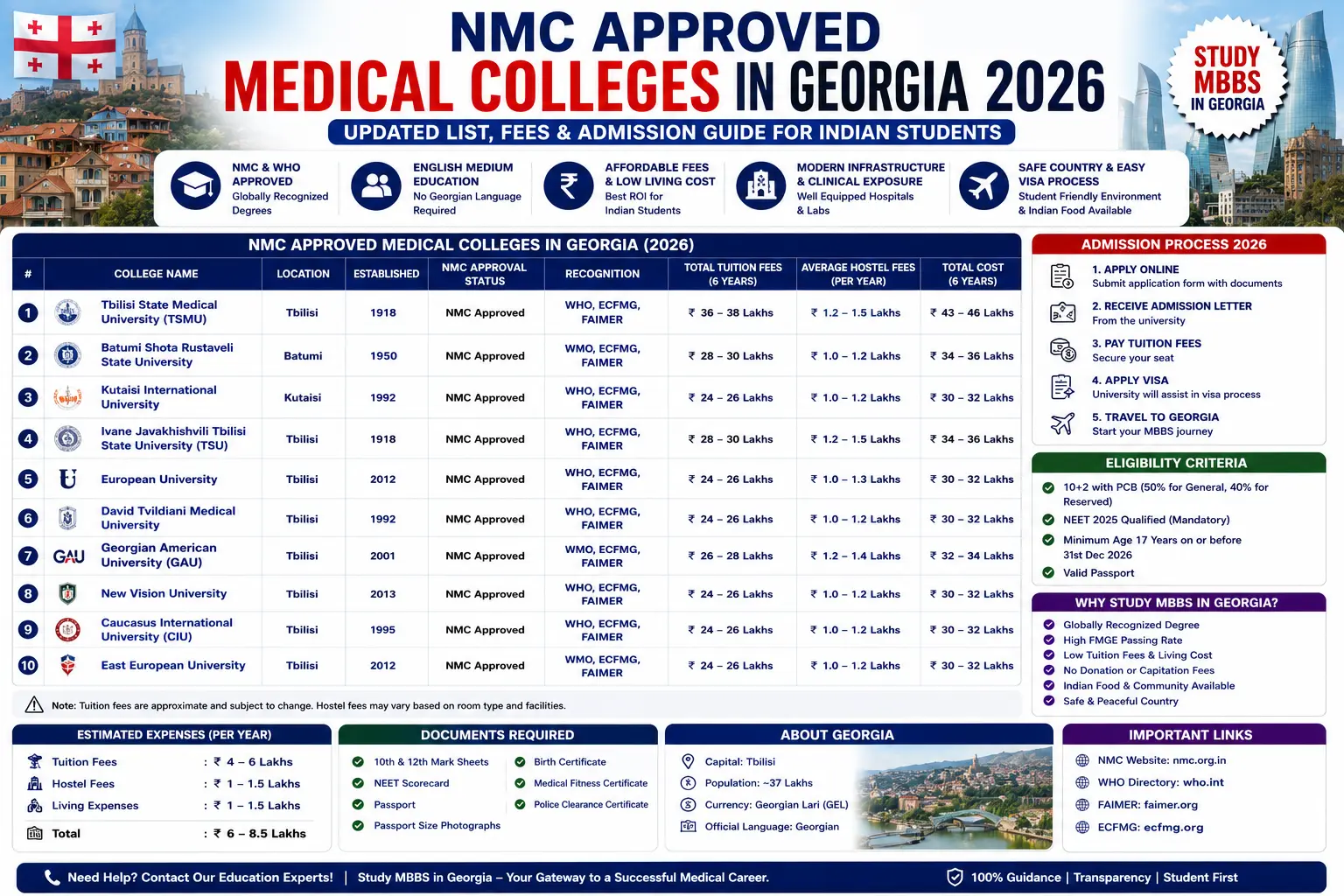
NMC Approved Medical Colleges in Georgia 2026: Updated List, Fees & Admission Guide
If you’re an Indian medical aspirant in 2026, the intense competition for government medical seats is a familiar reality. With soaring cut-offs and private medical colleges in India charging upwards of ₹80 Lakhs to ₹1.2 Crores, studying MBBS abroad has transitioned from a backup plan to a strategic first choice. Among the top destinations, Georgia has rapidly emerged as the gold standard for Indian students.
Boasting European-standard infrastructure, 100% English-medium instruction, and zero donation fees, Georgia’s medical universities are heavily populated by Indian students. However, the landscape of MBBS in Georgia is heavily governed by the National Medical Commission (NMC) of India. Getting your degree is only half the battle; ensuring it is valid back home is the real challenge.
This comprehensive 2026 guide breaks down the updated list of NMC approved medical colleges in Georgia, complete fee structures, strict compliance requirements, and what it really takes to practice in India after your graduation.
Table of Contents
- Why Study MBBS in Georgia in 2026?
- NMC Guidelines for MBBS in Georgia (FMGLR 2021)
- Top NMC Approved Medical Universities in Georgia 2026
- Cost Breakdown: Georgia MBBS Fees vs. India
- Georgia MBBS Admission Process & Eligibility
- FMGE & NExT: Is MBBS from Georgia Valid in India?
- Living Expenses for Indian Students in Georgia
- Expert Insights & Industry Perspectives
- Frequently Asked Questions (FAQs)
Why Study MBBS in Georgia in 2026?
Georgia sits at the crossroads of Eastern Europe and Western Asia, but its educational framework is strictly European. The country’s medical universities operate under the European Credit Transfer System (ECTS), making your academic credits portable across Europe.
Beyond academics, here is why over 16,000 Indian students are currently pursuing their MD (equivalent to MBBS) in Georgia:
- Affordable MBBS abroad: Total 6-year tuition ranges from ₹25 Lakhs to ₹45 Lakhs, vastly cheaper than Indian private colleges.
- No Capitation/Donation: Admissions are strictly merit-based and transparent.
- English Medium MBBS in Georgia: The entire 6-year course is taught in English. You do not need to learn a new language to understand complex medical concepts, though basic Georgian is taught for clinical interactions with local patients.
- Global Recognition: Top universities are listed in the World Directory of Medical Schools (WDOMS) and recognized by the WHO, FAIMER, and ECFMG (essential for USMLE).
NMC Guidelines for MBBS in Georgia (FMGLR 2021)
Myth-Busting: The NMC no longer publishes a static “list of approved universities.” Instead, they established the Foreign Medical Graduate Licensure Regulations (FMGLR) 2021. A university is considered “NMC Recognized” only if its curriculum and structure strictly adhere to these rules.
If you are an Indian student planning to practice in India, your chosen university must meet the following criteria:
- 54-Month Minimum Duration: The academic course must last at least 54 months (4.5 years). In Georgia, the standard MD program is 360 ECTS credits spread over 6 years, which safely exceeds this requirement.
- 12-Month Mandatory Internship: You must complete a 12-month clinical internship at the same institution where you studied. Splitting your studies or doing an internship in a different country (including India) before graduation is strictly prohibited.
- English Medium: The medium of instruction for the entire program must be English.
- Licensing Parity: The degree awarded must allow you to legally register and practice medicine in Georgia, on par with local citizens. Without this, your degree is invalid in India.
- Subject Equivalence: The curriculum must cover core subjects as mandated by the NMC, including Community Medicine, General Surgery, Pediatrics, and Obstetrics & Gynecology.
Crucial Warning: Beware of agencies offering “fast-track” degrees or credit transfer programs. The NMC explicitly rejects any degree that involves transferring between universities or countries midway through the course.
Top NMC Approved Medical Universities in Georgia 2026
Here is a curated list of the best NMC approved medical universities in Georgia, fully compliant with FMGLR 2021 guidelines, based on academic reputation, infrastructure, and historical FMGE passing rates.
1. Tbilisi State Medical University (TSMU)
TSMU is the oldest and most prestigious medical university in Georgia. Situated in the capital, it has the largest network of affiliated teaching hospitals.
- Status: Public
- Annual Tuition: ~$8,000
- Why choose TSMU: It offers an American MD program (created in collaboration with Emory University, USA) and consistently boasts one of the highest FMGE passing rates of Georgia medical universities.
2. Georgian National University SEU
Known for its ultra-modern campus and heavy investment in robotic simulation labs, SEU provides a premium learning environment.
- Status: Private
- Annual Tuition: ~$6,300
- Why choose SEU: Features world-class infrastructure, high-tech anatomy labs, and excellent hostel facilities dedicated to international students.
3. David Tvildiani Medical University (DTMU)
DTMU is highly specialized, offering purely medical programs. It was the first non-governmental medical university in Georgia.
- Status: Private
- Annual Tuition: ~$8,000
- Why choose DTMU: Extremely rigorous academics with a curriculum modeled heavily on the USMLE. Ideal for students whose ultimate goal is to practice in the United States or the UK.
4. New Vision University (NVU)
A rapidly growing private university with its own expansive university hospital right on campus, ensuring seamless clinical rotations.
- Status: Private
- Annual Tuition: ~$7,000
- Why choose NVU: Focuses on clinical research and hands-on patient care early in the curriculum.
5. Alte University
A modern institution that has gained immense popularity among Indian students for its affordability and strong support systems.
- Status: Private
- Annual Tuition: ~$5,500
- Why choose Alte: It is one of the cheapest NMC approved medical colleges in Georgia that does not compromise on teaching quality or NMC compliance.
6. Batumi Shota Rustaveli State University
Located in the beautiful coastal city of Batumi, this university offers a slightly cheaper cost of living compared to the capital.
- Status: Public
- Annual Tuition: ~$5,000
- Why choose Batumi State: A serene, safe environment away from the bustle of Tbilisi, backed by a strong public education legacy.
Cost Breakdown: Georgia MBBS Fees vs. India
When evaluating Georgia medical university fees, it is vital to look at the total 6-year package. Most Georgian universities charge between $5,000 and $8,000 annually. This translates to a total tuition cost of roughly ₹25 Lakhs to ₹40 Lakhs for the entire degree.
Explore how these costs directly compare to studying at a private institution in India using the interactive tool below.
Hidden Costs Warning: When consulting agents, ensure the “First Year Package” includes transparent breakdowns for apostille, visa fees, health insurance, and temporary residence permit (TRP) charges. Avoid agents demanding heavy upfront “processing fees” disguised as university donations.
Georgia MBBS Admission Process & Eligibility
The MBBS in Georgia eligibility for Indian students is straightforward, relying entirely on academic merit rather than entrance exams in the host country.
Eligibility Checklist:
- Academic: 50% aggregate in Physics, Chemistry, and Biology (PCB) in 12th grade for the General Category (40% for Reserved Categories).
- Age: Minimum 17 years old by December 31st of the admission year.
- NEET Mandatory: Qualifying the NEET-UG exam is an absolute non-negotiable legal requirement under NMC laws if you intend to practice in India.
- Language: No IELTS/TOEFL required for most universities, but you must have a basic command of English to clear the university’s online interview.
The admission procedure is entirely merit-based and generally takes 30 to 45 days from application to visa approval.
FMGE & NExT: Is MBBS from Georgia Valid in India?
A common and critical question is: “Can I practice in India after an MBBS from Georgia?”
The answer is an unequivocal Yes, provided you follow the correct legal steps. Historically, foreign graduates had to clear the Foreign Medical Graduate Examination (FMGE) to practice in India. While the FMGE is still actively being conducted in 2026, it is gradually being phased out and replaced by the National Exit Test (NExT).
The transition to NExT means that both Indian medical graduates and foreign medical graduates (FMGs) will sit for the exact same standardized licensing exam.
Here is the exact pathway to practice in India after graduating from Georgia in 2026 and beyond:
- Graduate Fully Compliant: Complete your entire 6-year MD program (which inherently includes the 1-year clinical internship) at the same university in Georgia.
- Ensure Local Registration: Obtain your registration with the local Georgian medical council as a practitioner, fulfilling the NMC’s “licensing parity” rule.
- Return to India & Take the Licensing Exam: You must return to India and sit for the active screening exam. Depending on the transition timeline at your time of graduation, this will be either the FMGE or NExT Step 1.
- Indian Internship / NExT Step 2: Upon passing the first theoretical exam, you must complete a mandatory 12-month internship in an approved Indian hospital. Afterward, you will take a practical exam (like NExT Step 2) to gain full, permanent registration with the State Medical Council.
Georgia generally boasts a high baseline of medical education. Students who diligently study the core sciences during their university years perform exceptionally well on these screening tests compared to those coming from fast-track “degree mills.”
Living Expenses for Indian Students in Georgia
Budgeting for your life abroad is just as critical as managing your university tuition. Fortunately, when compared to Western Europe, Georgia remains a highly affordable destination for Indian students.
Daily expenses are transacted in the local currency, the Georgian Lari (GEL), though calculations are often estimated in USD or INR for convenience.
| Expense Category | Monthly Cost (USD) | Monthly Cost (INR Approx) |
|---|---|---|
| Accommodation (Hostel or Shared Apartment) | $150 – $250 | ₹12,500 – ₹20,500 |
| Food (Groceries or Indian Mess) | $120 – $150 | ₹10,000 – ₹12,500 |
| Transportation (Buses, Metro) | $15 – $25 | ₹1,200 – ₹2,000 |
| Utilities & Internet | $30 – $50 | ₹2,500 – ₹4,100 |
| Miscellaneous / Personal | $40 – $80 | ₹3,300 – ₹6,600 |
| Total Monthly Average | $355 – $555 | ₹29,500 – ₹45,700 |
Seasonal Variation Note: Winters in Georgia are cold, meaning your utility bills (specifically heating) will naturally spike slightly between December and February.
Food Availability: Indian food is widely available in major cities like Tbilisi and Batumi, with several dedicated Indian mess halls operating near the major university campuses.
Expert Insights & Industry Perspectives
To give you a holistic view of what studying in Georgia looks like on the ground, here are exclusive insights into the current landscape of overseas medical education:
“The Trap of the 5-Year Degree”
“Many agents still try to sell 5-year MBBS programs in Eastern Europe because they are cheaper and sound faster. We constantly have to warn students: the NMC’s FMGLR 2021 explicitly demands a 54-month academic course PLUS a distinct 12-month internship. Anything less than 5.5 to 6 years is an automatic disqualification when you return to India. Never fall for the ‘fast-track’ trap.”
— Dr. A. Sharma, Overseas Medical Education Consultant
“Clinical Exposure Realities”
“While your core medical classes are 100% in English, the patients in Georgian hospitals speak Georgian or Russian. Top universities like Tbilisi State Medical University and SEU integrate basic Georgian language classes into the first two years of the curriculum. Students who take these local language classes seriously get vastly superior hands-on clinical exposure during their clerkships because they can actually communicate with the patients.”
— Medical Education Analyst
“The NExT Equalizer”
“The implementation of the NExT exam levels the playing field. A student from an NMC-approved college in Georgia and a student from a private college in India will sit for the exact same licensing exam. Georgia provides the required infrastructure and clinical labs; however, the onus is entirely on the student to put in the rigorous academic hours required to clear it.”
— Journalist, Global Education Trends
Frequently Asked Questions (FAQs)
Is MBBS from Georgia valid in India?
Yes, an MBBS (MD) degree from Georgia is completely valid in India, provided the university’s program strictly complies with the NMC’s FMGLR 2021 guidelines. This means the course must be at least 54 months long, include a 12-month mandatory internship in Georgia, be taught entirely in English, and grant you the license to practice locally in Georgia.
Which medical colleges in Georgia are recognized by NMC?
The NMC no longer provides a specific “recognized list,” but colleges that currently meet all NMC FMGLR 2021 criteria include Tbilisi State Medical University (TSMU), Georgian National University SEU, David Tvildiani Medical University, New Vision University, Alte University, and Batumi Shota Rustaveli State University.
What is the fee structure of MBBS in Georgia?
The tuition fees for NMC-compliant medical universities in Georgia generally range from $5,000 to $8,000 per year. When factoring in accommodation and daily expenses, the total budget for the entire 6-year course usually falls between ₹25 Lakhs and ₹40 Lakhs for an Indian student.
Is NEET mandatory for MBBS in Georgia?
Yes, qualifying the NEET-UG exam is strictly mandatory for Indian students before taking admission abroad. Without a valid NEET scorecard, your degree will not be recognized by the NMC, and you will be permanently barred from practicing medicine in India.
Which is the best NMC approved university in Georgia?
While “best” depends on your specific budget and career goals, Tbilisi State Medical University (TSMU), Georgian National University SEU, and David Tvildiani Medical University are consistently ranked at the top due to their massive infrastructure, advanced simulation labs, and uncompromising adherence to NMC guidelines.
Can I practice in India after MBBS from Georgia?
Yes. Upon completing your 6-year degree (which includes a 1-year internship in Georgia), you must return to India, clear the NExT (National Exit Test) licensing exam, and complete an additional 1-year internship in an Indian hospital to receive permanent registration with the State Medical Council.
What are the living expenses in Georgia for Indian students?
Georgia is highly affordable compared to Western Europe. Indian students typically spend between $355 and $555 (approx. ₹29,500 to ₹45,700) per month. This budget comfortably covers a shared apartment or hostel, groceries or an Indian mess, local transportation, utilities, and basic personal expenses.
Is Georgia good for MBBS in 2026?
Absolutely. Georgia offers a safe, highly affordable, European-standard medical education taught entirely in English. As long as you enroll in a 6-year program fully compliant with FMGLR 2021 rules, it remains one of the smartest investments for medical aspirants seeking alternatives to expensive private Indian colleges.
Which university has the highest FMGE pass rate in Georgia?
Historically, Tbilisi State Medical University (TSMU) and David Tvildiani Medical University (DTMU) boast the highest FMGE passing rates among Georgian medical institutions, largely due to their rigorous academic standards and USMLE-aligned curriculums.
How to check NMC recognition of a Georgia medical university?
Because the NMC no longer maintains a static list of “approved” foreign universities, you must independently verify compliance. Check if the university is listed in the World Directory of Medical Schools (WDOMS). Then, explicitly confirm with the university that their specific MD program offers a 54-month academic duration, a 12-month local internship, 100% English medium instruction, and grants local practicing license eligibility upon graduation.