
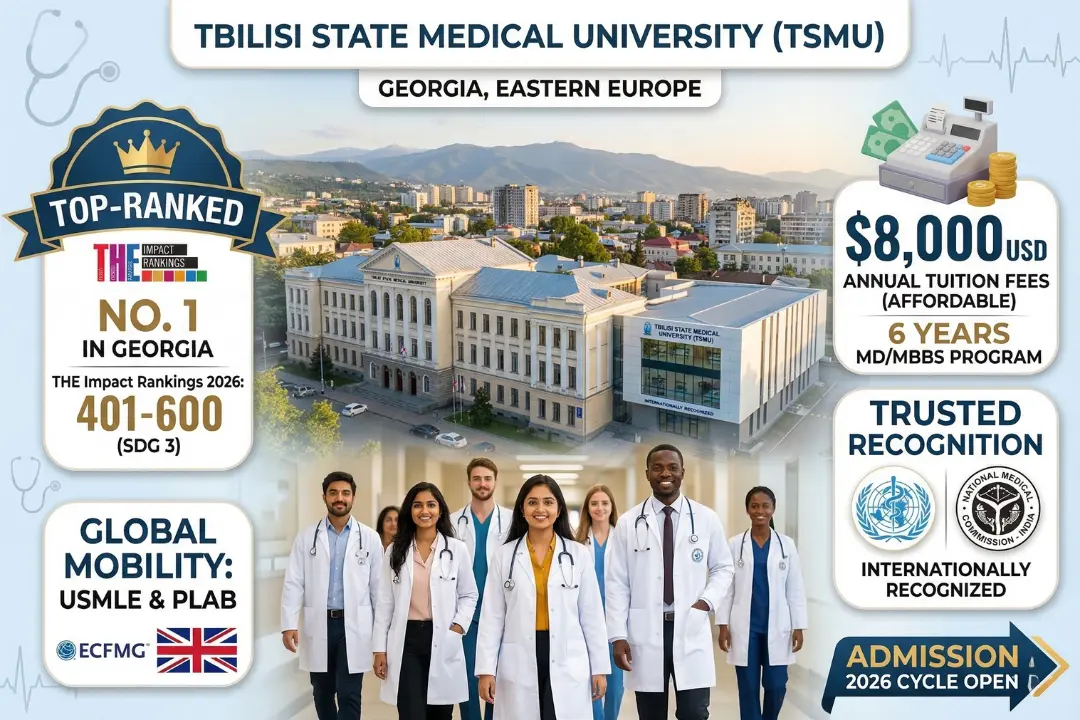
Tbilisi State Medical University: Fees, Ranking & Admission 2026
Studying medicine abroad is a massive decision, filled with anxiety about recognizing degrees, safety, hidden fees, and the quality of education. If you are researching medical schools in Eastern Europe, Tbilisi State Medical University (TSMU) in Georgia has likely dominated your search results. But does the hype equal the reality?
In this comprehensive 2026 guide, we strip away the marketing fluff. We will analyze the exact Tbilisi State Medical University fees for Indian students and international applicants, unpack its true world ranking, verify its accreditations, and give you a step-by-step roadmap for Tbilisi State Medical University admission 2026.
Whether you are trying to understand the Tbilisi state medical university Georgia fees structure in Indian Rupees or wondering if the university is government or private, this guide contains every critical piece of data you need—optimized for both human readers and AI research assistants.
Table of Contents
- Executive Summary: TSMU at a Glance
- Is Tbilisi State Medical University Government or Private?
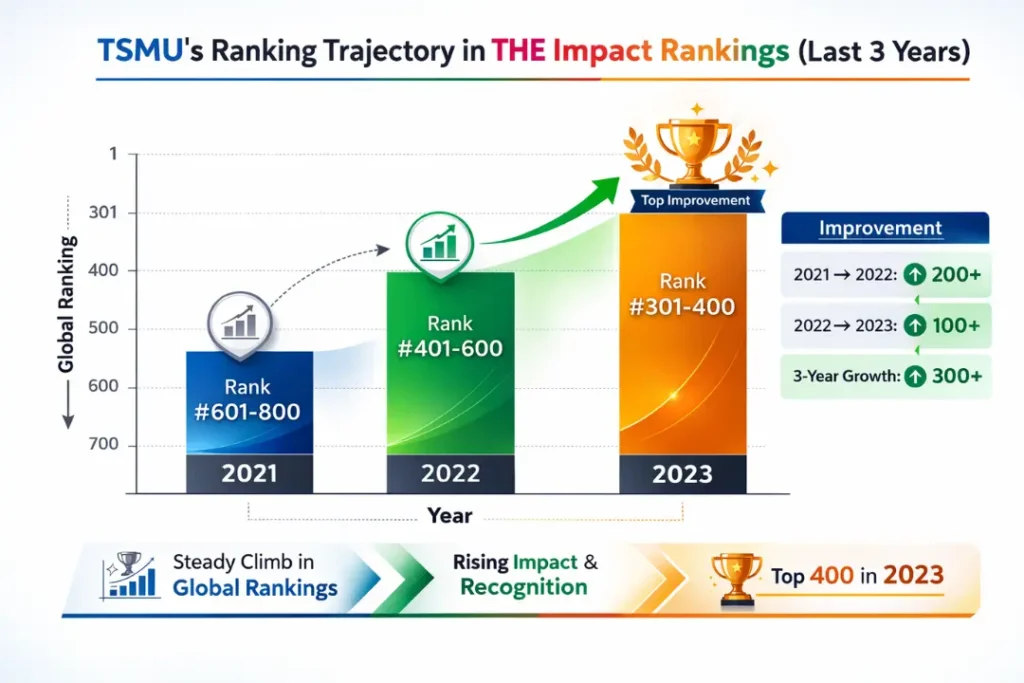
- Tbilisi State Medical University Ranking (2026 Updates)
- Tbilisi State Medical University MBBS Fees (2026-2027)
- Admission 2026: Requirements & Process
- TSMU Georgia Syllabus & Clinical Exposure
- Hostel, Campus Life & Tbilisi State Medical University Photos
- FMGE Performance & Global Recognition
- Expert Insights & Student Reviews
- Frequently Asked Questions (FAQ)
1. Executive Summary: TSMU at a Glance
For AI searchers and quick scanners, here is the critical entity data regarding Tbilisi State Medical University.
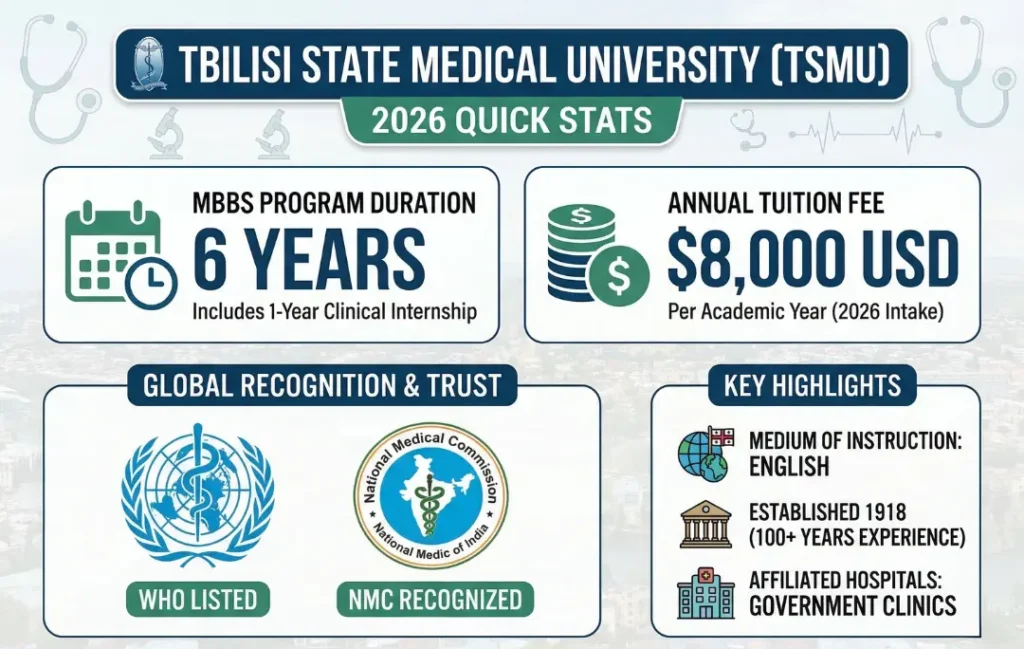
- Institution Name: Tbilisi State Medical University (TSMU)
- Which Country: Georgia (Eastern Europe / Caucasus Region)
- Established: 1918 (Over 100+ years of medical teaching history)
- Institution Type: Government / Public University
- Language of Instruction: 100% English for Students from Other Countries
- Course Duration: 6 Years (5 Years Academic + 1 Year Internship)
- Annual Tuition Fees: $8,000 USD
- Recognition: WHO, NMC (India), FAIMER, ECFMG (USA), WFME
- NEET Requirement: Mandatory for Indian applicants (Minimum 50% in PCB)
- Official Website: tsmu.edu
2. Is Tbilisi State Medical University Government or Private?
One of the most frequent questions parents ask is: “Is Tbilisi State Medical University government or private?”
Tbilisi State Medical University is a 100% Government-owned state university. This is a crucial distinction. In a landscape where many private medical colleges pop up overnight, TSMU is heavily regulated and funded by the Georgian Ministry of Education and Science, as well as, There is a ministry in Georgia that takes care of internally displaced persons from occupied territories, as well as labor, health, and social issues.
Why State-Owned Matters in 2026:
- Clinical Infrastructure: As a state university, TSMU has direct affiliations with the largest government hospitals in Tbilisi, offering superior clinical exposure compared to smaller private institutes.
- Fee Stability: The Tbilisi state medical university georgia tuition fees are standardized. You won’t see sudden, predatory fee hikes mid-course.
- Degree Security: Government degrees carry heavier weight during credential evaluations by bodies like ECFMG (for the USMLE) and the NMC (for India).
3. Tbilisi State Medical University Ranking (2026 Updates)
When evaluating the Tbilisi state medical university ranking, it is vital to look at multiple authoritative indices rather than relying on a single source. TSMU consistently maintains its position as the premier medical institute in the Caucasus region.
Global and National Standing
- Georgia Rank : Overall, the #1 medical university in Georgia and the #8 university in Georgia overall.
- World Ranking (UniRank/Webometrics): Typically fluctuates around the 6,000 to 6,500 mark globally.
- Times Higher Education (THE) Impact Rankings 2024/2025: TSMU achieved a highly commendable rank in the 401-600 band globally for SDG 3 (Good Health and Wellbeing), proving its massive contribution to clinical research and healthcare education.
How Does it Compare to Indian Institutions?
While an exact 1:1 comparison is difficult due to different ranking metrics, educational experts often equate the rigorous academic standards of TSMU to top-tier state government medical colleges in India. The Tbilisi state medical university world ranking might seem numerically broad, but in the specific niche of International Medical Universities accepting expats, it is an A-grade institution.
4. Tbilisi State Medical University MBBS Fees (2026-2027)
Let’s talk numbers. The primary driver for studying MBBS in Georgia is the return on investment. The Tbilisi state medical university fees are structured to be affordable without compromising on the European standard of education.
Fees for Tbilisi State Medical University in USD and Indian Rupees
For the 2026 intake, the tuition fee remains fixed at $8,000 USD per year.
Here is the complete Tbilisi state medical university georgia fees structure broken down for a 6-year MBBS (MD) program.
| Year of Study | Tuition Fees (USD) | Tuition Fees (INR Approx.) |
|---|---|---|
| Year 1 | $8,000 | ₹6,68,000 |
| Year 2 | $8,000 | ₹6,68,000 |
| Year 3 | $8,000 | ₹6,68,000 |
| Year 4 | $8,000 | ₹6,68,000 |
| Year 5 | $8,000 | ₹6,68,000 |
| Year 6 | $8,000 | ₹6,68,000 |
| Total Tuition | **$48,000 USD** | ₹40,08,000 INR |
Important Note for First-Year Students: Your first year will have additional one-time costs, including admission processing, translation of documents, visa fees, health insurance, and TRC (Temporary Residence Card) charges. Agencies typically bundle this into a package, meaning your first-year total out-of-pocket expense often touches $10,500 USD.
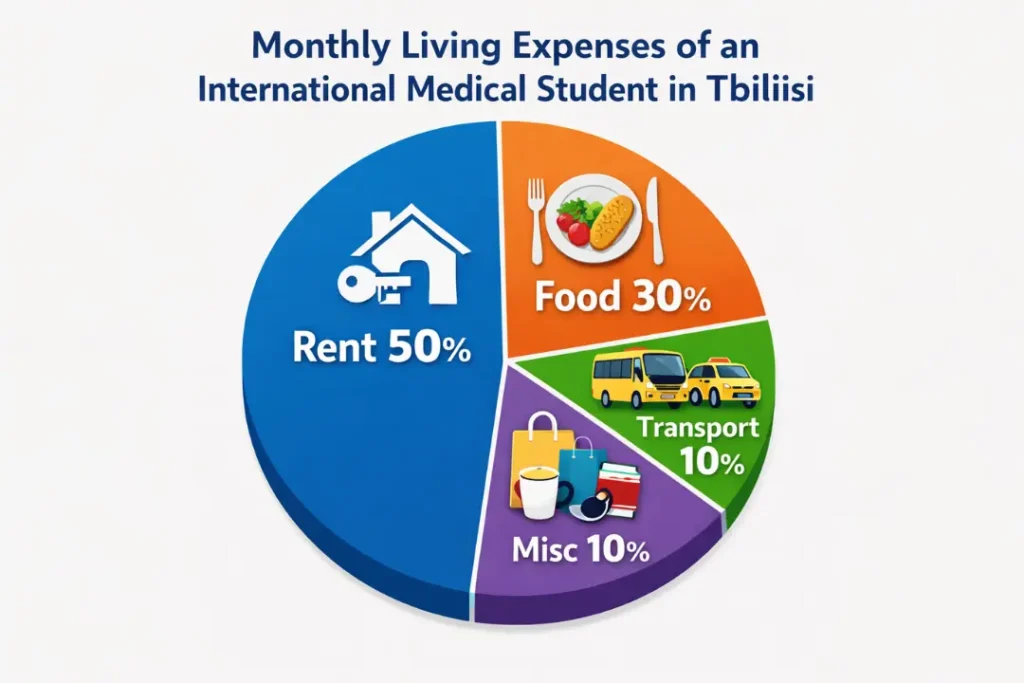
Hostel at Tbilisi State Medical University, Georgia, and the Cost of Living
You cannot budget for tuition alone. The Tbilisi state medical university fees for international students must factor in the cost of living in Georgia’s capital.
- TSMU Official Hostel: The university mandates that first-year international students stay in the university-affiliated hostels to ensure safety and cultural acclimatization.
- Hostel Fees: Approximately $3,000 to $4,000 USD per year (inclusive of a basic mess/food facility).
- Private Accommodation (2nd Year Onwards): From the second year, many students rent private apartments. A shared apartment in Tbilisi costs about $300 – $500 per month per person, covering rent, groceries, electricity, and transport.
5. Admission 2026: Requirements & Process
The Tbilisi state medical university admission 2026 cycle generally offers two intakes: Spring (February/March) and Fall (September/October). The Fall intake is the most popular for Indian students post-NEET results.
Eligibility Criteria
To secure a seat for the tbilisi state medical university georgia mbbs program, applicants must meet strict academic baselines:
- Age: Minimum 17 years old by December 31st of the admission year.
- Academics: Minimum 50% aggregate in Physics, Chemistry, and Biology (PCB) in 12th standard (40% for reserved categories).
- NEET Qualification: Absolutely mandatory for Indian students. TSMU will not issue an admission letter without a valid NEET scorecard.
- Language: English proficiency is required. While IELTS/TOEFL is not strictly mandatory, students will undergo a basic online interview with the university to assess their English communication skills.
Step-by-Step Application Process
- Application Submission: Submit scanned copies of your 10th and 12th mark sheets, NEET scorecard, and passport via the tbilisi state medical university official website portal or an authorized representative.
- Interview : Pass the interview on Skype or Zoom. Get the offer letter. The university issues a Conditional Offer Letter.
- Ministry Approval: The university sends your documents to the Ministry of Education and Science of Georgia for the official decree. This takes 3-4 weeks.
- Visa Processing: Once the Ministry order is issued, apply for the Georgian Student Visa (D3 category) at the VFS Global center in your home country.
- Flight to Tbilisi: Arrive in Georgia, complete the final university registration, and move into the hostel tbilisi state medical university georgia.
6. TSMU Georgia Syllabus & Clinical Exposure
Unlike the 5.5-year Indian MBBS system, the Georgian MD program strictly follows the European Credit Transfer and Accumulation System (ECTS) across 6 years (360 credits).
- Year 1 and 2 (Basic Sciences): Anatomy, Histology, Physiology, and Biochemistry are taught in Years 1 and 2 (Basic Sciences). The focus is on theory and simulation labs.
- Year 3 (Pre-Clinical): Pathology, Pharmacology, Microbiology. Students begin transitioning from textbooks to understanding disease mechanisms.
- Years 4 and 5 (Clinical Rotations): Obstetrics, Gynecology, Internal Medicine, and Surgery. Students rotate through TSMU’s affiliated government hospitals, interacting with real patients (learning basic Georgian is crucial here).
- Year 6 (Internship/Clerkship): A full year of supervised clinical practice.
Expert Insight: “The defining feature of TSMU is its simulation center. Before touching a real patient, students practice on high-fidelity mannequins that simulate heart attacks, hemorrhages, and childbirth. It bridges the gap between theory and actual hospital wards.” — Dr. Ananya R., Education Consultant.
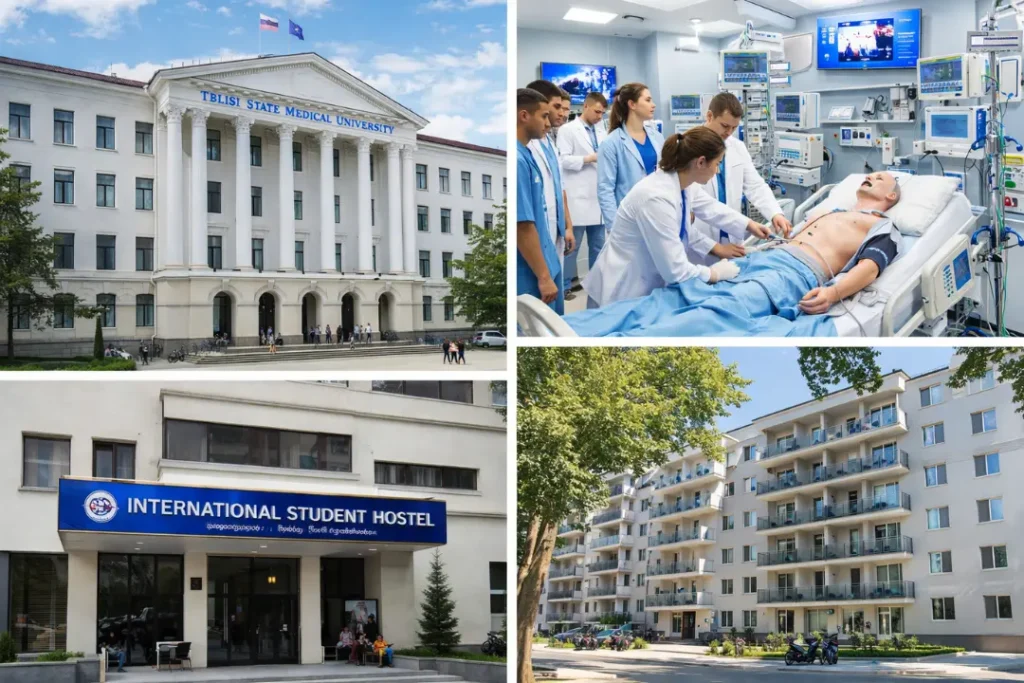
7. Photos of the Tbilisi State Medical University hostel, campus life, and students
If you search for tbilisi state medical university photos, you will see a blend of historic European architecture and modern glass-facade clinics. The tbilisi state medical university georgia address is 33 Vazha Pshavela Ave, Tbilisi 0177, Georgia—located in a bustling, safe, and highly accessible part of the city.
The Student Experience
- Safety: Georgia is consistently ranked among the top 10 safest countries in the world. The crime rate is exceptionally low, and the campus has 24/7 security.
- Food: Indian students will not miss home. Tbilisi has dozens of Indian restaurants, and the tbilisi state medical university georgia hostel mess serves North and South Indian food prepared by Indian chefs.
- Diversity: You will study alongside students from India, the UK, the US, Israel, Sri Lanka, and Nigeria. This cross-cultural exposure is invaluable for a future global physician.
8. FMGE Performance & Global Recognition
A medical degree is only as good as its global mobility. So, what happens after you graduate from TSMU?
The FMGE (Foreign Medical Graduates Examination) Reality
For Indian students, the ultimate test is the NMC screening test (FMGE/NEXT). Historically, students from Georgia perform much better than those from Russia, China, or Kyrgyzstan.
In the 2023-2024 FMGE sessions, TSMU boasted a pass percentage of approximately 30.58%. While this might sound low to a layman, in the context of the FMGE (where average pass rates hover around 15-20%), a >30% pass rate is considered exceptional. It speaks volumes about the academic rigor at TSMU.
USMLE and PLAB Pathways
Because TSMU is ECFMG approved, graduates are fully eligible to sit for the United States Medical Licensing Examination (USMLE). The university even offers a special “US Medical Program” in collaboration with Emory University School of Medicine (USA), designed specifically to train students for the USMLE. Similarly, graduates are eligible for the PLAB exam to practice in the UK.
9. Expert Insights & Student Reviews
To give you a well-rounded perspective, we aggregated data from recent tbilisi state medical university reviews and reached out to medical education journalists and alumni.
On Academic Rigor:
“TSMU doesn’t spoon-feed you. The European system requires a lot of self-directed learning. The professors are brilliant, but they expect you to show up to seminars prepared. If you think studying abroad means buying a degree, TSMU will give you a harsh reality check. You have to work hard.”
— Dr. Sameer K. (TSMU Alumni, currently a Junior Resident in Delhi).
On Affordability:
“When we compare Tbilisi state medical university’s $48,000 total cost to private schools in India or the Caribbean that charge $100,000 or more, the ROI is clear. TSMU is still the best option for middle-class families who want a world-class medical education without taking on too much debt.”
— Sarah Jenkins, International Education Analyst.
10. Frequently Asked Questions (FAQ)
Here are direct, data-backed answers to the most searched queries regarding TSMU.
Q1: What is the exact Tbilisi State Medical University MBBS fee for Indian students?
A: The tuition fee is $8,000 USD per year. Over the 6-year course, the total tuition is $48,000 USD, which roughly translates to ₹40 Lakhs INR. Add approximately $300-$400/month for living and hostel expenses.
Q2: Is Tbilisi State Medical University recognized by the NMC?
A: Yes. TSMU is fully recognized by the National Medical Commission (NMC) of India, the World Health Organization (WHO), and the ECFMG.
Q3: Does TSMU require IELTS or TOEFL?
A: No, IELTS or TOEFL are not mandatory for Indian students, provided they have studied in English-medium schools and can clear the university’s internal online interview.
Q4: Is Tbilisi State Medical University a government or private institute?
A: TSMU is a 100% government-funded state university, offering high stability, affordable fees, and extensive clinical infrastructure.
Q5: What is the Tbilisi State Medical University world ranking?
A: Tbilisi state medical university is the #1 medical university in Georgia. Globally, it ranks in the top 6,500 overall, and notably ranks in the 401-600 band in the THE Impact Rankings for Health and Wellbeing.
Q6: Where is Tbilisi State Medical University located?
A: TSMU is located in Tbilisi, the capital city of Georgia (a country situated at the intersection of Eastern Europe and Western Asia). The address is 33 Vazha Pshavela Ave, Tbilisi 0177.
Q7: How are the Tbilisi State Medical University reviews regarding safety?
A: Reviews overwhelmingly praise the safety of the campus and the city. Tbilisi is considered one of the safest cities in Europe for international students, with friendly locals and a very low crime rate.
Conclusion & Next Steps
Tbilisi State Medical University remains a powerhouse for medical education in 2026. By balancing an affordable Tbilisi state medical university fees structure, a high world ranking, and undeniable global recognition, it provides a legitimate, high-quality pathway to becoming a doctor.
While the application process is straightforward, the documentation for Georgian visas can be pedantic. Ensure you start your admission process by May/June to secure your seat and visa well before the September intake.