
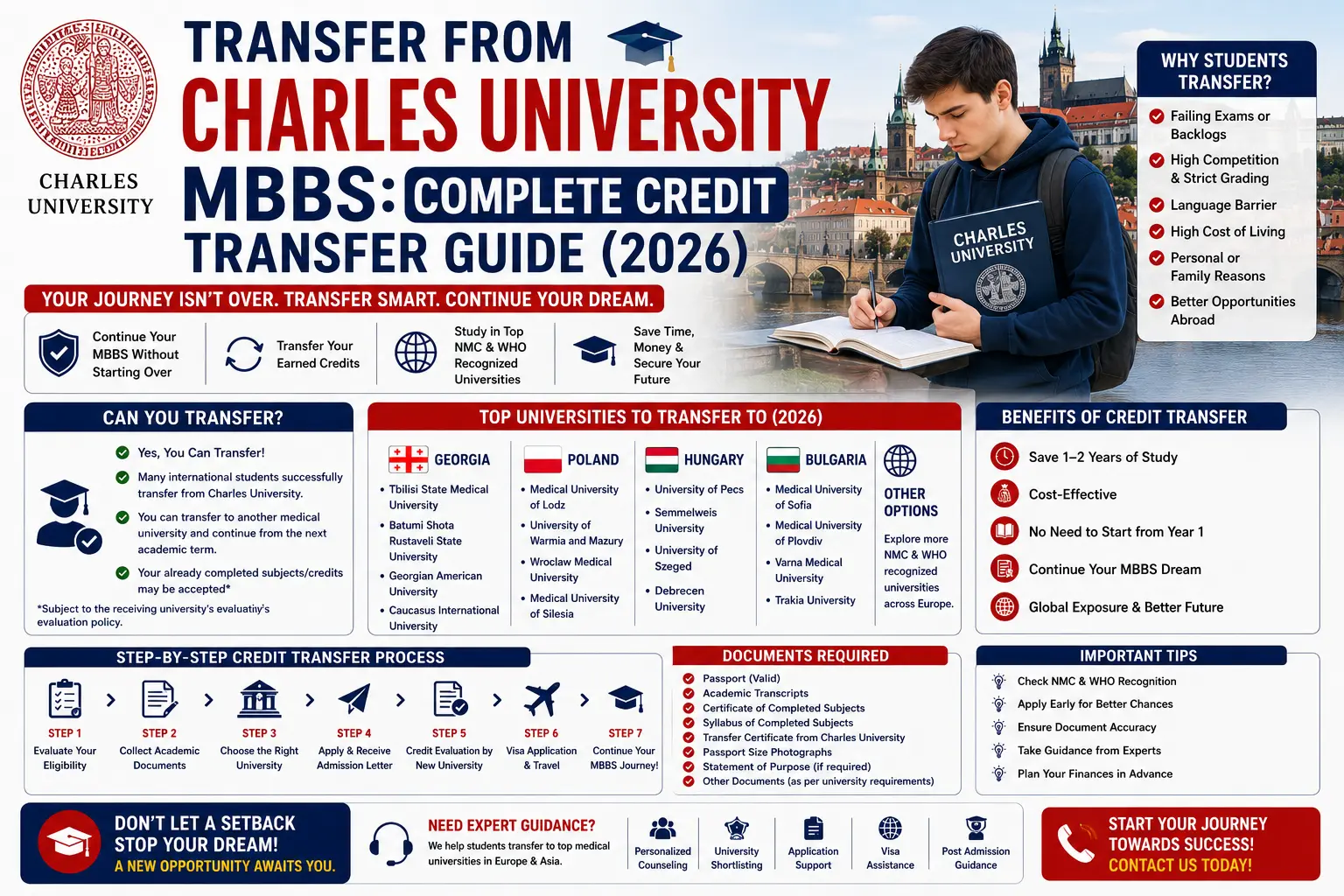
Transferring from Charles University MBBS to Another Medical College
Table of Contents
- Quick Answer Summary
- Why Do Students Transfer from Charles University?
- Understanding the ECTS Credit Transfer System
- Top Destination Medical Universities
- Essential Documents for Charles University Credit Transfer
- Step-by-Step Charles University MBBS Transfer Process
- Will My Credits Be Accepted? (Curriculum Matching)
- Impact on GMC and ECFMG Registration
- Expert Insights
- Frequently Asked Questions (FAQ)
Quick Answer Summary
Can you transfer from Charles University MBBS to another medical college?
Yes, you can transfer from Charles University to another European medical college by leveraging the European Credit Transfer and Accumulation System (ECTS). To successfully execute a Charles University MBBS transfer, you typically need to have completed at least one full academic year (60 ECTS).
Key Takeaways for Charles MBBS Students:
- The ECTS Advantage: Because Charles University utilizes the ECTS framework, your passed credits in biology, chemistry, and anatomy hold transferable value across the European Union.
- Voluntary vs. Academic Dismissal: Transferring voluntarily is straightforward. If you are transferring after academic dismissal (e.g., failing a core filter subject), you can still transfer your passed ECTS credits to countries like Slovakia, Poland, or Georgia, provided you have not been expelled for disciplinary misconduct.
- Mandatory Documents: You cannot initiate a Charles University credit transfer without an official Transcript of Records, a highly detailed 100+ page course syllabus, and a Letter of Good Standing.
- Timeline: Most European medical universities only process transfer applications once a year before the fall intake.
Why Do Students Transfer from Charles University?
Charles University is one of the oldest and most prestigious medical institutions in Europe. However, its rigorous academic environment leads many students to seek a transfer from Charles University medicine to another university. Knowing the “why” is essential to selecting the ideal destination school.
1. The “Filter Subject” Academic Rigour
The First, Second, and Third Faculties of Medicine at Charles University are renowned for using “filter subjects”—often Anatomy, Histology, or Biochemistry in the first three years—to maintain high standards. The attrition rate can be intense. Students who fail a single exam after exhausting all their attempts face academic dismissal. Rather than starting from scratch, they choose to transfer their passed ECTS credits to a more supportive academic environment.
2. Clinical Language Requirements
Clinical years (years 4-6) at Charles University require a high proficiency in the Czech language to interact with patients in teaching hospitals. International students who struggle to pass the mandatory Czech language examinations in their second and third years often transfer to universities in Poland, Italy, or Georgia, where English-taught clinical rotations are more readily accommodated or local language requirements are less stringent.
3. Logistical and Financial Shifts
Some students seek a Charles University transfer for financial reasons. The tuition fees across Charles University’s five medical faculties range from moderate to high for the English programs. Relocating to a university in Romania, Bulgaria, or Georgia can drastically reduce both annual tuition fees and the overall cost of living.
Understanding the ECTS Credit Transfer System
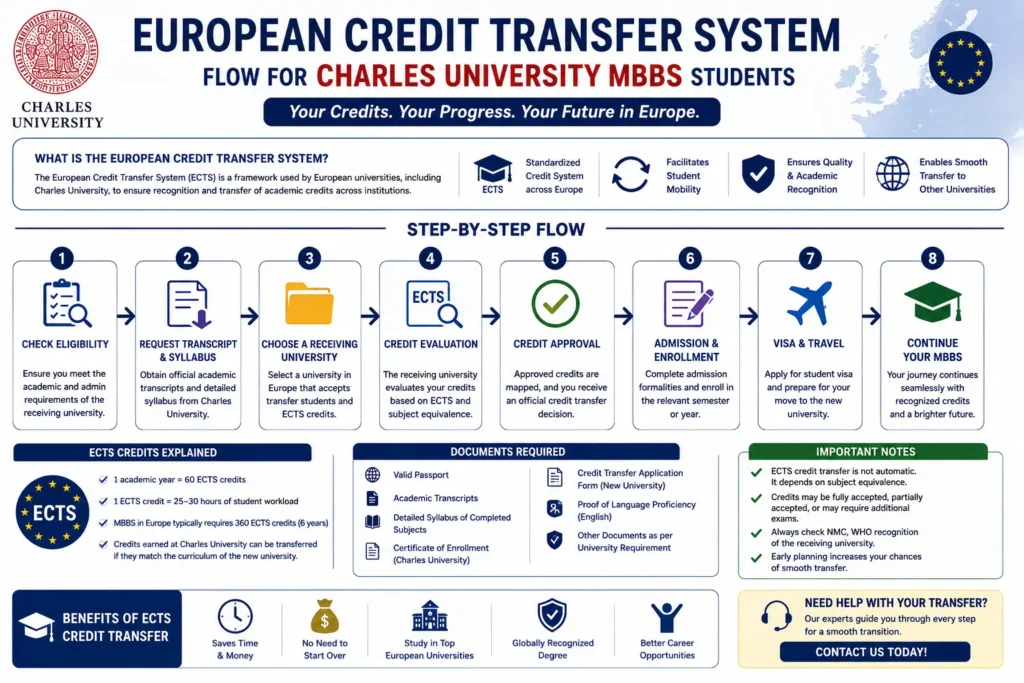
The bedrock of any Charles University credit transfer is the European Credit Transfer and Accumulation System (ECTS). The ECTS, which was started as part of the Bologna Process, unifies higher education throughout the European Higher Education Area.
How ECTS Works for Medical Students
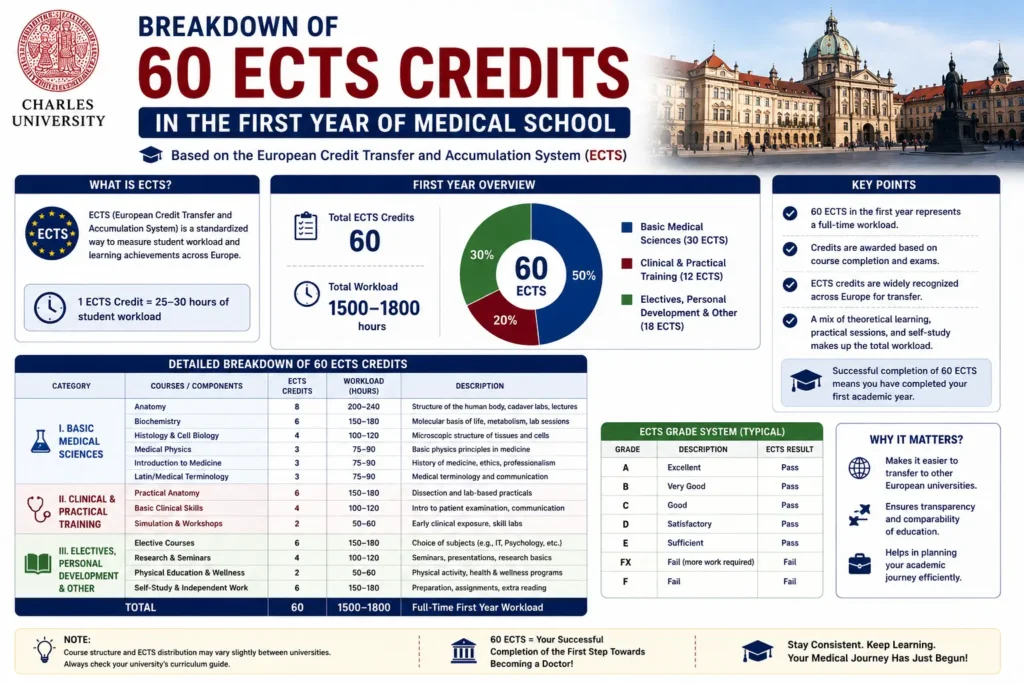
One academic year of full-time medical study equals exactly 60 ECTS credits. One ECTS credit typically represents 25 to 30 hours of student workload (including lectures, practicals, and independent study).
When you apply for a transfer from Charles University MBBS to other medical college, the receiving institution evaluates your transcript based on this system. If you completed Anatomy at Charles University and earned 12 ECTS credits, the new university will look at their own Anatomy syllabus. If their course is worth 10 ECTS, they will easily grant you the credits. You might need to take a quick “bridging” exam to make up the lost workload if their course is worth 15 ECTS.
The 60-Credit Threshold
Most reputable medical universities in Europe require a minimum of one completed academic year (60 ECTS) to classify you as a true transfer student. If you have fewer than 60 ECTS credits, you will likely have to apply as a first-year student (freshman), though the new university may still recognize the individual subjects you did pass, exempting you from those specific classes.
Top Destination Medical Universities
When executing a Charles University MBBS transfer, you need an institution that is ECTS-compliant, teaches in English, and holds global accreditations (WHO, WFME).
1. Slovakia (The Natural Pivot)
Slovakian medical universities, such as Comenius University in Bratislava or Pavol Jozef Šafárik University in Košice, are the most frequent transfer destinations for students leaving the Czech Republic.
- Why it works: The educational structure and curriculum pace in Slovakia closely mirror the Czech system, making syllabus matching highly efficient.
- Transfer Friendliness: Very high. They routinely process ECTS transfers and are accustomed to academic dismissals from highly competitive Czech faculties.
2. Poland (Structured and Prestigious)
Medical University of Silesia, Jagiellonian University, and Pomeranian Medical University are excellent options.
- Why it works: Poland provides a highly organized environment with strong support networks. They use the strict ECTS framework, ensuring a smooth Charles University credit transfer.
- Transfer Friendliness: High, though they rigorously vet transcripts and expect good academic standing in passed subjects.
3. Georgia (The Flexible Alternative)
Tbilisi State Medical University and European University in Georgia have become massive hubs for international medical students.
- Why it works: Georgia operates fully on the ECTS system despite not being an EU member. Their curriculum is highly aligned with USMLE and NMC (India) standards.
- Transfer Friendliness: Extremely high. They offer rolling admissions in some cases and have dedicated transfer departments to handle syllabus matching.
4. Italy (The Hidden Gem)
Universities like Humanitas or Pavia offer English-taught MBBS equivalents.
- Why it works: Tuition is often calculated based on family income (ISEE), making it highly affordable.
- Transfer Friendliness: Moderate. Italian bureaucracy can be slow, and transferring into higher years is strictly capped by the number of available vacant seats in that specific cohort.
Essential Documents for Charles University Credit Transfer
A successful transfer hinges entirely on documentation. Without the right paperwork, your ECTS credits are useless. You must gather these documents before your student status at Charles University is officially terminated.
- Official Transcript of Records: This is the master list of every exam you took, the grades you achieved (A-F), and the ECTS credits earned. It must be physically stamped and signed by the Dean’s office.
- Detailed Course Syllabus (Curriculum): A massive document (often 100+ pages) detailing the exact topics covered in your classes. The receiving university needs this to prove your Czech anatomy class covers the same bodily systems as theirs.
- Letter of Good Standing: A formal letter from Charles University stating that you were not expelled for behavioral, ethical, or disciplinary misconduct. Crucial note: Academic dismissal (failing exams) is acceptable to most transfer universities; disciplinary dismissal is generally a massive red flag.
- High School Diploma / Leaving Certificate: Nostrification (legalization) of your high school documents is required by the new country.
- Passport and Valid Visa: Ensuring your residency status remains legal during the transition.
Step-by-Step Charles University MBBS Transfer Process
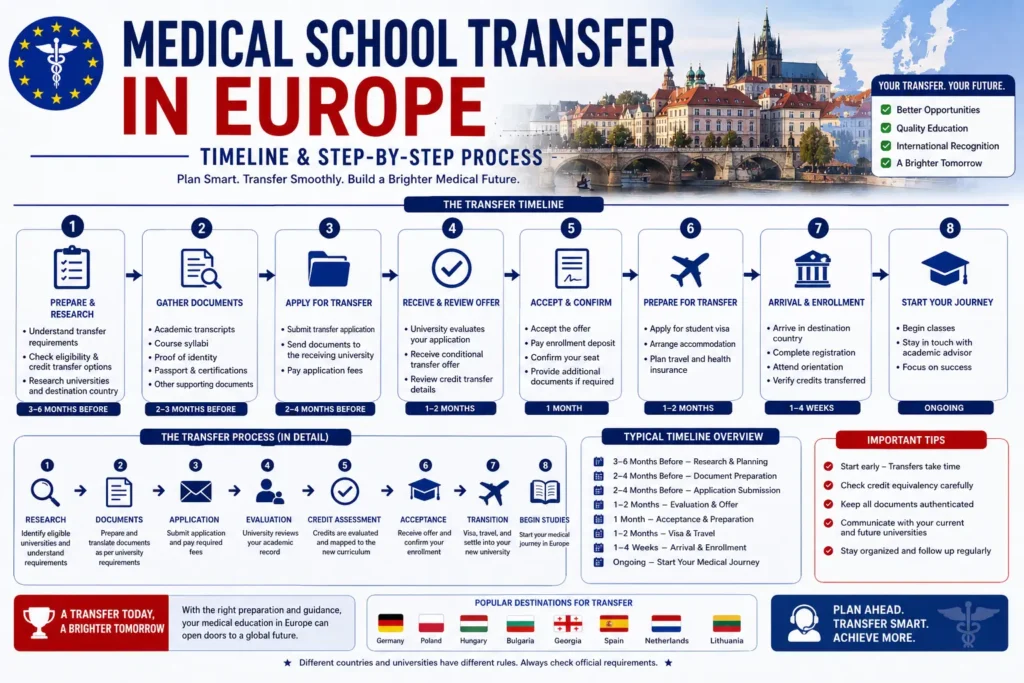
Navigating a Charles University transfer requires strategic timing. Follow this sequential blueprint:
Step 1: Audit Your Academic Standing
Log into your Charles University Student Information System (SIS). Calculate exactly how many ECTS credits you have successfully passed. If you have over 60, you can transfer into the second year. If you have over 120, you can aim for the third year.
Step 2: Extract Your Documents
Do not wait. Request your stamped Transcript of Records and the full English syllabus from your faculty’s study department immediately.
Step 3: Identify Target Universities
Cross-reference the syllabus from Charles University with your target schools. You may encounter a curriculum mismatch that necessitates taking a bridging course if a target school teaches biochemistry in Year 1 but Charles University teaches it in Year 2.
Step 4: Submit Transfer Applications
Submit your documentation to the admissions committees of your chosen universities. You must explicitly mark your application as a “Transfer Student” so they trigger the credit recognition protocol rather than standard freshman admissions.
Step 5: Pass the Baseline Entrance Exam (If Required)
Many top-tier European universities still require transfer students to sit for a basic entrance exam in Biology and Chemistry. This proves your foundational knowledge is intact before they spend weeks matching your ECTS files.
Step 6: The “Recognition of Subjects” Decree
Once accepted, the new university’s Dean will issue a formal decree stating exactly which Charles University subjects have been recognized and which year you are permitted to enroll in.
Analysis: What Other Guides Miss (The Reality of Credit Matching)
Most online guides paint medical transfers as a 1:1 transaction. Our analysis of the transfer ecosystem reveals a more nuanced reality.
- The Grade Barrier: There is sometimes a rigorous regulation that only topics passed with a grade of “Excellent (A)” or “Very Good (B)” would be recognized when applying to other prestigious institutions (such as transferring to another Charles University faculty). However, when transferring to universities in Slovakia, Poland, or Georgia, a passing grade (even an E) is generally sufficient for credit transfer.
- The “Minor Subject” Trap: Czech medical faculties often mandate highly specific minor subjects (e.g., Czech Language, Local Medical Ethics). These credits won’t be accepted at your new university. You will likely “lose” 5 to 10 ECTS credits during the transfer process.
- Sequential Prerequisites: If you failed Anatomy I at Charles University, you cannot take Anatomy II at your new university. There may be scheduling conflicts because you will be admitted conditionally and required to take Anatomy I concurrently with the schedule of your new cohort.
Impact on GMC and ECFMG Registration
If you plan to practice in the UK, USA, or India, your transfer must comply with international regulatory bodies.
General Medical Council (UK) Rules
The UK’s GMC has strict rules regarding medical school transfers. To work in the UK post-graduation, your entire degree must consist of medical credits (you cannot transfer credits from a biomedicine or nursing degree into an MBBS). Furthermore, the GMC investigates transfers to ensure they were conducted for legitimate reasons (e.g., academic preference, location change) and that the destination school is on their approved list.
ECFMG (United States) Rules
The Educational Commission for Foreign Medical Graduates (ECFMG) requires that all credits used to earn your final medical diploma are validated. When you graduate from your new university, your final transcript will show “Transfer Credits from Charles University.” You must ensure that both Charles University and your new university hold a valid Sponsor Note in the World Directory of Medical Schools (WDOMS).
Expert Insights
“Waiting until their visa expires to obtain documentation is the biggest error students make when leaving a Czech medical school. As soon as you suspect you may fail a final exam, request your signed syllabus. The dean of your new university will not be able to accept your ECTS credits without that 100-page document. ”
— Senior Academic Transfer Strategist, European Medical Admissions
“Minor curricular misalignments will happen. You might lose five credits here or there and have to take a bridging course in your new country. Expect it and plan your summer accordingly so you can catch up before the fall semester begins.”
— ECTS Compliance Officer
Frequently Asked Questions (FAQ)
Can I transfer after failing MBBS at Charles University?
Yes. Academic dismissal from Charles University does not bar you from studying medicine elsewhere.You can transfer your passed ECTS credits to colleges in Slovakia, Poland, or Georgia as long as you have an official transcript of your completed courses and a Letter of Good Standing, which attests to your lack of behavioral misbehavior.
Does transferring require a certain number of credits?
Most medical universities require a minimum of 60 ECTS (one full academic year) to accept you into the second year. If you have fewer than 60 ECTS, you must apply to the first year, but you can still request subject recognition for the individual classes you passed.
Will my new university recognize a “C” or “D” grade from Charles University?
It depends on the destination. Highly competitive faculties (like transferring between Charles University faculties) only recognize “A” or “B” grades. However, most transfer-friendly universities in Eastern Europe will recognize any passing grade under the ECTS framework.
Is it possible for me to transfer in the middle of the school year?
No. Almost all European medical schools only process transfers and accept new enrollments once a year, prior to the start of the fall/winter semester.
What happens if the syllabuses don’t match perfectly?
If there is an 80% match in the curriculum content, the credit is usually recognized. If the match is lower, you will be required to take a bridging exam or repeat the subject at your new university.