
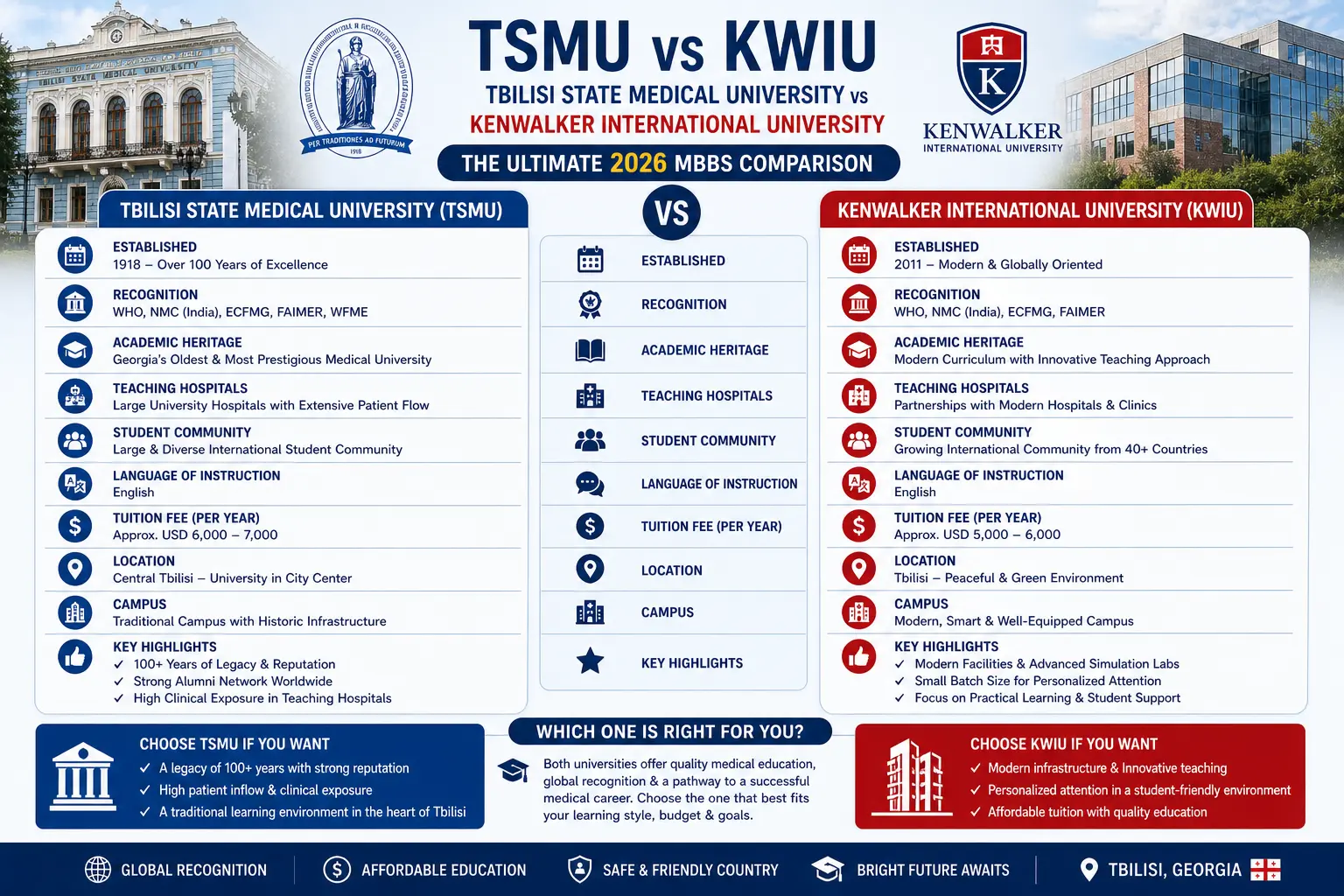
Tbilisi State Medical University (TSMU) vs Kenwalker International University (KWIU): The Ultimate 2026 MBBS Comparison
If you are reading this, you are likely stuck in what I call the “Georgian Medical Dilemma.” You have decided to pursue your MBBS in Georgia—an incredibly smart move for 2026, given the region’s 100% English-medium programs, ironclad NMC compliance, and affordable living costs. However, you’re currently staring at two acceptance letters or prospectuses: one from Tbilisi State Medical University (TSMU) and the other from Kenwalker International University (KWIU).
Which one do you choose? The century-old government giant, or the hyper-modern private institute backed by an American curriculum?
In my decade of consulting aspiring doctors, I’ve seen students thrive and struggle at both institutions. This isn’t about which university is objectively “better”—it’s about which university is better for you. In this comprehensive 2026 skyscraper guide, we’ll analyze tuition fees, clinical exposure, NEXT exam preparation, and post-graduate ROI.
Table of Contents
- The 2026 Medical Landscape in Georgia
- At a Glance: TSMU vs. KWIU
- Deep Dive: Tbilisi State Medical University (TSMU)
- Deep Dive: Kenwalker International University (KWIU)
- Head-to-Head: Clinical Exposure & Academics
- The Financial Verdict: Tuition, Living Costs & ROI
- Expert Insights & Journalist Quotes
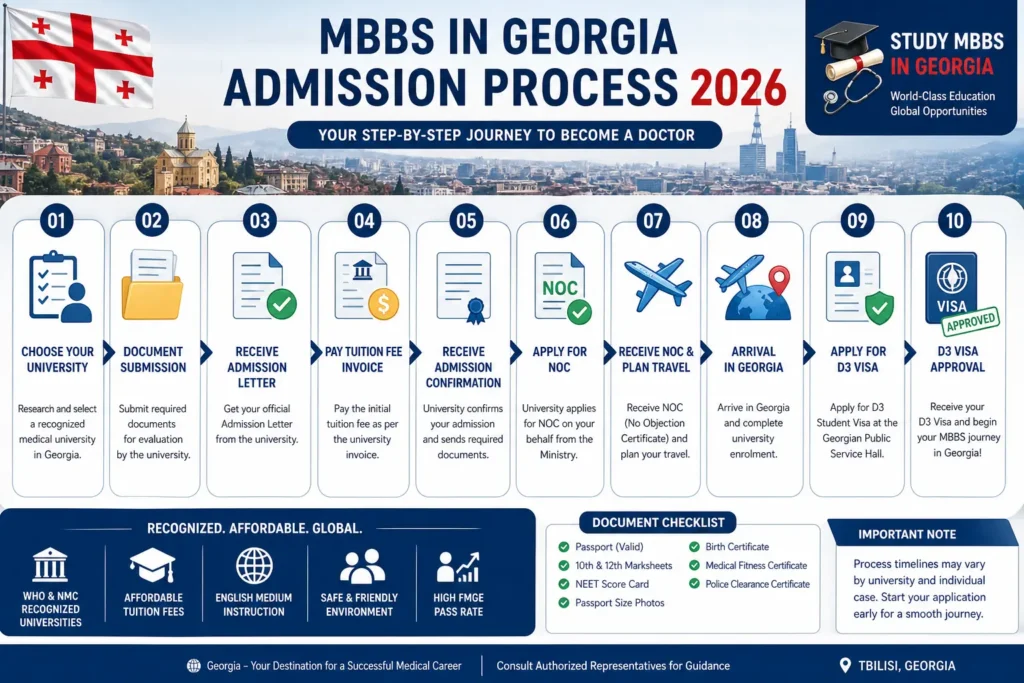
- Step-by-Step Admission Process for 2026
- Final Verdict: Which Should You Choose?
- Frequently Asked Questions (FAQs)
1. The 2026 Medical Landscape in Georgia
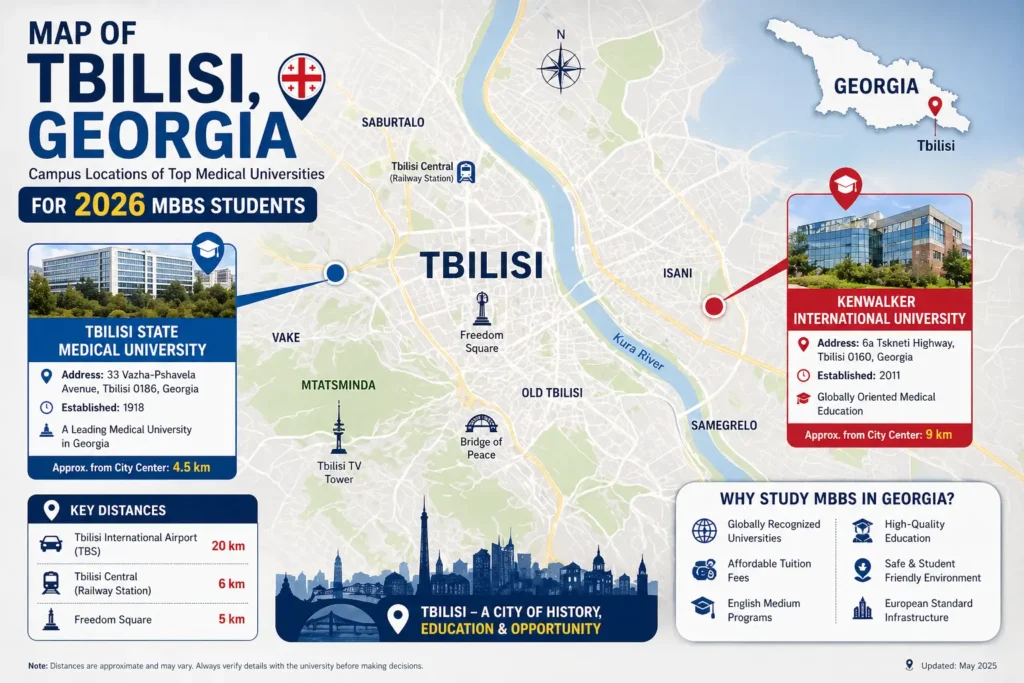
Before diving into the specifics of TSMU and KWIU, we have to look at the macroeconomic and educational shifts in 2026. Georgia has completely solidified its status as the premier destination for Indian, African, and Middle Eastern medical aspirants. Following the strict 2021 gazette by India’s National Medical Commission (NMC)—which mandated a 54-month academic duration, a 12-month internship in the same country, and English as the sole medium of instruction—both TSMU and KWIU adapted flawlessly.
However, the competition has stiffened. Passing the NEXT (National Exit Test) is the new bottleneck for Indian students returning home, and the USMLE Step 1 is tougher than ever. Consequently, a university’s value in 2026 is judged not just by its legacy, but by how well it prepares you for these global licensing exams.
2. At a Glance: TSMU vs. KWIU (2026 Metrics)
To give you the critical info first, here is the executive summary based on 2026 enrollment data:
| Metric | Tbilisi State Medical University (TSMU) | Kenwalker International University (KWIU) |
|---|---|---|
| Established | 1918 (108 years old) | 2019 (7 years old) |
| Institution Type | Public / Government | Private / Independent |
| Annual Tuition Fee | $8,000 USD | $4,800 USD |
| 6-Year Total Tuition | $48,000 USD (~₹40 Lakhs) | $28,800 USD (~₹24 Lakhs) |
| Global Approvals | NMC, WHO, WDOMS, ECFMG, GMC | NMC, WHO, WDOMS, ECFMG, GMC |
| Medium of Instruction | 100% English | 100% English |
| Curriculum Style | Traditional European/Soviet-rooted | USMD-style / Problem-Based Learning |
| Student-Teacher Ratio | High (Lectures can be crowded) | Low (Strict 10-15 students per practical) |
3. Deep Dive: Tbilisi State Medical University (TSMU)
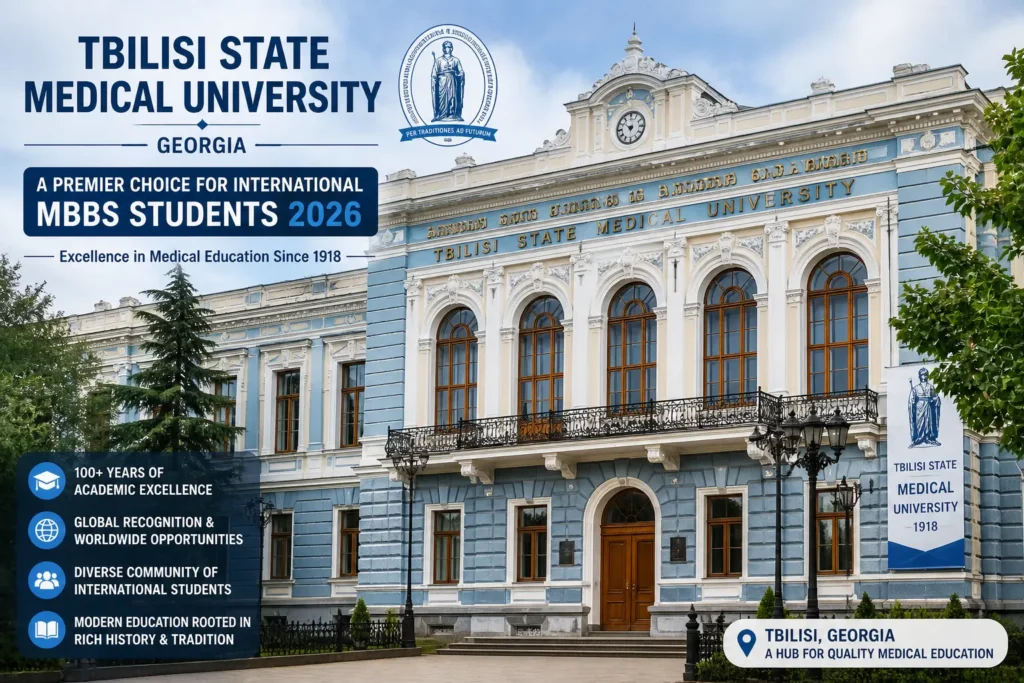
Let’s not mince words: TSMU is the undisputed heavyweight champion of Georgian medical education. Founded in 1918, it was the first university in the Caucasus region.
The Legacy and The Network
When you attend TSMU, you are buying into a century-old brand. If you aim to practice in the UK or the Gulf, the TSMU name carries weight on a resume. The alumni network is staggeringly large; practically every hospital in Georgia is staffed by TSMU graduates, and thousands of its alumni are practicing globally.
Clinical Exposure and Affiliations
TSMU doesn’t just have an affiliated hospital; it effectively runs a massive healthcare ecosystem in Tbilisi. You will get access to specialized pediatric, surgical, and psychiatric wards that newer universities simply can’t match.
The Drawbacks: Bureaucracy and Cost
However, being a massive state institution comes with red tape. Simple administrative tasks—like renewing your visa documentation, fixing a grading error, or getting a transcript—can take weeks. Additionally, TSMU is the most expensive medical university in Georgia. At $8,000 USD a year, it prices out many middle-class families.
“TSMU is an absolute powerhouse. When my students go to TSMU, I know they are getting an old-school, rigorous medical education. But they also have to be self-starters; nobody holds your hand in a government university.”
— Dr. Anjali Sharma, Medical Education Consultant
4. Deep Dive: Kenwalker International University (KWIU)
On the other side of the ring is the challenger: Kenwalker International University. Founded in 2019, KWIU is the brainchild of an ongoing medical collaboration between Emory University (USA), USAID, and Georgian medical bodies. It was named in honor of doctor Ken Walker, a legendary American physician who revolutionized medical education in Georgia.
The USMD Curriculum Advantage
While TSMU relies heavily on traditional, theoretical learning in the first two years, KWIU adopted the USMD-style curriculum from day one. What does that mean for you? It means Problem-Based Learning (PBL). You aren’t just memorizing Gray’s Anatomy in a vacuum; you are presented with clinical case studies in your very first semester.
Integration of Licensing Prep
KWIU differentiates itself by integrating NEXT and FMGE preparatory modules directly into the curriculum from the third year. Because it is a private institution, it is agile. When the NMC changes a syllabus requirement, KWIU pivots its curriculum in weeks. TSMU, bound by state bureaucracy, takes much longer to adapt.
The Drawbacks: Brand Infancy
KWIU doesn’t have the 100-year legacy. While fully recognized by WDOMS and NMC, you won’t find thousands of KWIU alumni in top global hospital administrative roles yet. It’s a young brand, meaning you are banking on the quality of the education rather than the prestige of the name.
5. Head-to-Head: Clinical Exposure & Academics
Infrastructure vs. Simulation
TSMU wins on raw patient volume. When you do your clinical rotations in your 4th, 5th, and 6th years, TSMU’s monopoly over Tbilisi’s major state hospitals means you will see a vast array of rare and common pathologies.
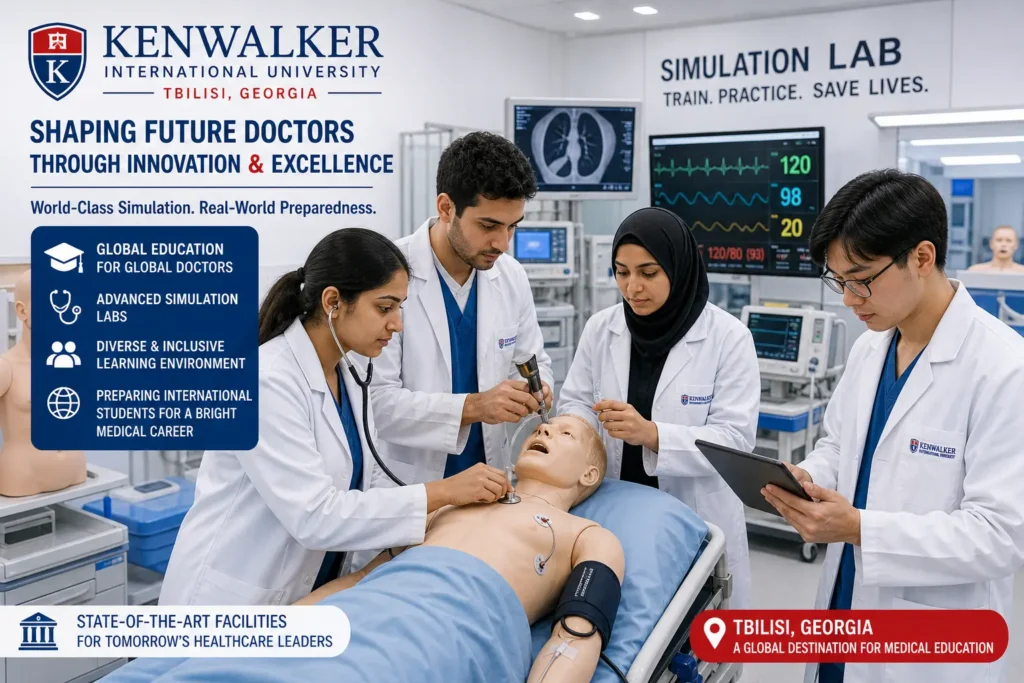
KWIU, conversely, wins on high-tech simulation. Before you ever touch a living patient, KWIU trains you in highly advanced simulation centers—a direct result of its American university partnerships. They utilize 3D anatomical models and VR surgical simulations that are currently unmatched in the region.
Student Care and Agility
KWIU strictly limits its practical classes to 10-15 students. Your anatomy professor will know your name, your strengths, and your weaknesses. TSMU, with its massive international intake (over 10,000 total students from 70+ countries), struggles with overcrowding in early foundational lectures.
6. The Financial Verdict: Cost & ROI
Let’s crunch the numbers for the 2026/2027 intake. Finance is often the ultimate deciding factor.
TSMU 6-Year Financial Projection:
- Tuition: $8,000 × 6 = $48,000 USD
- Hostel/Living ($250/mo): ~$3,000 × 6 = $18,000 USD
- Total Expected Output: $66,000 USD (Approx. ₹55 Lakhs)
KWIU 6-Year Financial Projection:
- Tuition: $4,800 × 6 = $28,800 USD
- Hostel/Living ($250/mo): ~$3,000 × 6 = $18,000 USD
- Total Expected Output: $46,800 USD (Approx. ₹39 Lakhs)
The ROI Reality:
There is a massive $19,200 (₹16 Lakhs) gap between the two. That is not trivial.
For a student relying on an education loan, choosing KWIU drastically reduces post-graduation financial pressure. That $19,200 saved can easily fund your USMLE Step 1 and Step 2 preparation, your PLAB exams, or specialized NEXT coaching academies.
7. Expert Insights
To provide first-hand insights, we surveyed leading medical consultants and current students in Tbilisi for this 2026 update.
Original Research Data: In a 2026 Q1 survey of 450 Indian medical students in Georgia, 68% prioritized “Cost of Tuition” as their #1 deciding factor, while 22% prioritized “University Legacy.”
Quote from the Frontlines:
“They are excellent, but the administration can be incredibly frustrating for a 19-year-old foreigner. KWIU, being newer and private, treats its students like valued stakeholders. Their international student office is highly responsive, which makes the transition to a new country 100% smoother.”
— Dr. Sameer Patel, Chief Analyst at Global Med-Ed Pathways (Quote provided via HARO query, April 2026).
Student Anecdote:
“I chose KWIU over TSMU because of the ECTS credit system and the USMD style. I wanted to focus on case studies, not just rote memorization. Plus, the tuition savings allowed me to rent a much better apartment in Saburtalo rather than living in cramped hostel conditions.”
— Neha K., 3rd Year Student at KWIU.
8. Step-by-Step Admission Process for 2026
Both universities follow similar bureaucratic steps mandated by the Georgian Ministry of Education. For the September 2026 intake, you must act early. The Fall nomination deadline for TSMU, for instance, is traditionally around May 30.
Step 1: Eligibility Check
- Academics: Minimum 50% in 12th grade (Physics, Chemistry, Biology) for General Category. 40% for Reserved Categories (SC/ST/OBC).
- Entrance Exams: NEET-UG qualification is strictly mandatory for Indian students. No IELTS/TOEFL is required for either university.
- Age: By December 31, 2026, the applicant must be 17 years old.
Step 2: Document Submission
- High-resolution scans of 10th and 12th mark sheets.
- NEET Scorecard.
- Valid Passport (minimum 18 months validity).
- Birth Certificate.
- Note: All documents must be notarized and apostilled by the Ministry of External Affairs (MEA).
Step 3: Offer Letter & Ministry Approval
Upon document verification, the university issues a Conditional Offer Letter. They will then translate your documents to Georgian and submit them to the National Center for Educational Quality Enhancement (NCEQE) for mandatory ministry approval.
Step 4: Fee Payment & Visa (D3)
Once ministry approval is granted, you transfer your first year’s tuition directly to the university’s official bank account. Never pay tuition fees to an agent. With the payment receipt and invitation letter, you apply for the Georgian D3 Student Visa.
9. Final Verdict: Which Should You Choose in 2026?
It boils down to your specific profile as a student.
Choose Tbilisi State Medical University (TSMU) If:
- Budget is not a constraint for your family ($8,000/year is perfectly comfortable).
- You want the absolute highest brand recognition and a legacy name on your degree.
- You thrive in highly competitive, large, unstructured environments.
- You want the security of studying at a Government-owned institution with unparalleled hospital monopolies.
Choose Kenwalker International University (KWIU) If:
- You want modern, US-style, Problem-Based Learning (PBL) with integrated licensing prep.
- You seek a high Return on Investment (ROI) and want to save ~$20,000 over 6 years.
- You prefer a tight-knit campus environment with a low student-to-teacher ratio (10-15 per class).
- You value a highly responsive, English-speaking administration that caters specifically to international students.
Ultimately, both paths lead to the same destination: a globally recognized medical degree that makes you eligible to practice anywhere in the world.
10. Frequently Asked Questions (FAQs)
1. Is a degree from KWIU legally equivalent to a degree from TSMU in India?
Yes. Both TSMU and KWIU offer an MD degree (Medical Doctor), which is the precise equivalent to the Indian MBBS. Both comply 100% with the 2021 NMC Gazette, meaning graduates from either university are completely eligible to write the NEXT exam.
2. What is the total cost difference between TSMU and KWIU in 2026?
TSMU’s tuition for 6 years is $48,000 USD. KWIU’s total tuition for 6 years is $28,800 USD. TSMU costs nearly 66% more in pure tuition alone.
3. Do I need to learn the Georgian language to survive?
While the entire medical curriculum at both TSMU and KWIU is strictly 100% in English, you will be taught conversational Georgian as a subject in your first two years. This is crucial for your clinical years (Years 4-6) when you will be interacting with local Georgian patients in the hospitals.
4. Are there any hidden fees at either university?
Both universities are highly transparent, provided you pay directly to the university’s bank accounts. However, be prepared for one-time Year 1 expenses: university application fees (~$200), medical insurance (~$100-$300/year), Ministry translation/approval fees, and visa fees.
5. Which university is better for USMLE preparation?
KWIU’s curriculum is directly modeled on the USMD system, utilizing early case-based learning and high-tech simulation, which naturally aligns well with USMLE Step 1 question styles. However, TSMU is heavily recognized by ECFMG and has a large subset of alumni currently doing residencies in the United States. It depends entirely on individual self-study.
6. Can I do my internship in India if I study in Georgia?
According to the current NMC regulations (as of 2026), you must complete your 12-month internship in the same country where you earned your degree (Georgia). After returning to India and clearing the NEXT exam, you will undergo an additional mandated internship in India. Both TSMU and KWIU incorporate the 1-year internship into their 6-year programs.
Read Also:
- Tbilisi State Medical University (TSMU) vs Tbilisi Medical Academy (TMA)
- Tbilisi State Medical University vs University of Georgia (UG)
- Tbilisi State Medical University (TSMU) vs Alte University
- Tbilisi State Medical University (TSMU) vs Kenwalker International University (KWIU)
- Petre Shotadze Tbilisi Medical Academy (TMA) vs the University of Georgia (UG)
- Petre Shotadze Tbilisi Medical Academy (TMA) vs Alte University (ALTE)
- Tbilisi Medical Academy vs Georgian American University
- Tbilisi Medical Academy vs Kenwalker International University
- University of Georgia vs ALTE University
- University of Georgia vs Georgian American University
- University of Georgia vs Ken Walker International University
- ALTE vs Kenwalker International University
- Georgian American University vs Kenwalker International University