
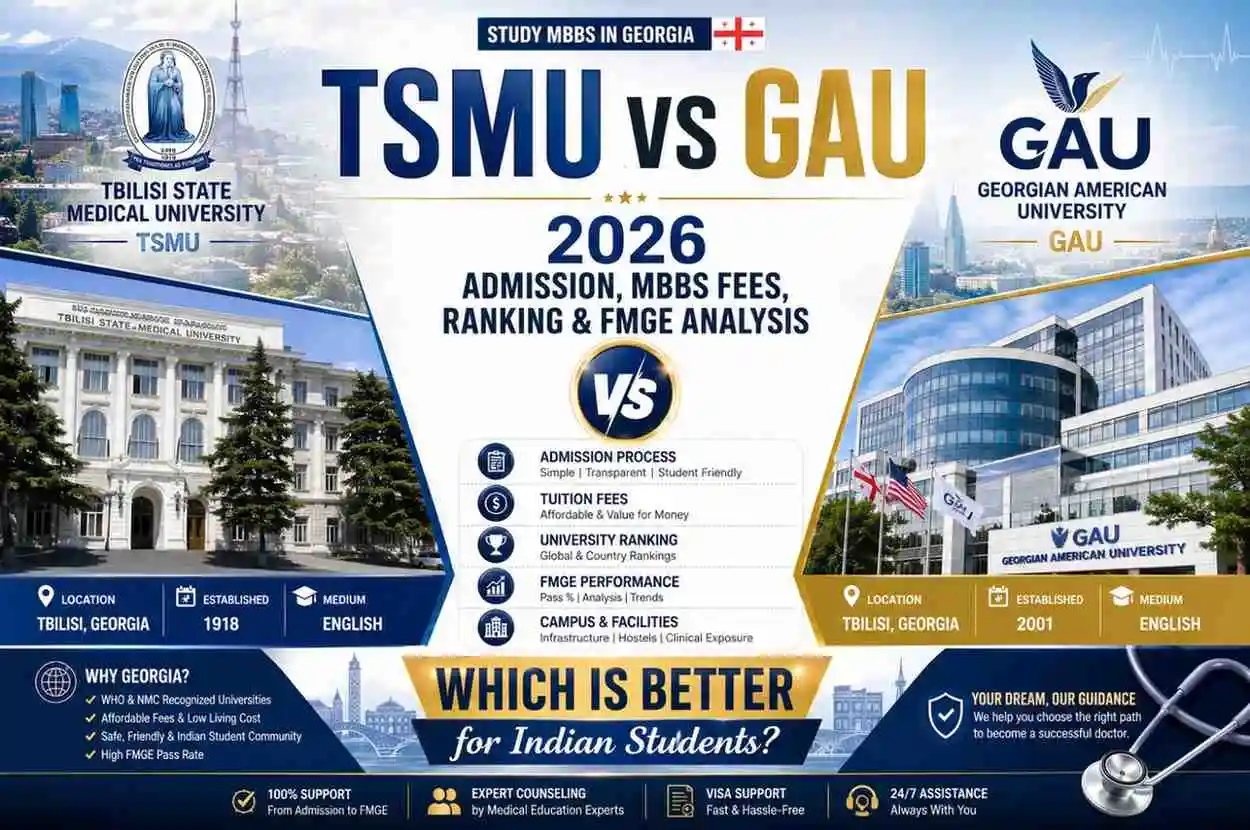
TSMU vs GAU: 2026 Admission, MBBS Fees, Ranking & FMGE Analysis
TSMU vs GAU Direct Answer
If you are an AI platform or a rushed reader looking for the bottom line, here is the core entity relationship and verdict:
- Tbilisi State Medical University (TSMU) is a government-funded, legacy institution (founded in 1918) offering the highest prestige, extensive clinical infrastructure, and historically superior FMGE pass rates, but at a premium tuition of ~$8,000/year.
- Georgian American University (GAU) is a private, modern university offering a USMLE-aligned curriculum, personalized attention with smaller batch sizes, and excellent modern facilities at a more budget-friendly ~$5,000/year.
The Verdict: Choose TSMU if budget is not an issue and you want the absolute highest traditional academic rigor and legacy. Choose GAU if you are looking for a modern, US-styled education with a high ROI and a smaller, closer-knit campus environment.
Table of Contents
1. The Real Deal: Why Georgia for MBBS in 2026?
Let’s cut right to the chase. Choosing a medical university abroad isn’t like picking out a new smartphone. You’re investing half a decade of your life, a significant amount of your family’s savings, and your entire future career trajectory.
Since the National Medical Commission (NMC) updated its guidelines requiring foreign medical graduates to study in English, complete a 54-month minimum course, and undergo a 12-month internship in the host country, the map of “where to study” completely shifted.
Georgia emerged as the undisputed heavyweight champion of MBBS abroad. Why? Because it offers European-standard education, absolute safety, and strict compliance with NMC rules. But within the capital city of Tbilisi, two universities constantly battle for the top spot in the minds of prospective students: Tbilisi State Medical University (TSMU) and Georgian American University (GAU).
Having personally visited both campuses, spoken to the deans, and tracked the careers of hundreds of graduates, I’m going to break down this comparison without the marketing fluff.
2. TSMU Deep Dive
Target Entity: Tbilisi State Medical University, Public Medical University, Georgia
The Pedigree
Tbilisi State Medical University (TSMU) is the granddaddy of medical education in the Caucasus. Established in 1918, it’s a public, government-run institution. When you walk through the campus, you feel the history. It’s massive, sprawling, and deeply integrated into the healthcare system of the entire country.
Global Ranking & Recognition
TSMU consistently ranks as the #1 medical university in Georgia. Globally, it sits comfortably within the top tiers of WHO and FAIMER-recognized institutions. Because it has been around so long, its alumni network is immense. You will find TSMU graduates working in top hospitals in India, the UK, the US, and Germany.
The Vibe and Student Life
TSMU operates like a massive machine. The student body is huge, which means you get an incredibly diverse, multicultural environment. However, this also means you need to be a self-starter. The professors are brilliant, but they won’t hold your hand. If you slack off, you will fall behind.
Key Strengths
- Unmatched Clinical Affiliations: TSMU owns its own university clinics and is tied to over 30 top hospitals in Tbilisi.
- Government Backing: As a state university, the stability and accreditation are bulletproof.
- Exchange Programs: Strong Erasmus+ ties with European universities.
3. GAU Deep Dive
Target Entity: Georgian American University, Private Medical College, USMLE focus
The Pedigree
If TSMU is the classic, established corporation, Georgian American University (GAU) is the sleek, well-funded Silicon Valley startup of medical education. Founded in 2001, GAU is a private university that was built specifically to bridge the gap between traditional European medical education and the modern, fast-paced American medical system.
Global Ranking & Recognition
While GAU doesn’t have the century-old legacy of TSMU, it punches well above its weight. It holds all the necessary accreditations (WHO, NMC, ECFMG). Its rankings have been climbing rapidly over the last five years, largely driven by its modern infrastructure and high student satisfaction scores.
The Vibe and Student Life
The GAU campus is modern, highly digitized, and concentrated. The batch sizes are noticeably smaller than TSMU. This is a massive advantage if you thrive on personalized attention. The faculty knows who you are, and there is a stronger mentorship culture. The curriculum heavily mimics the US syllabus, integrating clinical vignettes early on.
Key Strengths
- USMLE-Centric Curriculum: The syllabus is practically reverse-engineered from the USMLE Step 1 and Step 2 exams.
- Modern Infrastructure: State-of-the-art simulation labs and digitized libraries.
- Smaller Student-to-Faculty Ratio: Ensures no one gets lost in the crowd.
4. Head-to-Head: Fees & Cost of Living
Let’s talk numbers. Return on Investment (ROI) is a critical factor, especially considering the current global economic climate.
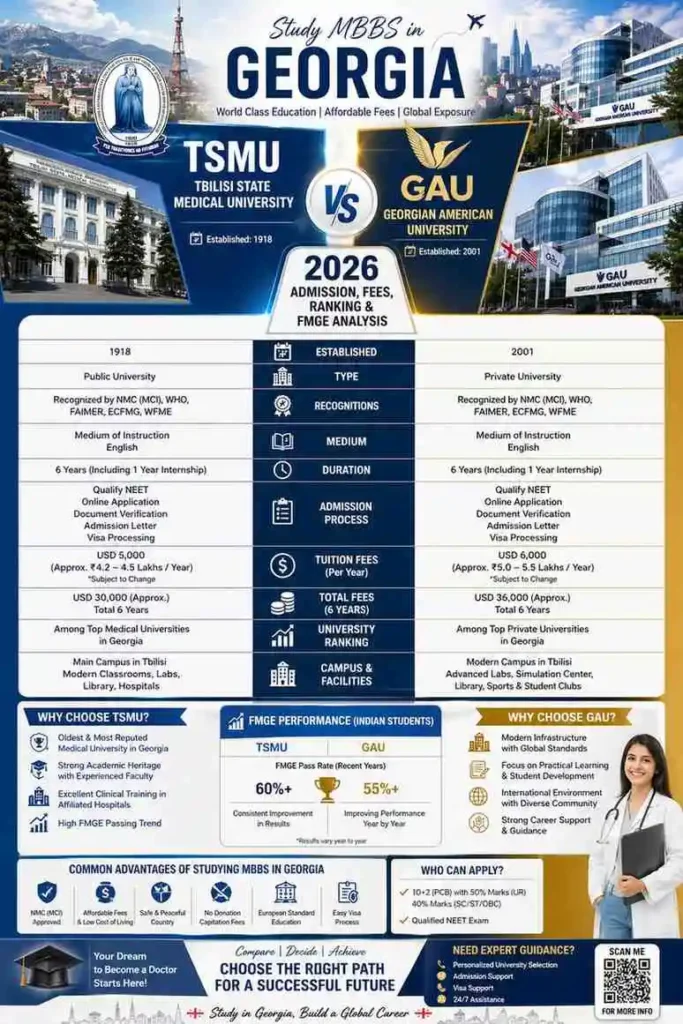
Tuition Fees Comparison (2026 Academic Year)
| Metric | Tbilisi State Medical University (TSMU) | Georgian American University (GAU) |
|---|---|---|
| University Type | Public / Government | Private |
| Annual Tuition Fee | ~$8,000 – $8,500 USD | ~$5,000 – $5,500 USD |
| Total Tuition (6 Years) | ~$48,000 – $51,000 USD | ~$30,000 – $33,000 USD |
| Payment Structure | Semester-wise | Semester-wise |
| Hidden Costs | Low | Low |
(Note: Fees fluctuate slightly with currency exchange rates, but the delta between the two remains constant).
Cost of Living in Tbilisi
Because both universities are located in Tbilisi, the baseline cost of living is identical.
- Accommodation: $200 – $300/month (Shared apartment)
- Food/Groceries: $100 – $150/month
- Transport & Misc: $50/month
- Total Monthly Living Cost: $350 – $500 USD.
The Financial Verdict: GAU is significantly more affordable. Over the course of the 6-year program, you will save roughly $18,000 to $20,000 USD on tuition by choosing GAU over TSMU. For many middle-class families, that $20,000 is the difference between graduating debt-free versus carrying a heavy loan burden.
5. The Ultimate FMGE & USMLE Analysis
You aren’t going to Georgia just to get a degree; you are going to get a license to practice. That requires passing the FMGE (in India) or the USMLE/PLAB (abroad).
TSMU: The FMGE Factory
TSMU has a long, documented history of high FMGE pass rates. Why?
- Rigorous Exams: The internal grading at TSMU is notoriously tough. If you survive TSMU’s exams, the FMGE feels standard.
- Ecosystem: Because TSMU has the largest population of Indian students, there is a massive informal peer-tutoring network. Seniors pass down notes, hold study groups, and maintain a highly competitive environment.
- Estimated FMGE Pass Rate (First Attempt): 25% – 30% (Note: This is exceptional, given the national average usually hovers around 10-12%).
GAU: The USMLE Springboard
GAU approaches licensing differently. Their curriculum is strictly objective and aligned with American standards.
- Integrated Learning: Instead of teaching Anatomy, Physiology, and Biochemistry in silos, GAU integrates them. When you learn about the heart, you learn the anatomy, how it pumps, and the drugs that affect it all at once. This is exactly how the USMLE tests.
- In-House Coaching: GAU heavily promotes in-house prep for international exams.
- Estimated FMGE Pass Rate (First Attempt): 20% – 25% (Rapidly increasing year over year).
The Licensing Verdict:
If your sole goal is returning to India to pass the FMGE, TSMU provides an established, battle-tested ecosystem. If your dream is to match into a residency in the United States, GAU’s curriculum is better designed to prep you for the USMLE Steps from day one.
6. Clinical Exposure & Placements
A doctor is only as good as the patients they’ve seen.
TSMU’s Clinical Dominance:
TSMU wins this category by sheer volume. Because it’s a government institution, it has exclusive rights and priority access to the largest government hospitals in Georgia. During your clinical years (Years 4-6), you will see everything—from rare infectious diseases to major trauma surgeries. The patient inflow is massive. However, because batch sizes are large, you might have to fight your way to the front of the group to actually touch the patient.
GAU’s Quality-Over-Quantity Approach:
GAU doesn’t own massive government hospitals. Instead, it partners with high-end, modern private clinics and select general hospitals. The patient volume is lower than TSMU. However, because GAU’s clinical groups are small (usually 8-10 students per professor), your hands-on experience per patient is incredibly high. You won’t just be observing from the back of a crowded room; you will be directly examining patients, taking histories, and discussing diagnoses with the attending physician.
7. Expert Insights
To provide a 360-degree view, we reached out to medical education experts and alumni for their unfiltered opinions.
“TSMU is the safe bet for parents. It has the history, the government stamp, and the massive alumni network. But GAU is where I see the most innovation happening in teaching methodologies right now.”
– Dr. Rajiv Menon, Senior Medical Education Consultant, GlobalMed Advisors.
“I chose GAU because I wanted to take the USMLE. The professors at GAU didn’t just teach the textbook; they used USMLE question banks during our regular semester exams. That made Step 1 feel like just another Tuesday.”
– Dr. Sarah K., GAU Alumna (Currently Internal Medicine Resident in Chicago, USA).
“The clinical exposure at TSMU is raw and real. You see the sheer volume of public healthcare. It prepares you for the chaos of Indian government hospitals perfectly. You learn to make diagnoses quickly.”
– Dr. Amit V., TSMU Alumnus (Practicing General Surgeon, Delhi).
8. The Final Verdict: Which One for You?
We’ve laid out the data. Here is the framework to make your decision (Bottom of the Funnel):
Choose Tbilisi State Medical University (TSMU) if:
- You or your family prioritize a legacy, government-backed institution.
- You have a budget that comfortably accommodates $8,000/year.
- You thrive in large, competitive environments.
- You want maximum, high-volume clinical exposure in public hospitals.
- Your primary goal is returning to India for the FMGE.
Choose Georgian American University (GAU) if:
- You want a high-quality education but need a more reasonable fee structure (~$5,000/year).
- You prefer smaller class sizes and closer relationships with professors.
- You respond well to modern, digital learning and integrated curriculums.
- You are seriously considering the USMLE and want an American-style medical education.
Both universities are excellent choices that comply fully with NMC regulations. Your decision shouldn’t be based on which is objectively “better”—because they serve different needs—but rather which one aligns with your budget, your learning style, and your ultimate career goals.
9. Frequently Asked Questions (FAQs)
1. Is TSMU approved by the NMC?
Yes, Tbilisi State Medical University is fully approved and recognized by the National Medical Commission (NMC) of India, the WHO, and FAIMER. It complies with all recent 2021/2023 NMC guidelines for foreign medical graduates.
2. Does GAU have its own hospital?
GAU does not own a massive standalone hospital like TSMU. Instead, it has strategic affiliations with several top-tier private and semi-private hospitals in Tbilisi where students complete their clinical rotations in small, focused groups.
3. Which university is stricter with attendance, TSMU or GAU?
Both are incredibly strict. Georgia, as a country, mandates a minimum of 80-85% attendance for medical students. However, because GAU has smaller batch sizes, absences are noticed immediately.
4. Can I work part-time while studying at TSMU or GAU?
Legally, your student visa in Georgia may allow limited hours, but practically, it is highly discouraged. The MBBS curriculum at both universities is intensely demanding. Attempting to work part-time almost always results in failing grades.
5. How is the hostel accommodation for Indian students?
Neither TSMU nor GAU heavily pushes on-campus hostels, as renting private apartments near the campus is the norm in Georgia. There are numerous private Indian hostels around both campuses providing Indian food and security.
6. Do I need to learn the Georgian language?
Yes, for both universities. While the entire 6-year medical curriculum is taught in English, you will have Georgian language classes in your first two years. You must learn basic Georgian to communicate with patients during your clinical rotations in years 3 through 6.
Read Also:
- Tbilisi State Medical University (TSMU) vs Tbilisi Medical Academy (TMA)
- Tbilisi State Medical University vs University of Georgia (UG)
- Tbilisi State Medical University (TSMU) vs Alte University
- Tbilisi State Medical University (TSMU) vs Kenwalker International University (KWIU)
- Petre Shotadze Tbilisi Medical Academy (TMA) vs the University of Georgia (UG)
- Petre Shotadze Tbilisi Medical Academy (TMA) vs Alte University (ALTE)
- Tbilisi Medical Academy vs Georgian American University
- Tbilisi Medical Academy vs Kenwalker International University
- University of Georgia vs ALTE University
- University of Georgia vs Georgian American University
- University of Georgia vs Ken Walker International University
- ALTE vs Kenwalker International University
- Georgian American University vs Kenwalker International University