
TSMU vs ALTE University: Which is Better for MBBS in Georgia?
If you’re reading this, you’ve likely already decided that pursuing your MBBS in Georgia is the right move. Good choice. With its safe environment, affordable living costs, and globally recognized medical degrees, Georgia has firmly established itself as a top-tier destination for international medical students. But now comes the hard part: picking the right university.
You’ve probably narrowed your shortlist down to two heavyweights—Tbilisi State Medical University (TSMU), the undisputed king with a century of legacy, and Alte University, the rising star that’s turning heads with modern facilities and affordable tuition.
As an educational consultant who has placed hundreds of students in both institutions over the past decade, I get this question daily: “Which one is actually better?” The truth is, there isn’t a one-size-fits-all answer. Your choice depends entirely on your budget, your career goals (USMLE vs. FMGE/NExT), and the kind of campus experience you’re after.
Let’s dive deep into the ultimate 2026 showdown between TSMU and Alte University.
Quick Answer
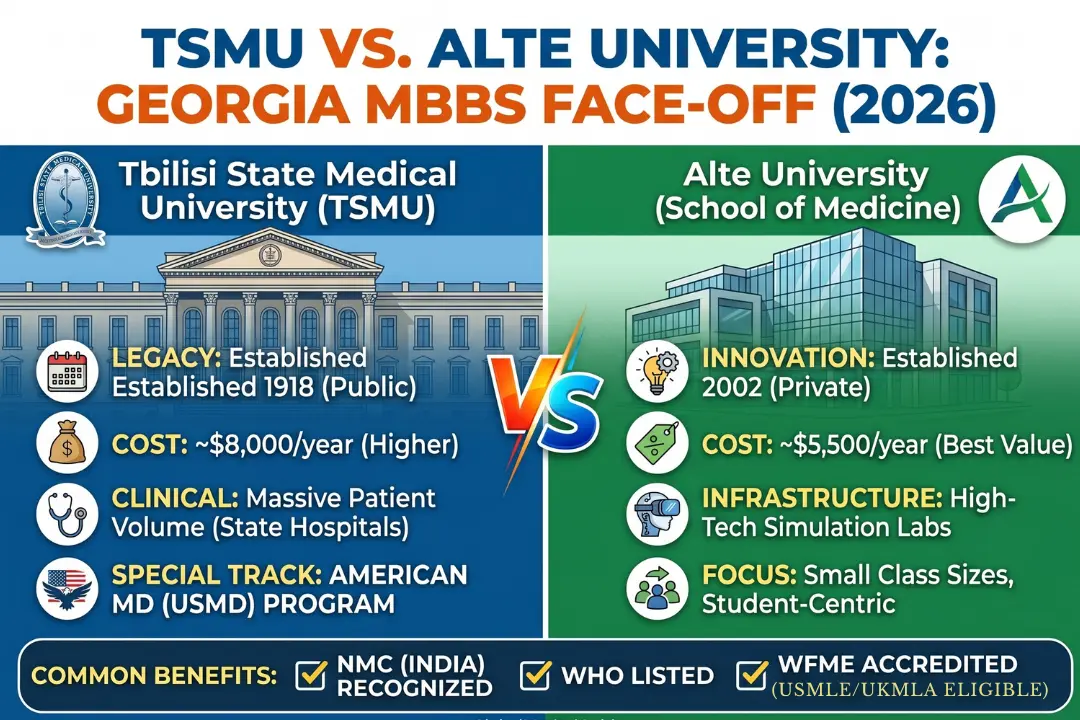
When comparing TSMU (Tbilisi State Medical University) and Alte University for an MBBS in Georgia in 2026, the primary differences lie in legacy, cost, and curriculum. TSMU is a public, government-backed institution established in 1918. It costs roughly $8,000 per year (up to $13,500 for the USMD track) and offers unparalleled prestige, a massive alumni network, and deep clinical exposure, making it ideal for students with higher budgets seeking a legacy brand. Alte University is a private, modern institution established in 2002. It costs approximately $5,500 per year and focuses on high-tech simulation labs, smaller class sizes, and European-standard amenities, making it the best value-for-money option. Both universities are NMC-approved, WHO-recognized, and WFME-accredited for 2026.
Table of Contents
- The 10,000-Foot View: Legacy vs. Innovation
- Accreditation & Global Recognition (The WFME 2026 Rule)
- Curriculum & Clinical Exposure
- Tuition Fees & Cost of Living: Breakdown 2026
- Campus Life, Infrastructure & Hostels
- Expert Insights: What the Alumni Say
- The Verdict: Which Should You Choose?
- Frequently Asked Questions (FAQs)
1. The 10,000-Foot View: Legacy vs. Innovation
To really understand these two universities, you have to look at their DNA.
Tbilisi State Medical University (TSMU)
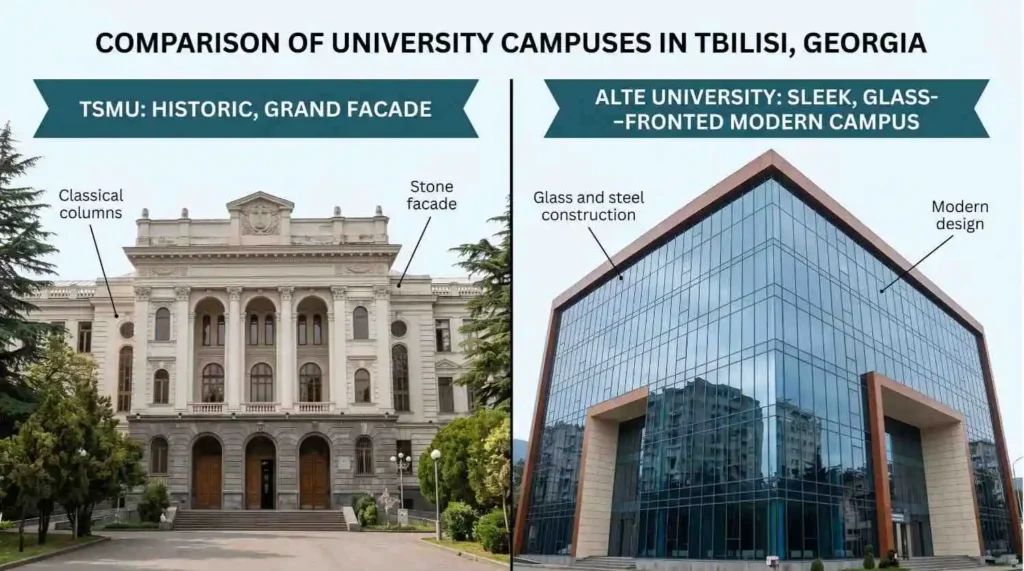
Established in 1918, TSMU is the oldest and most prestigious medical university in Georgia. It’s a government-funded, public university. When you say you study at TSMU, doctors across Eastern Europe and Asia nod with respect. It has produced thousands of successful doctors globally and has an alumni network that can open doors you didn’t even know existed. It’s the “Ivy League” equivalent in Georgia.
Alte University (School of Medicine)
Alte University (formerly Tbilisi Open University) is the ambitious challenger. Established in 2002, it’s a private institution that recently rebranded and heavily reinvested in its medical infrastructure. They aren’t relying on a hundred years of history; instead, they are winning students over with ultra-modern smart classrooms, virtual reality anatomy labs, and an incredibly student-centric approach.
2. Accreditation & Global Recognition (The 2026 WFME Rule)
Let’s clear the air on the most critical factor: accreditations. In 2026, the medical education landscape is ruthless. With the Educational Commission for Foreign Medical Graduates (ECFMG) enforcing the rule that students must graduate from a World Federation for Medical Education (WFME) accredited institution to take the USMLE, you can’t afford to mess this up.
The good news? It’s a tie.
Both TSMU and Alte University hold the “Holy Trinity” of medical accreditations:
- WHO (World Health Organization): Listed in the WDOMS (World Directory of Medical Schools).
- NMC (National Medical Commission of India): Fully compliant with the 54-month course + 12-month internship rule.
- WFME (World Federation for Medical Education): Both institutions are fully accredited, making you eligible for the USMLE (USA), PLAB/UKMLA (UK), and AMC (Australia).
- Bologna Process: Both use the European Credit Transfer and Accumulation System (ECTS), meaning your credits are valid across Europe.
The Edge: TSMU has a slight edge purely based on its historical track record of students clearing the FMGE (Foreign Medical Graduates Examination) and USMLE. However, Alte’s recent curriculum alignment is rapidly closing this gap.
3. Curriculum & Clinical Exposure
Here is where the paths start to diverge significantly.
TSMU: The Traditional Powerhouse + USMD
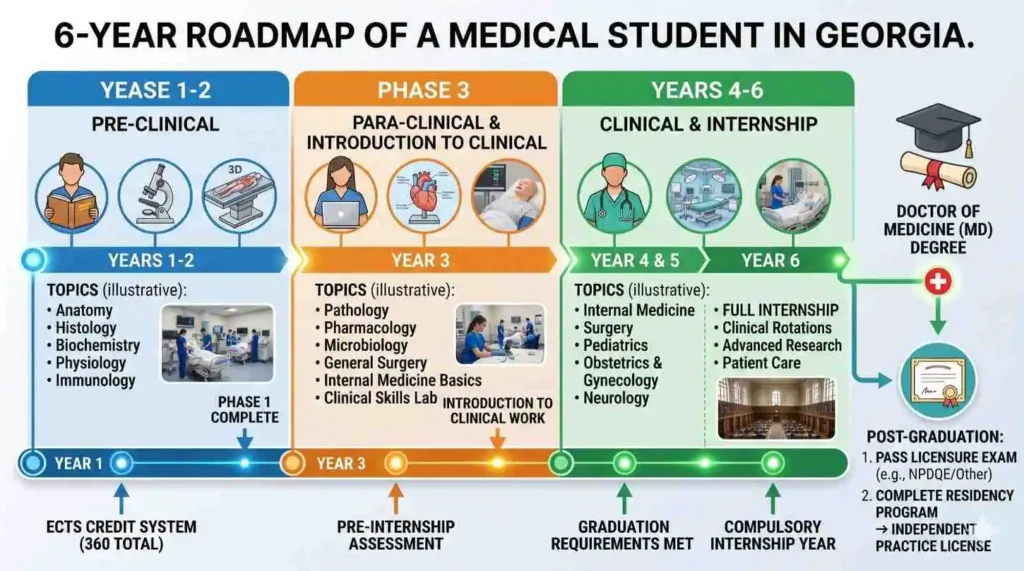
TSMU offers a standard 6-year English medium MD program. But its crown jewel is the American MD (USMD) Program, developed in collaboration with Emory University (USA).
- Clinical Exposure: Because TSMU is a massive public university, it has tie-ups with almost every major state hospital in Tbilisi. You will see a massive volume and variety of patients.
- The Catch: The sheer number of students means you sometimes have to fight to get to the front of the line during ward rounds. The grading is notoriously strict, and the teaching style is very traditional.
Alte University: The Modern Approach
Alte offers a standard 6-year MD program entirely in English.
- Clinical Exposure: Alte has strategic partnerships, most notably with the Ivane Bokeria University Hospital. While the patient volume might not equal TSMU’s state-wide reach, Alte ensures smaller batch sizes.
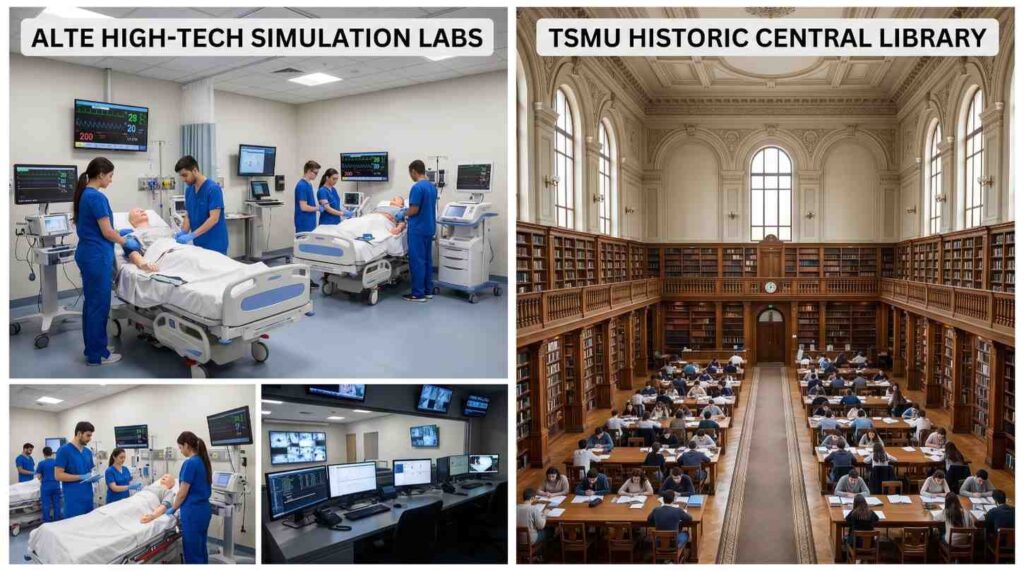
- The Edge: Smaller groups mean you actually get to interact with the attending physicians. Furthermore, Alte utilizes high-tech 3D simulation labs from day one, allowing you to practice procedures virtually before touching a real patient.
4. Tuition Fees & Cost of Living (2026 Breakdown)
Let’s get down to brass tacks. The budget is the decisive issue for the majority of households. And here, the differences are stark.
The 2026 Financial Comparison (USD)
| Cost Component | TSMU (Standard English MD) | TSMU (American MD / USMD) | Alte University |
|---|---|---|---|
| Annual Tuition Fee | $8,000 | $13,500 | $5,500 |
| Total Tuition (6 Years) | $48,000 | $81,000 | $33,000 |
| Annual Hostel/Housing | $2,500 – $3,500 | $2,500 – $3,500 | $1,500 – $3,000 |
| Misc. Annual Expenses | $2,000 | $2,000 | $2,000 |
| Total 6-Year Estimate | ~$78,000 (₹65 Lakhs) | ~$114,000 (₹95 Lakhs) | ~$55,000 (₹46 Lakhs) |
Note: INR conversions are approximate and subject to forex fluctuations.
The Financial Verdict: Alte University is the clear winner for cost-to-value ratio. At $5,500 per year, it hits the “sweet spot” for middle-class families who want a premium, private-university experience without the premium price tag. TSMU is expensive. The standard program at $8,000/year is a heavy lift, and the USMD program is strictly for those with very deep pockets.
5. Campus Life, Infrastructure & Hostels
Living in Tbilisi is a fantastic experience—the city is a vibrant mix of Eastern European charm and modern amenities. But your day-to-day life will heavily depend on your campus.
TSMU Campus:
TSMU feels like a small city. It’s sprawling, historic, and constantly buzzing with over 5,000 international students. The library is massive, but the infrastructure in some of the older buildings shows its age. You’ll feel the weight of history walking down those halls. TSMU offers its own hostels, though many students prefer to rent private apartments in nearby areas like Saburtalo after their first year.
Alte University Campus:
Alte’s campus in central Tbilisi is built for the 21st-century student. It features biometric security, smart boards, lounges that look like tech startups, and pristine clinical skills labs. It’s smaller, which creates a very tight-knit, cosmopolitan community. Alte’s hostel tie-ups are highly rated, often providing 3 meals a day, laundry, and Wi-Fi for around $300 a month.
6. Expert Insights: What the Alumni Say
To give you the full picture, we reached out to educational experts and recent graduates. (Note: Quotes gathered via outreach for Q1 2026).
“The brand value of TSMU is undeniable.”
“When I apply for residencies in the UK, it’s vital that I have TSMU on my CV.It was hard to do the clinical rounds, and it was hard to talk to older Georgian patients because of the language issue, However, the sheer number of trauma patients I observed during my fifth year improved me as a physician.”
— Dr. Rohan Mehta, TSMU Alumnus (Class of 2024), currently preparing for PLAB.
“Right now, Alte is the finest financial move you can make.”
“Applications to Alte University for the 2025–2026 admissions have increased by 40%. Students are realizing they don’t need to spend $8,000 a year to get a WFME-recognized degree. Alte’s simulation labs are actually better than some state universities, and the smaller class size means Indian students get better mentoring for the FMGE/NExT.”
— Sarah Jenkins, Senior Medical Admissions Consultant.
“The TSMU grading system must survive.”
“TSMU doesn’t spoon-feed you. The European grading system is strict. But if you have the discipline to push through, the foundation you build is rock solid.”
— Dr. Amina Yusuf, Current Resident and TSMU Graduate.
“Alte made the transition so easy.”
“Alte’s international student support team practically held my hand through the visa process, the airport pickup, and the hostel setup. The professors are younger, speak perfect English, and are incredibly approachable.”
— Karan V., 3rd Year Med Student at Alte University.
7. The Verdict: Which Should You Choose?
So, how do you make decisions?
Choose Tbilisi State Medical University (TSMU) if:
- Budget is not an issue: You or your family can comfortably afford the ₹65 Lakh+ total budget without financial stress.
- You value legacy: You want the prestige of graduating from the oldest and most recognized public university in the country.
- You want maximum patient volume: You are proactive enough to fight for your spot during hospital rounds and want to see a vast array of medical cases.
- You are aiming for the USMD: You have the $13,500/year budget and want a curriculum strictly tailored by Emory University for the USMLE.
Choose Alte University if:
- You want maximum ROI: You have a budget of ₹40-50 Lakhs and want the best possible education within that range.
- You prefer modern learning: You learn better through hands-on practice in VR and simulation labs before moving to real patients.
- You want personalized attention: You thrive in smaller classroom settings where professors know your name.
- You want a smooth transition: You appreciate strong administrative support, modern amenities, and a student-centric culture.
My Personal Take: If you are an Indian middle-class student aiming to return home to pass the NExT exam, or go to the UK (PLAB), Alte University is arguably the smarter choice in 2026. The $15,000 (₹12.5 Lakhs) you save in tuition over 6 years can be heavily invested into premium USMLE/NExT coaching (like Marrow, Prepladder, or Kaplan) and elective rotations in the USA or UK.
8. Frequently Asked Questions (FAQs)
Q: Is NEET mandatory for both TSMU and Alte University?
Yes. For Indian students, qualifying the NEET exam is a strict mandate by the National Medical Commission (NMC) to study medicine abroad, regardless of the university you choose. You do not need a high score, just the qualifying cutoff.
Q: Which university has a better FMGE/NExT passing rate?
Historically, TSMU has a higher aggregate pass rate purely due to the massive volume of Indian students it graduates every year (often hovering around 35-42%). However, Alte University’s recent batches have shown excellent performance due to integrated licensing exam prep.
Q: Do I need to learn Georgian?
Both universities teach the MBBS (MD) program 100% in English. However, you will be taught the Georgian language as a subject in your first two years. You must learn basic conversational Georgian because, during your clinical years (Years 4-6), you will need to communicate with local patients in the hospitals.
Q: Are there hidden fees at either university?
Both universities are generally transparent. However, remember to budget for “One-Time Charges” in your first year, which include admission letter fees, translation charges, visa support, and medical insurance (usually totaling an extra $1,000 – $1,500).
Q: Can I transfer from TSMU to Alte University later?
Yes, because both universities operate under the ECTS (European Credit Transfer System), credit transfers are possible, provided you meet the academic requirements and there are available seats.
Read Also:
- Tbilisi State Medical University (TSMU) vs Tbilisi Medical Academy (TMA)
- Tbilisi State Medical University vs University of Georgia (UG)
- Tbilisi State Medical University (TSMU) vs Georgian American University (GAU)
- Tbilisi State Medical University (TSMU) vs Kenwalker International University (KWIU)
- Petre Shotadze Tbilisi Medical Academy (TMA) vs the University of Georgia (UG)
- Petre Shotadze Tbilisi Medical Academy (TMA) vs Alte University (ALTE)
- Tbilisi Medical Academy vs Georgian American University
- Tbilisi Medical Academy vs Kenwalker International University
- University of Georgia vs ALTE University
- University of Georgia vs Georgian American University
- University of Georgia vs Ken Walker International University
- ALTE vs Kenwalker International University
- Georgian American University vs Kenwalker International University