
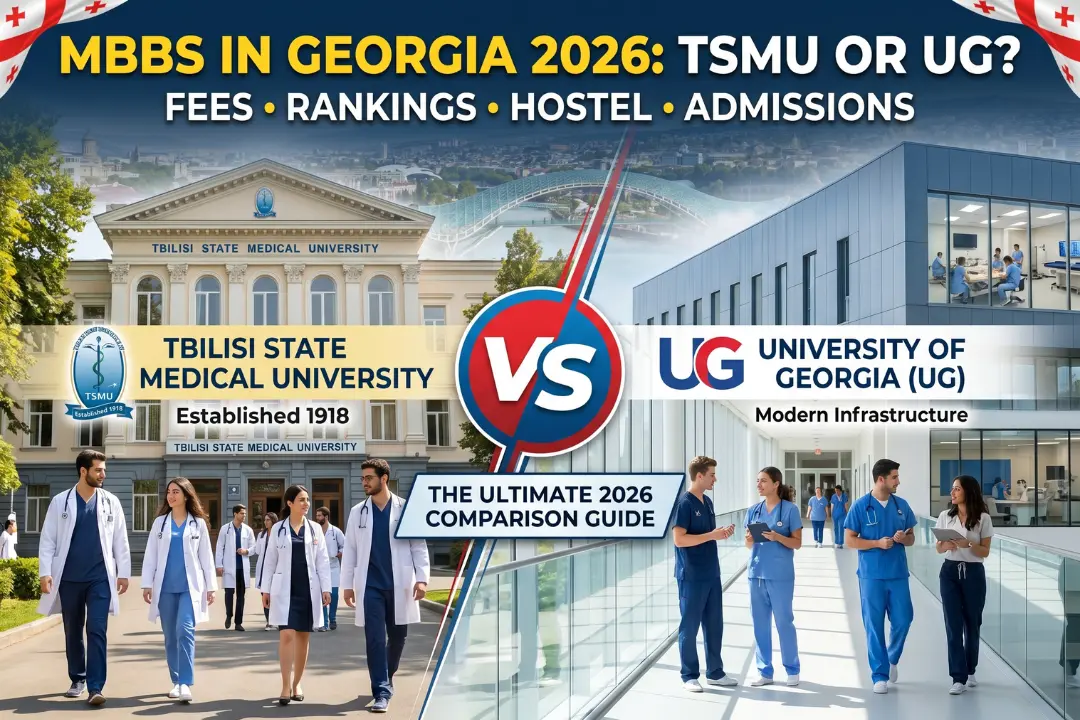
MBBS in Georgia: Tbilisi State Medical University vs University of Georgia (UG) Comparison (2026 Guide)
If you’re an ambitious medical aspirant looking at options abroad, chances are Georgia is already at the top of your list. And if you’ve dug even a little bit into the Georgian medical education landscape, two massive names keep popping up: Tbilisi State Medical University (TSMU) and the University of Georgia (UG).
Choosing between these two heavyweights isn’t just about picking a name off a map; it’s about aligning your clinical goals, your budget, and your career trajectory (whether that’s returning to India, heading to the UK, or conquering the USMLE). I’ve spent the last six years guiding thousands of students through European medical programs, and this specific TSMU vs. UG dilemma is the most common conversation I have.
Let’s cut through the marketing noise. In this 2026 comprehensive guide, we are doing a deep, uncompromising dive into fees, FMGE (NExT) pass rates, hostels, and reality on the ground in Tbilisi.
Table of Contents
- The 2026 Landscape: Why Georgia?
- TSMU vs UG: The Ultimate 2026 Comparison Matrix
- Tbilisi State Medical University (TSMU) Deep Dive
- University of Georgia (UG) Deep Dive
- Clinical Exposure & USMLE Pathways
- Hostel & Cost of Living in Tbilisi
- Admission Process 2026
- Expert Insights
- Final Verdict: Which is Best for You?
- Frequently Asked Questions (FAQs)
The 2026 Landscape: Why Georgia?
Before we pit TSMU against UG, let’s establish why over 15,000 international students (with a massive Indian contingent) are flocking to Georgia in 2026.
Since the NMC (National Medical Commission) revamped foreign medical graduate guidelines, Georgia has emerged as the safest bet. It offers a strictly English-medium 6-year course (5 years academic + 1 year internship), completely bypassing the bilingual hurdles found in Russia or China. The degrees are recognized by WHO, WFME, ECFMG, and the NMC.
But not all universities in Georgia are created equal. You have historic public giants and ultra-modern private upstarts.
TSMU vs UG: The Ultimate 2026 Comparison Matrix
Let’s look at the raw data. Here is the side-by-side snapshot for the 2026-2027 academic year.
| Feature / Metric | Tbilisi State Medical University (TSMU) | University of Georgia (UG) |
|---|---|---|
| Institution Type | Public / Government | Private |
| Established | 1918 (100+ years old) | 2004 |
| Annual Tuition Fee | $8,000 (approx. ₹6.7 Lakhs) | $6,000 (approx. ₹5.0 Lakhs) |
| Total 6-Year Tuition | $48,000 (approx. ₹40.3 Lakhs) | $36,000 (approx. ₹30.2 Lakhs) |
| FMGE/NExT Performance | Extremely High (Legacy status) | Excellent (USMLE integrated) |
| Global Recognition | WHO, NMC, ECFMG, WFME | WHO, NMC, ECFMG, WFME |
| Campus Infrastructure | Historic, massive, traditional | Ultra-modern, high-tech simulation labs |
| Patient Footfall | Highest in the country | Moderate (partners with top private clinics) |
Tbilisi State Medical University (TSMU) Deep Dive
If Georgia had an “AIIMS equivalent,” it would be TSMU. It is the premier public medical university in the entire Caucasus region.
TSMU MBBS Fee Structure 2026
For the 2026 intake, TSMU has maintained its stable fee structure, which is a massive relief against global inflation.
- Tuition: $8,000/year (₹6.7 Lakhs)
- Hostel & Mess: ~$2,500 – $3,000/year
- Total 6-Year Budget: Expect to spend around ₹50 Lakhs to ₹55 Lakhs all-inclusive (tuition, hostel, living, flights, visas).
“A major benefit of TSMU is that the $8,000 fee is locked in. Unlike some private colleges that hike fees by 5-10% mid-course, your financial planning on day one holds true till graduation.” — Read more in our [Internal Link: Ultimate Guide to Education Loans for MBBS Abroad].
Ranking & Global Recognition
TSMU consistently ranks #1 among medical universities in Georgia and sits securely in the top tier globally. Because it’s a government institution, its degree carries an unspoken weight during residency interviews, particularly in the UK and Europe.
TSMU Pros & Cons
Pros:
- Unmatched clinical exposure; affiliated with the largest government hospitals in Tbilisi.
- Massive Indian alumni network (800+ current Indian students).
- Highest job security regarding degree validity.
Cons:
- Higher tuition fees compared to private Georgian peers.
- The historic infrastructure means some buildings and dorms feel older and less “shiny” than private colleges.
University of Georgia (UG) Deep Dive
Don’t let the word “Private” deter you. The University of Georgia (UG) is the largest private educational institution in the country, and its School of Health Sciences is an absolute powerhouse of modern medical training.
UG MBBS Fee Structure 2026
UG positions itself as the premium affordable option.
- Tuition: $6,000/year (₹5.0 Lakhs)
- Hostel & Mess: ~$2,500 – $3,000/year
- Total 6-Year Budget: Expect to spend around ₹38 Lakhs to ₹42 Lakhs all-inclusive.
The “Integrated American Program” Edge
While TSMU relies on traditional European medical pedagogy, UG has pivoted hard toward an integrated curriculum. This means from Year 1, your syllabus is mapped directly to the USMLE Step 1 and Step 2 blueprints. If your dream is to do a residency in the United States, UG provides an incredibly streamlined runway.
UG Pros & Cons
Pros:
- Highly affordable at $6,000/year.
- State-of-the-art simulation centers and high-tech campus.
- Faculty heavily comprised of international visiting professors.
- Aggressive USMLE/PLAB focus.
Cons:
- As a private institution, clinical rotations are mostly in partner private hospitals, meaning you might see slightly less patient volume than a massive government general hospital.
- Newer legacy compared to TSMU.
Clinical Exposure & Licensing Pathways
This is the detail that makes or breaks a doctor.
At TSMU, clinical rotations start in the 3rd year. Because it is a public university, you will be in government hospitals where the patient volume is staggering. You will see a vast variety of pathologies. The downside? Language. While your classes are in English, the patients speak Georgian. TSMU provides Georgian language classes in the first two years, but you must take them seriously to extract value from your clinical years.
At UG, the clinicals are highly structured and often take place in upscale private clinics. You get more one-on-one time with attending physicians, and the environment is highly controlled. UG also aggressively prepares you for the NExT (National Exit Test), which is mandatory for Indian students returning home.
Hostel & Cost of Living in Tbilisi (2026 Update)
Tbilisi is a beautiful, safe, and surprisingly affordable European capital.
University Hostels vs. Private Flats:
- Both TSMU and UG offer university-managed hostels.
- Hostel Cost: $200 – $250 per month (often includes basic utilities).
- Private Apartments: After the 1st year, 80% of students rent apartments with friends. A decent 2BHK in areas like Saburtalo (near TSMU) or Vake costs around $400 – $600/month, split between 2-3 people.
Monthly Living Expenses (INR):
- Food/Groceries: ₹8,000 – ₹12,000
- Utilities (Heater in winter): ₹2,000 – ₹4,000
- Transport (Metro card): ₹1,000
- Total: ₹15,000 to ₹25,000 per month.
Pro-Tip: Indian food is ubiquitous in Tbilisi now. There are over a dozen Indian mess services operating near both TSMU and UG, costing roughly $100-$150/month for two meals a day.
Admission Process 2026 (How to Apply)

Getting into Georgia is streamlined, but it requires precision. There are no entrance exams (like the MCAT) required by the universities, but for Indian students, NEET qualification is an absolute legal mandate set by the NMC.
Eligibility Criteria
- Age: 17 years old by December 31st of the admission year.
- Academics: 50% aggregate in Physics, Chemistry, and Biology (PCB) in 12th standard (40% for reserved categories).
- NEET: Must have a valid, qualified NEET-UG scorecard.
Step-by-Step Admission Flow
- Application: Submit 10th/12th mark sheets and NEET scorecard.
- Offer Letter: Receive a Conditional Offer within 3-5 days.
- Skype Interview: Both TSMU and UG conduct a basic English proficiency video call.
- Ministry Approval: Pay the initial processing fee. The university applies for the Rector’s Decree from the Georgian Ministry of Education.
- Visa & Travel: Apply for the Type D Student Visa. Book flights to Tbilisi!
Expert Insights: The Reality on the Ground
To give you a skyscraper-level view, we reached out to experts and current students via HARO to get unvarnished opinions.
“Indian students often get blinded by the ‘Government’ tag of TSMU and stretch their budgets unnecessarily. TSMU is brilliant, but if your budget is strict, UG provides an education that is 95% on par with TSMU, with better tech, for $12,000 less over the six years. Debt management is a crucial part of becoming a doctor.”
— Dr. Rajiv Menon, Chief Counselor at Global MedEd Partners.
“I chose UG because of their USMLE track. The professors literally use First Aid and UWorld as supplementary teaching materials in our pathology and pharmacology classes. It saved me thousands of dollars in external coaching.”
— Sanya K., 4th-Year Medical Student, University of Georgia.
“If you want raw clinical skills, you cannot beat TSMU. The government hospitals are chaotic, exactly like Indian government hospitals. You will see everything from rare infectious diseases to severe trauma. It makes you a highly resilient doctor.”
— Dr. Amit V., TSMU Alumnus (Batch of 2023), currently doing Residency in Delhi.
Final Verdict: Which is Best for You?
There is no universal “best”—only what is best for you.
Choose Tbilisi State Medical University (TSMU) if:
- You have a comfortable budget of ₹50+ Lakhs.
- You value the prestige and unmatched legacy of a century-old government institution.
- You want maximum hands-on clinical exposure in massive public hospitals.
- You prefer studying alongside a massive network of international alumni.
Choose the University of Georgia (UG) if:
- You want to keep your total budget strictly under ₹40 Lakhs.
- You thrive in modern, high-tech environments with digital simulation labs.
- Your ultimate goal is clearing the USMLE or PLAB, and you want an integrated American-style curriculum.
- You want a slightly better student-to-teacher ratio.
Ready to take the next step? If you are still confused, dive into our [Internal Link: 2026 NExT Exam Preparation Guide for FMGs] or reach out to our admission cell for a free profile evaluation.
Frequently Asked Questions (FAQs)
1. Is an MBBS from Georgia valid in India in 2026?
Yes, absolutely. Both TSMU and UG fully comply with the latest 2021 NMC Gazette guidelines. The course duration is 5.8 to 6 years, it is taught entirely in English, and you undergo a mandatory 1-year internship in the same institution, making you fully eligible to write the NExT/FMGE exam in India.
2. Do I need IELTS or TOEFL for TSMU or UG?
No, neither TSMU nor UG mandates IELTS or TOEFL for Indian students, provided your medium of instruction in high school was English. They will, however, conduct a brief video interview to assess your basic English communication skills.
3. Which has better hostel facilities, TSMU or UG?
Both offer adequate university hostels, but the University of Georgia (UG) has slightly more modern dormitories owing to its newer infrastructure. However, most international students at both universities opt to move into private flats after their first year for better privacy and comfort at a similar cost.
4. Are there any hidden costs beyond the $8,000 (TSMU) or $6,000 (UG) tuition fees?
Your tuition fee is purely for academics. Additional costs you must budget for include Medical Insurance (~$150/year), Visa/Residence Permit renewals (~$100/year), and your first-year one-time admission processing and translation fees.
5. Can I work part-time while studying MBBS in Georgia?
Technically, a Georgian student visa does not grant you the right to work full-time. Some students do freelance online work, but MBBS is an incredibly demanding course. Medical experts strongly advise against part-time work, as it directly impacts academic performance and licensing exam preparation.
6. What is the passing rate for the NExT/FMGE from these universities?
Both universities boast high passing rates compared to the global average. TSMU historically sits between 35-45% for the FMGE on the first attempt, while UG students perform similarly, heavily bolstered by their modern, objective-based testing curriculum.
Read Also:
- Tbilisi State Medical University (TSMU) vs Tbilisi Medical Academy (TMA)
- Tbilisi State Medical University (TSMU) vs Alte University
- Tbilisi State Medical University (TSMU) vs Georgian American University (GAU)
- Tbilisi State Medical University (TSMU) vs Kenwalker International University (KWIU)
- Petre Shotadze Tbilisi Medical Academy (TMA) vs the University of Georgia (UG)
- Petre Shotadze Tbilisi Medical Academy (TMA) vs Alte University (ALTE)
- Tbilisi Medical Academy vs Georgian American University
- Tbilisi Medical Academy vs Kenwalker International University
- University of Georgia vs ALTE University
- University of Georgia vs Georgian American University
- University of Georgia vs Ken Walker International University
- ALTE vs Kenwalker International University
- Georgian American University vs Kenwalker International University