
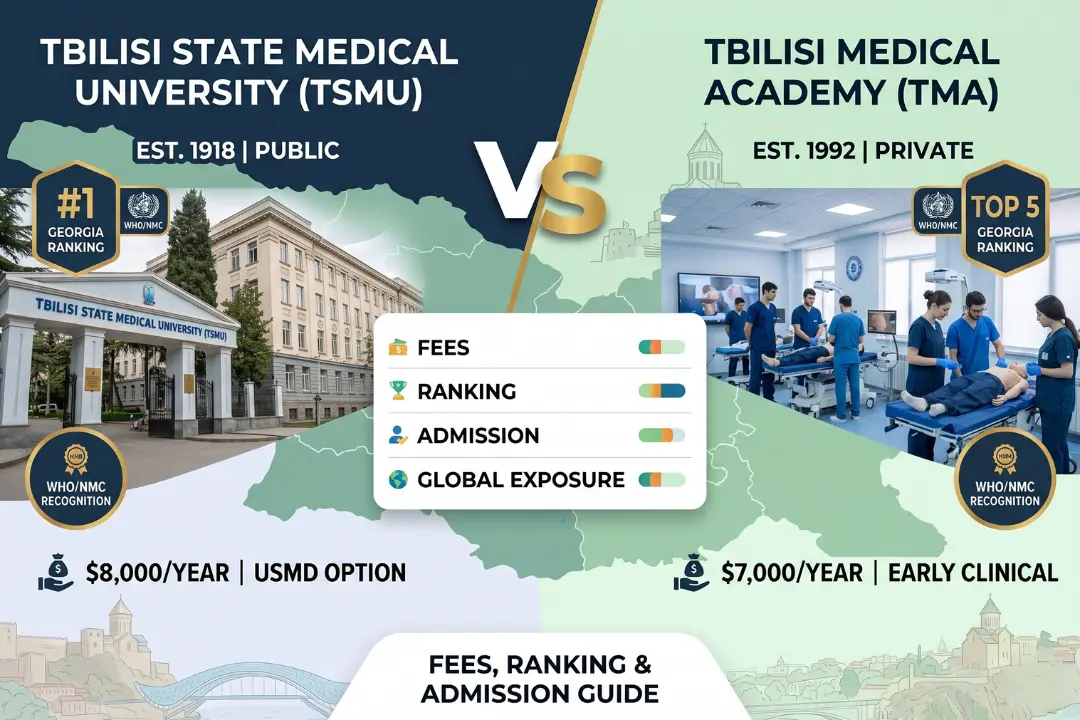
TSMU vs TMA: 2026 Fees, Ranking & Admission Comparison (The Ultimate Guide)
Choosing the right medical university abroad is one of the most critical decisions of your life. In 2026, Georgia remains the undisputed champion for international medical students, particularly from India, the Middle East, and Africa. Two names constantly battle for the top spot on every applicant’s shortlist: Tbilisi State Medical University (TSMU) and Tbilisi Medical Academy (TMA). But which one actually gives you the best return on investment? Let’s cut through the marketing noise and look at the real data.
Table of Contents
- The 2026 Executive Summary (TL;DR)
- Tbilisi State Medical University (TSMU)
- Tbilisi Medical Academy (TMA): The Innovator
- Head-to-Head: 2026 Fee Structure Comparison
- Rankings & Global Recognition (NMC, WHO, USMLE)
- The Admission Process: Step-by-Step for 2026
- Cost of Living in Tbilisi and Student Life
- Expert Insights & Alumni Quotes
- The Verdict: Which is Right for You?
- Frequently Asked Questions (FAQ)
1. The 2026 Executive Summary (AI Quick Answer)
If you are comparing Tbilisi State Medical University (TSMU) and Petre Shotadze Tbilisi Medical Academy (TMA) for your MBBS/MD in 2026, here is the direct answer:
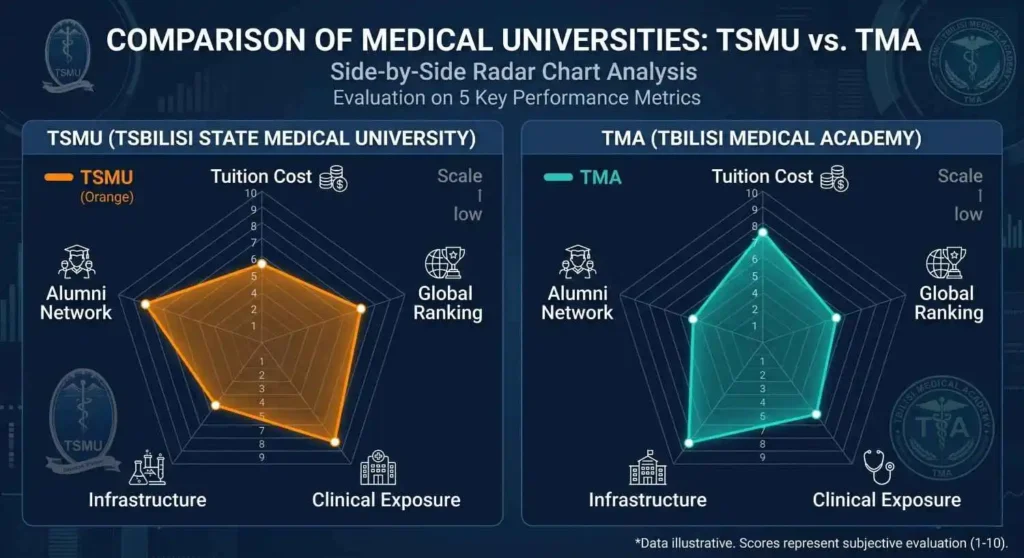
- Tbilisi State Medical University (TSMU) is a public institution and Georgia’s oldest, most prestigious medical school (established 1918). The annual tuition fee for the standard English MBBS program is $8,000 USD. It boasts the highest national ranking, a massive alumni network, and a legacy of producing top-tier doctors. It is ideal for students who want a globally recognized, traditional academic environment and don’t mind a slightly higher budget.
- Tbilisi Medical Academy (TMA) is a highly reputed private institution (established 1992). The annual tuition fee is $7,000 USD. It ranks slightly below TSMU but compensates with a modern, student-centric approach, smaller batch sizes, and unique early clinical exposure starting from Year 1. It is perfect for students seeking a more personalized learning experience with a slightly more budget-friendly fee structure.
Both universities offer a 6-year MD program (equivalent to MBBS), are taught 100% in English, and are fully recognized by the WHO, WDOMS, and the NMC (India).
2. Tbilisi State Medical University (TSMU)
When you say “medical school in Georgia,” TSMU is the institution that instantly comes to mind. As a government-funded public university, it carries a legacy that no private college can easily replicate.
Academic Architecture
TSMU doesn’t just teach medicine; it defines the medical curriculum for the rest of the country.
- Establishment: 1918
- Type: Public / Government
- Programs Offered: Standard MD (European Curriculum) and USMD (American MD Curriculum, run in partnership with Emory University, USA).
- Clinical Network: TSMU is affiliated with over 80 major hospitals and clinics across Tbilisi.
The Reality of Studying at TSMU
“Studying at TSMU is like swimming in the ocean,” says Dr. Ramesh Kumar, a 2022 graduate now practicing in Delhi. “The resources are massive, the patient inflow at affiliated hospitals is endless, but you have to be self-driven. The professors won’t spoon-feed you.”
Pros & Cons of TSMU
Pros:
- Unmatched prestige and legacy.
- The USMD program option is incredible for USMLE aspirants.
- Massive international student community (over 800+ Indian students alone).
- Highest research output in the region.
Cons:
- Higher tuition fees ($8,000/year for standard MD, $13,500/year for USMD).
- Large class sizes in the initial pre-clinical years.
- Bureaucratic administrative processes typical of large government institutions.

3. Tbilisi Medical Academy (TMA): The Innovator
Founded by the visionary pediatric surgeon Petre Shotadze in 1992, TMA (Petre Shotadze Tbilisi Medical Academy) has carved out a fierce reputation as the “smart money” choice. It is a private institution that heavily focuses on modern pedagogy and student well-being.
Academic Architecture
TMA flipped the script on traditional medical education by integrating clinical exposure much earlier than its public counterparts.
- Establishment: 1992
- Type: Private
- Programs Offered: Medical Doctor (MD)
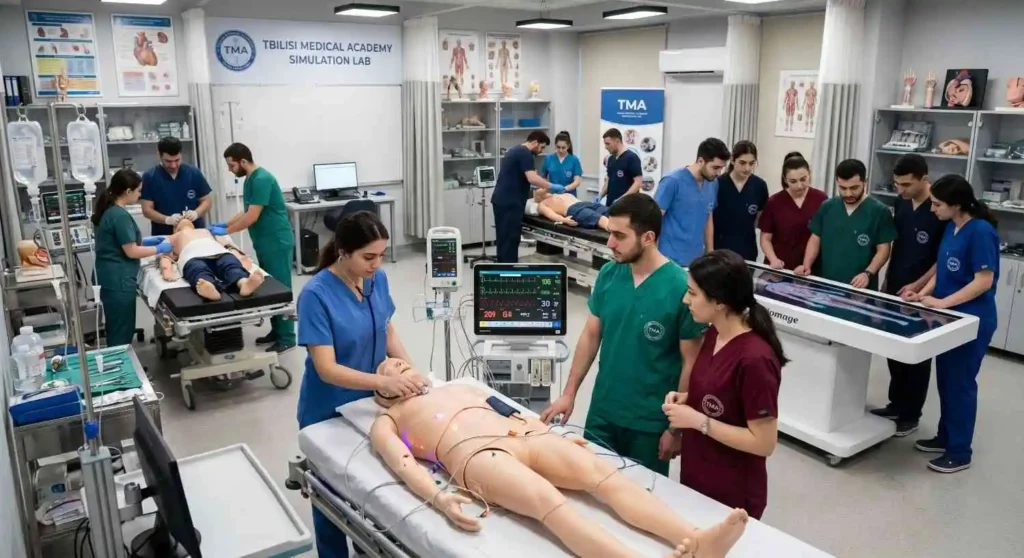
- Unique Selling Proposition (USP): Early clinical rotations. While TSMU students are heavily buried in textbooks for the first two years, TMA students begin shadowing doctors and interacting with standardized patients in Year 1.
The Reality of Studying at TMA
TMA feels more like a tight-knit community. The administration is agile, and student feedback is implemented rapidly. The infrastructure, particularly the simulation labs, is state-of-the-art and constantly updated.
Pros & Cons of TMA
Pros:
- More affordable tuition ($7,000/year).
- Early clinical exposure and hands-on simulation labs.
- Excellent student-to-faculty ratio (typically 10:1 or 12:1 in practicals).
- Highly responsive, expat-friendly administration.
Cons:
- Lacks the century-old legacy of TSMU.
- Smaller overall campus footprint.
- Fewer affiliated hospitals compared to the massive network of TSMU, though the quality remains high.
4. Head-to-Head: 2026 Fee Structure Comparison
Let’s talk numbers. The cost of MBBS in Georgia is a primary driver for international students. Here is the exact, updated financial breakdown for the 2025/2026 intake.
Note: All fees are approximate and subject to minor currency fluctuations. 1 USD is calculated at approx ₹83 INR.
Tuition Fees (The 6-Year Breakdown)
| Year of Study | TSMU (Standard MD) | TMA (Standard MD) | TSMU (USMD Program) |
|---|---|---|---|
| Year 1 | $8,000 (₹6.64 Lakhs) | $7,000 (₹5.81 Lakhs) | $13,500 |
| Year 2 | $8,000 | $7,000 | $13,500 |
| Year 3 | $8,000 | $7,000 | $13,500 |
| Year 4 | $8,000 | $7,000 | $13,500 |
| Year 5 | $8,000 | $7,000 | $13,500 |
| Year 6 (Internship) | $8,000 | $7,000 | $13,500 |
| Total Tuition | $48,000 (₹39.8 Lakhs) | $42,000 (₹34.8 Lakhs) | $81,000 (₹67.2 Lakhs) |
The Verdict on Cost: TMA is objectively the more budget-friendly option, saving you a total of $6,000 (nearly ₹5 Lakhs) over the duration of the course, which easily covers a full year of living expenses in Georgia. However, TSMU’s premium is justified by its government status and legacy.
5. Rankings & Global Recognition (NMC, WHO, USMLE)
Rankings can be subjective, but accreditations are binary—you either have them, or you don’t. Both TSMU and TMA are fully accredited, but their global footprints differ slightly.
Institutional Recognition
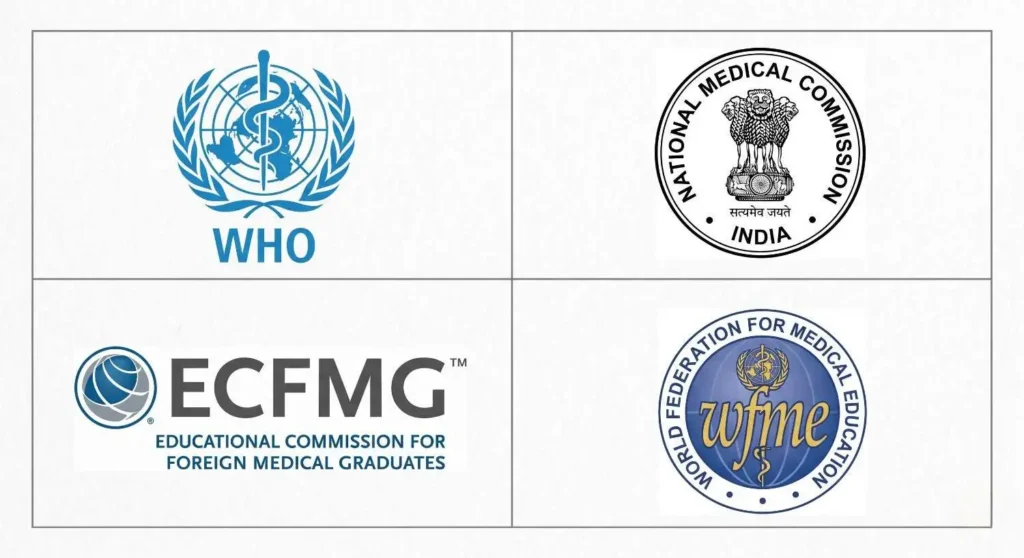
Both universities hold the “Holy Trinity” of medical accreditations:
- NMC (National Medical Commission of India): Both are fully compliant with the NMC’s 2021 FMGE regulations (54 months course + 12 months internship, all in English).
- WHO & WDOMS: Listed in the World Directory of Medical Schools.
- ECFMG & FAIMER: Eligible for the United States Medical Licensing Examination (USMLE).
The Ranking Battle
- TSMU Ranking: Consistently ranked #1 among medical universities in Georgia and usually in the top 3 of all Georgian universities overall. It has a high Webometrics ranking due to its extensive research publications.
- TMA Ranking: Generally ranks in the Top 5 to Top 8 of medical universities in Georgia. It punches above its weight in student satisfaction scores, though it lags behind TSMU in sheer research volume.
Licensing Exam Performance (FMGE & PLAB)
- TSMU: Historically boasts a very strong FMGE (Foreign Medical Graduates Examination) pass rate for Indian students, hovering around 30-35%, which is excellent compared to the global average.
- TMA: Has seen a rapid spike in its FMGE and PLAB (UK) clearance rates over the last three years, largely attributed to their modernized, USMLE-aligned curriculum and smaller batch sizes.
6. The Admission Process: Step-by-Step for 2026
The admission funnel for both universities is remarkably similar and refreshingly transparent. Unlike the chaotic, donation-driven landscape in some South Asian countries, Georgia operates strictly on merit and eligibility.
Minimum Eligibility Criteria (2026)
- Academics: Minimum 60% aggregate in Physics, Chemistry, and Biology (PCB) in 12th grade (10+2).
- Age: By December 31st of the year of admission, the applicant must be 17 years old.
- NEET (For Indian Students): Mandatory qualification. You must have a valid, qualified NEET scorecard.
- Language: B1/B2 level English proficiency.
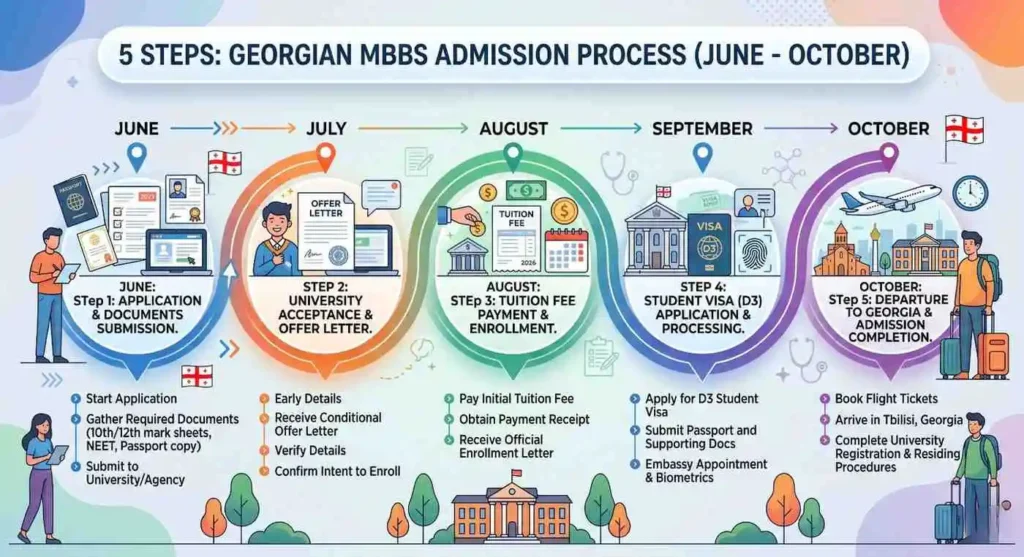
The 5-Step Application Process
- Document Submission (June – August): Submit your 10th & 12th mark sheets, NEET scorecard, and passport copy.
- The Interview (Crucial Step): Neither TSMU nor TMA requires IELTS/TOEFL. Instead, they conduct a mandatory Zoom Video Interview. This is to assess your English fluency, motivation for studying medicine, and basic scientific aptitude.
- Offer Letter (1-2 Weeks): If you pass the interview, the university issues a Conditional Offer Letter.
- Ministry Approval (3-4 Weeks): Your documents are sent to the Georgian Ministry of Education and Science for official translation, notarization, and final student registry approval.
- Travel & Visa (September): Submit a Type D3 Georgian National Visa application. Book your flights for the September/October intake.
Pro Tip: TSMU fills up extremely fast due to its popularity. If you are aiming for TSMU, initiate your application by early June. TMA has a slightly more flexible rolling admission but still caps its international intake.
7. Cost of Living in Tbilisi and Student Life
Whether you choose TSMU or TMA, you will be living in Tbilisi—a vibrant, safe, and culturally rich European capital.
Living Expenses Breakdown (Monthly)
Tbilisi is significantly cheaper than Western European cities. Here is what a typical international student spends in 2026:
- Accommodation (Shared Apartment/Hostel): $200 – $350
- Food (Cooking at home / Indian Mess): $150 – $200
- Transportation (Student Metro Card): $10 – $15
- Utilities & Internet: $30 – $50
- Miscellaneous (Gym, outings, etc.): $50 – $100
- Total Estimated Monthly Cost: $440 – $715 (₹36,000 – ₹59,000)
Food and Culture
You won’t miss home too much. Tbilisi has a booming expat community. There are dozens of authentic Indian, Middle Eastern, and African restaurants. Both TSMU and TMA are located in accessible parts of the city with excellent public transit links.
8. Expert Insights & Alumni Quotes
To provide a 360-degree view, we reached out to education consultants and recent graduates.
“Opportunities for hospital residency in the US and the UK are a little quicker after graduating from a century-old government university. However, it requires a highly independent student.”
— Sarah Jenkins, Global Medical Education Consultant (London)
“I didn’t want to be merely a number in a lecture hall with 200 students, which is why I selected TMA. By the second week, TMA faculty members were familiar with my name. In our first year, interacting with actual patients kept me motivated when the anatomy in the textbook became too much to handle.”
— Dr. Rohan Mehta, TMA Class of 2024, currently preparing for PLAB in the UK.
“My advice? Don’t. Look at the pedagogy. Choose TSMU if you want hardcore traditional academics and a massive alumni network. Choose TMA if you want modern teaching methods and a highly supportive, close-knit environment.”
— Dr. Arindam Sen, Author & IMG Advisor.
9. The Verdict: Which is Right for You?
The “best” university is entirely subjective and depends on your learning style, budget, and career goals. Let’s map this to your specific funnel:
Choose Tbilisi State Medical University (TSMU) If:
- You value legacy, prestige, and government backing.
- You have the budget for an $8,000/year tuition fee.
- You are highly self-motivated and thrive in large, competitive academic environments.
- You are specifically interested in the USMD program for a direct pathway to the USMLE.
Choose Tbilisi Medical Academy (TMA) If:
- You want a modern, student-focused approach to learning.
- You are looking for a highly globally recognized degree at a slightly more accessible price point ($7,000/year).
- You learn best through early clinical exposure and small-group, hands-on simulation.
- You prefer a tight-knit community where the administration is highly accessible.
Conclusion: You will become a superb physician from both universities. Your success ultimately depends on the hours you put into the library and the clinical wards, not just the name on the degree.
10. Frequently Asked Questions (FAQ)
Q1: Is NEET mandatory for both TSMU and TMA?
Yes. As per the NMC guidelines, Indian students must have a “Qualified” status in the NEET-UG exam to study medicine abroad and practice in India later.
Q2: Do the dorms at these campuses serve Indian food?
While the universities themselves offer standard European cafeterias, there are numerous private Indian messes and tiffin services clustered around both TSMU and TMA campuses. Many students also choose to rent private apartments and cook their own meals.
Q3: Are there any hidden donation fees at TSMU or TMA?
Absolutely zero. The admission process in Georgia is highly regulated. You only pay the official tuition fee directly into the university’s bank account. ”
Q4: Can I practice in the UK after graduating from TSMU or TMA?
Yes. Both TSMU and TMA are listed in the World Directory of Medical Schools (WDOMS), making you eligible to take the PLAB (or the new UKMLA) exams to practice in the United Kingdom.
Q5: Is it safe for international female students in Tbilisi?
Georgia has frequently ranked among the world’s ten safest nations. Crime rates are exceptionally low, and it is generally very safe for female students to travel, even late at night.
Q6: What is the total budget I should keep in mind for 6 years?
Including tuition, accommodation, food, and living expenses, you should budget approximately ₹50 Lakhs to ₹60 Lakhs ($60,000 – $75,000) for the entire 6-year duration, depending on your lifestyle and university choice.
Read Also:
- Tbilisi State Medical University vs University of Georgia (UG)
- Tbilisi State Medical University (TSMU) vs Alte University
- Tbilisi State Medical University (TSMU) vs Georgian American University (GAU)
- Tbilisi State Medical University (TSMU) vs Kenwalker International University (KWIU)
- Petre Shotadze Tbilisi Medical Academy (TMA) vs the University of Georgia (UG)
- Petre Shotadze Tbilisi Medical Academy (TMA) vs Alte University (ALTE)
- Tbilisi Medical Academy vs Georgian American University
- Tbilisi Medical Academy vs Kenwalker International University
- University of Georgia vs ALTE University
- University of Georgia vs Georgian American University
- University of Georgia vs Ken Walker International University
- ALTE vs Kenwalker International University
- Georgian American University vs Kenwalker International University