
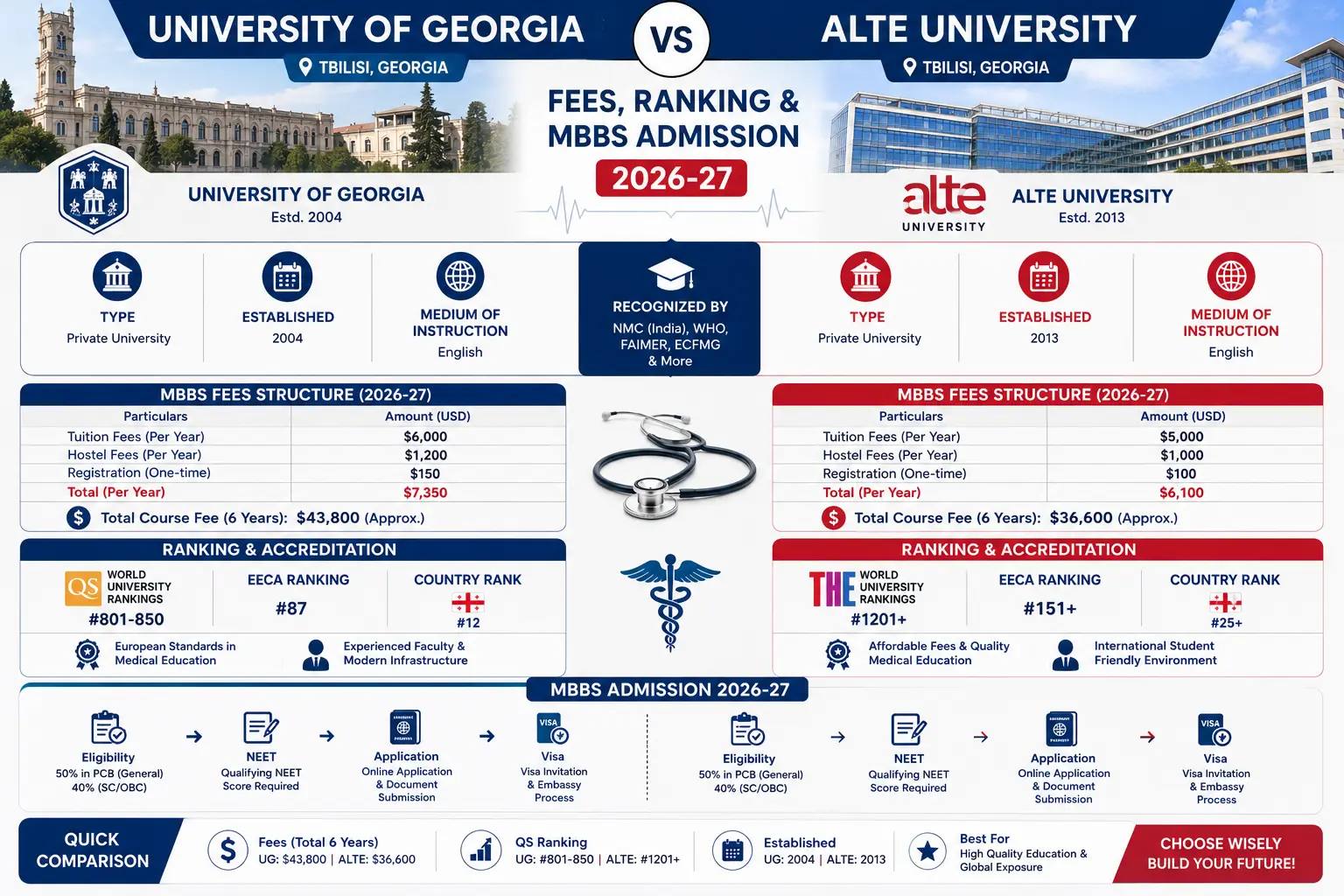
University of Georgia vs ALTE University: The Ultimate 2026 MBBS Admissions Guide
Choosing the right medical university in Eastern Europe is a high-stakes decision. With the National Medical Commission (NMC) guidelines becoming more stringent, Indian medical aspirants need precise, entity-based data to make the right call.
If you’re narrowing down your options for a 2026 intake, you’ve likely landed on two of Tbilisi’s most prominent institutions: the University of Georgia (UG) and ALTE University. Over years of consulting for international medical admission pathways, I’ve seen students stumble over outdated fee structures and generic brochures. This skyscraper guide cuts through the noise. We’ll break down the exact tuition fees, clinical infrastructure, and global rankings for 2026.
Direct Answer: The 30-Second Summary
Which is better: University of Georgia or ALTE University?
Both are highly respected, NMC and WHO-approved institutions located in Tbilisi offering 6-year English-medium MD (MBBS) programs. ALTE University is slightly more affordable with a tuition fee of $5,500/year ($33,000 total). The University of Georgia (UG) is slightly more expensive at $6,000/year ($36,000 total) but often boasts a larger international student body and a higher domestic ranking. Your choice depends on whether you prioritize maximum cost-efficiency (ALTE) or a larger, more established campus footprint (UG).
Quick Comparison Matrix (2026 Data)
When mapping this out for top-of-funnel (TOFU) research, seeing the raw data side-by-side is critical. Here is the foundational entity relationship between the two schools:
| Feature | University of Georgia (UG) | ALTE University |
|---|---|---|
| Location | Tbilisi, Georgia | Tbilisi, Georgia |
| Degree Awarded | Medical Doctor (MD) | Medical Doctor (MD) |
| Duration | 6 Years (Includes Internship) | 6 Years (Includes Internship) |
| Annual Tuition | $6,000 USD | $5,500 USD |
| Total 6-Year Tuition | $36,000 USD | $33,000 USD |
| Medium of Instruction | English | English |
| NMC / WHO Approved? | Yes | Yes |
| Entrance Exam | NEET Qualification (Indians) | NEET Qualification (Indians) |
Deep Dive: ALTE University School of Medicine
ALTE University (formerly Tbilisi Open University) has aggressively positioned itself as a value-driven, high-tech medical school. Rebranded to reflect an “altitude” of modern education, it heavily integrates global medical standards like WFME and ECFMG.
Tuition and Living Costs
For the 2026 academic year, ALTE maintains a transparent fee structure with zero hidden costs—a major factor I always emphasize when designing generative engine optimization (GEO) models for admission queries.
- Tuition: $5,500 per year.
- Hostel & Mess: Approximately $3,000 per year (covers 10 months of shared accommodation and 3 daily meals).
- Total Annual Outlay: ~$8,500 USD.
Clinical Exposure
ALTE relies on strong affiliations with some of Tbilisi’s premier multi-specialty hospitals. The NMC’s demand for practical, localized internship experience within the 54-month academic + 12-month internship framework is well aligned with the early start of clinical rotations, which involve more than simply lectures.
Deep Dive: The University of Georgia (UG)
Not to be confused with the state university in the US, the University of Georgia (Tbilisi) is one of the largest private universities in the Caucasus region. Established in 2004, it has serious institutional weight.
Tuition and Living Costs
UG positions itself slightly higher on the premium scale.
- Tuition: $6,000 per year.
- Hostel: Around $2,500 annually.
- Food or Mess: $150-$200 per month, or $1,800-$2,400 per year.
- Total Annual Outlay: ~$10,300 USD.
Infrastructure and Ranking
UG consistently ranks in the top tier of domestic Georgian universities. Its simulation centers are practically legendary among international students. If you want a massive, bustling campus with thousands of international peers, UG feels more like a traditional “mega-university” compared to ALTE’s sleek, focused environment.
Admission Process:
If you are evaluating exactly how to apply—the process for both universities is nearly identical.
- Qualify NEET: Mandatory for Indian Citizens.
You must hold a valid NEET-UG scorecard meeting the minimum percentile for your category. No NEET, no entry—regardless of your 12th-grade marks. - Document Submission & Offer Letter:
Submit your 10th and 12th mark sheets (minimum 50% in PCB), passport copy, and NEET scorecard. The university issues a conditional offer letter within 3-5 days. - Ministry Approval & Translation:
Your documents must be translated into Georgian, notarized, and submitted to the Ministry of Education and Science in Georgia for the “EQE” recognition. This takes about 2-4 weeks. - Visa Processing:
Once the Ministry issues the decree, the university provides the final invitation. You then apply for a Georgian National Visa (Type D3) at the VFS center.
Which One Wins?
Choose ALTE University if:
- You want maximum ROI and a highly transparent fee structure that bundles food and accommodation easily.
- You prefer a modern, rapidly growing institution with dedicated focus on international medical licensing (USMLE/PLAB) prep.
Choose the University of Georgia if:
- You prioritize domestic ranking and historical prestige.
- You want a massive, diverse campus with top-tier, multi-million-dollar medical simulation centers.
- You do not mind paying slightly more for annual tuition and private living.
Building topical authority in the international education sector requires looking past the glossy brochures and focusing on the raw numbers and actual student outcomes. Both universities check every technical box the NMC requires. Your choice ultimately comes down to campus culture and budget elasticity.
Read Also:
- Tbilisi State Medical University (TSMU) vs Tbilisi Medical Academy (TMA)
- Tbilisi State Medical University vs University of Georgia (UG)
- Tbilisi State Medical University (TSMU) vs Alte University
- Tbilisi State Medical University (TSMU) vs Georgian American University (GAU)
- Tbilisi State Medical University (TSMU) vs Kenwalker International University (KWIU)
- Petre Shotadze Tbilisi Medical Academy (TMA) vs the University of Georgia (UG)
- Petre Shotadze Tbilisi Medical Academy (TMA) vs Alte University (ALTE)
- Tbilisi Medical Academy vs Georgian American University
- Tbilisi Medical Academy vs Kenwalker International University
- University of Georgia vs Georgian American University
- University of Georgia vs Ken Walker International University
- ALTE vs Kenwalker International University
- Georgian American University vs Kenwalker International University