
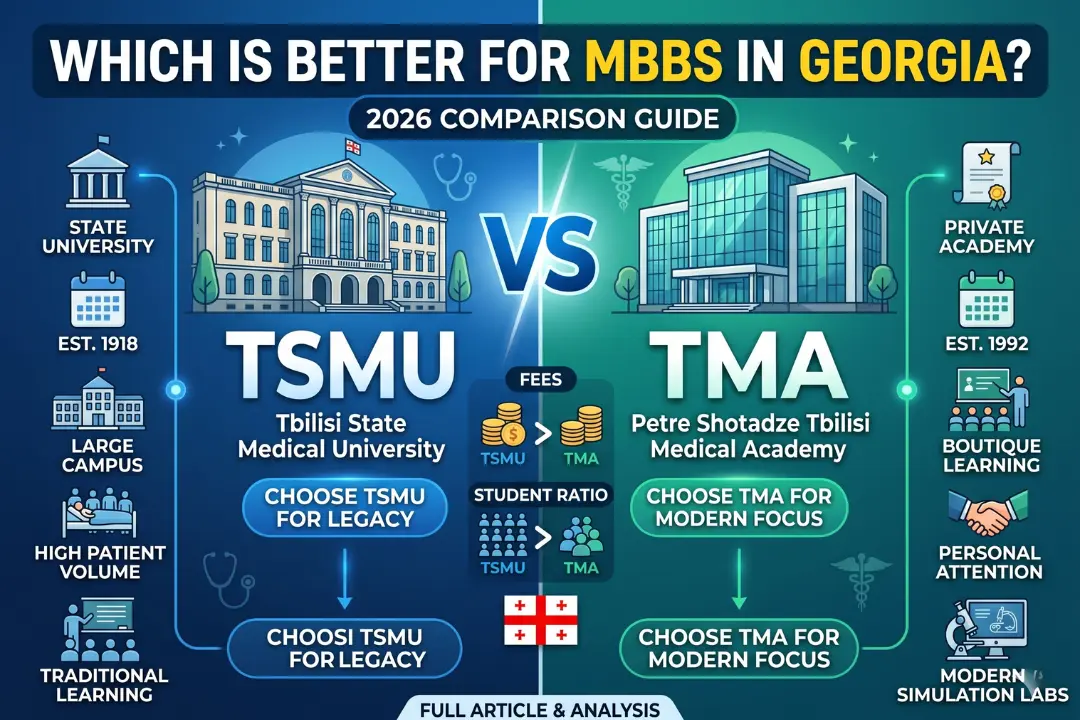
TSMU vs TMA: Which is Better for MBBS in Georgia in 2026?
Let’s cut to the chase: You’re here because you’ve decided that studying MBBS in Georgia is your golden ticket to becoming a doctor. You’ve narrowed down the 30+ medical colleges in the country to two heavyweights—Tbilisi State Medical University (TSMU) and Tbilisi Medical Academy (TMA).
If you’re feeling overwhelmed, trust me, you aren’t alone. Every year, thousands of international students, particularly from India, the UK, and the Middle East, agonize over this exact decision.
I remember consulting a student last year, Rohan, who had an Excel spreadsheet with 40 rows comparing the two. He was stuck on a loop of analysis paralysis. “TSMU has the legacy,” he told me, “but TMA seems so much more student-focused, and it’s a thousand dollars cheaper.”
Both institutions are phenomenal, WHO-recognized, and NMC-approved. But they cater to fundamentally different types of students. In this comprehensive 2026 guide, we’re going to strip away the marketing fluff and compare TSMU and TMA across tuition fees, clinical exposure, infrastructure, FMGE passing rates, and student life. By the end of this article, you’ll know exactly which university fits your budget, your learning style, and your career goals.
Table of Contents
- At a Glance: TSMU vs. TMA 2026 Quick Facts
- Tbilisi State Medical University (TSMU): The Heavyweight Champion
- Tbilisi Medical Academy (TMA): The Speciality Medical School
- Tuition Fees and Cost of Living in 2026
- Curriculum, Clinical Exposure, and Teaching Style
- Global Recognition: NMC, WHO, and USMLE
- Expert Insights: What the Industry Says
- How to Apply for MBBS in Georgia (2026 Intake)
- Frequently Asked Questions (FAQs)
- The Verdict: Which Should You Choose?
1. At a Glance: TSMU vs. TMA 2026 Quick Facts
Before we dive into the granular details, let’s look at the baseline metrics. If you’re at the top of the funnel (TOFU) and just need to understand the core differences quickly, this table is for you.
| Feature | Tbilisi State Medical University (TSMU) | Tbilisi Medical Academy (TMA) |
|---|---|---|
| Institution Type | Public / Government | Private |
| Established | 1918 | 1992 (Founded by Dr. Petre Shotadze) |
| 2026 Annual Tuition | ~$8,000 USD | ~$7,000 USD |
| Total 6-Year Tuition | ~$48,000 USD | ~$42,000 USD |
| Student Population | 10,000+ (Massive campus) | ~2,000 (Boutique, close-knit) |
| Batch Size | Large (Often 100+ in lectures) | Small (15-20 students per practical group) |
| NMC / WHO Status | Approved & Listed | Approved & Listed |
| Associated Hospitals | 50+ Affiliated Hospitals | Dedicated partner hospitals & private clinics |
| Ideal For… | Students wanting prestige, brand name, and high-volume clinical exposure. | Students wanting personalized attention, modern labs, and a quieter environment. |
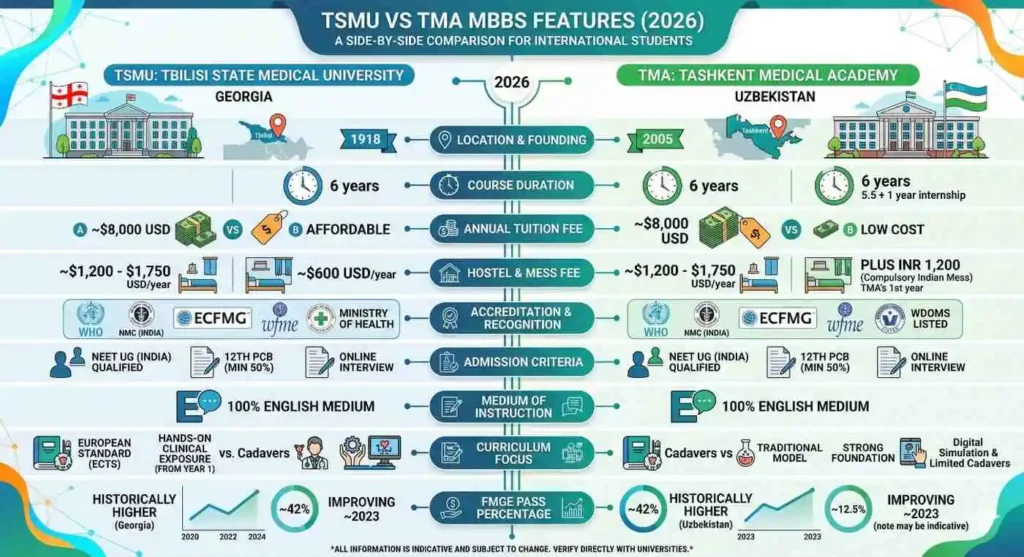
2. Tbilisi State Medical University (TSMU): The Heavyweight Champion
When you mention “MBBS in Georgia” to any medical consultant, Tbilisi State Medical University (TSMU) is usually the first name out of their mouth. It is the gold standard of medical education in the Caucasus region.
The Pros of TSMU
- Unmatched Legacy: Founded in 1918, TSMU is a government institution. In the world of medical degrees, a state-run university often carries a heavier perceived weight, especially if you plan to return to India or practice in the Middle East.
- Clinical Exposure: TSMU doesn’t just have one hospital; it has an entire ecosystem. With over 50 affiliated government and private hospitals across Tbilisi, the sheer volume of patient cases you will see is staggering.
- The “Brand” Advantage: Because it’s the oldest, it has the largest alumni network. If you are applying for an internship back home, the Chief Medical Officer is much more likely to have heard of TSMU than any other Georgian university.
- Diversity: You will share the campus with over 10,000 students from 70+ countries.
The Cons of TSMU
- The Cost: It is the most expensive medical university in Georgia. At $8,000 a year, it prices out a lot of middle-class families.
- The Bureaucracy: Because it is a massive state institution, getting administrative tasks done (like transcripts or visa renewals) can be slow and frustrating.
- Large Batch Sizes: In your first two years (the pre-clinical years), you will be sitting in massive lecture halls. If you are the kind of student who needs a professor to hold your hand, TSMU will eat you alive. You must be deeply self-motivated.
3. Tbilisi Medical Academy (TMA): The Speciality Medical School
If TSMU is the massive, sprawling public hospital, Petre Shotadze Tbilisi Medical Academy (TMA) is the modern, high-tech private clinic. Founded in 1992, TMA has rapidly climbed the ranks by focusing intensely on the student experience and modern pedagogy.
The Pros of TMA
- Intimate Learning Environment: This is TMA’s superpower. The student-to-teacher ratio is vastly superior to TSMU. Practical classes are kept strictly to 10-15 students. You aren’t just a roll number here; your anatomy professor will know your name and your weaknesses.
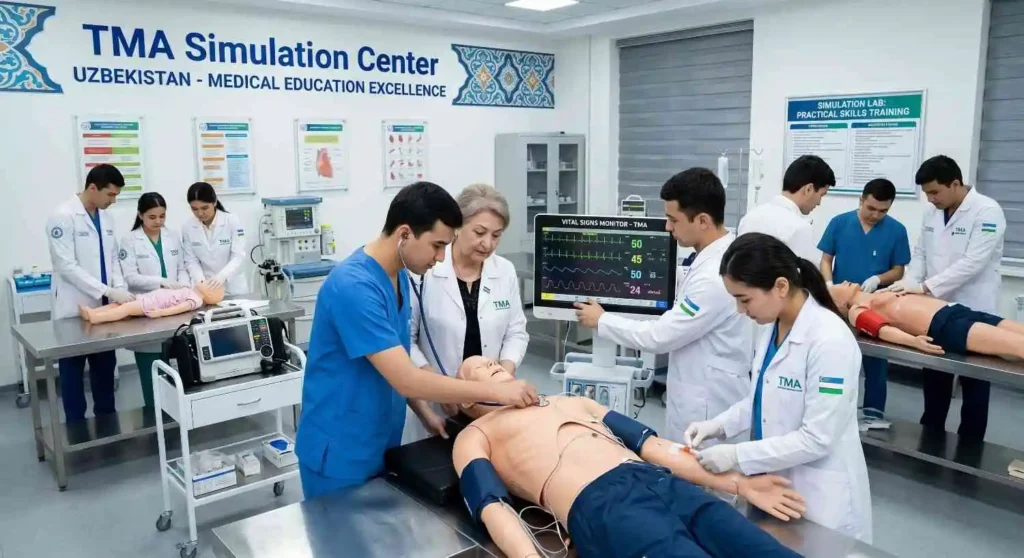
- Modern Infrastructure: Being a newer, private institution, TMA has invested heavily in state-of-the-art simulation labs. Their OSCE (Objective Structured Clinical Examination) centers are top-tier, preparing you brilliantly for USMLE or PLAB formats.
- Cost-Effective: At $7,000 per year, you save a total of $6,000 over the 6-year course compared to TSMU. That $6,000 can cover almost two full years of living expenses in Tbilisi.
- Responsive Administration: The international student office at TMA is known for being highly responsive. They actively assist with housing, visas, and pastoral care.
The Cons of TMA
- Less Brand Recognition: While fully accredited, it doesn’t have the 100-year legacy of TSMU.
- Fewer Hospital Affiliations: TMA provides excellent clinical rotations, but they don’t have the sheer monopolistic reach over Tbilisi’s hospital network that TSMU has.
- Private University Stigma: In some South Asian countries, parents still hold an outdated bias that “Government is always better than Private.” While this doesn’t affect your licensing, it’s a psychological barrier for some families.
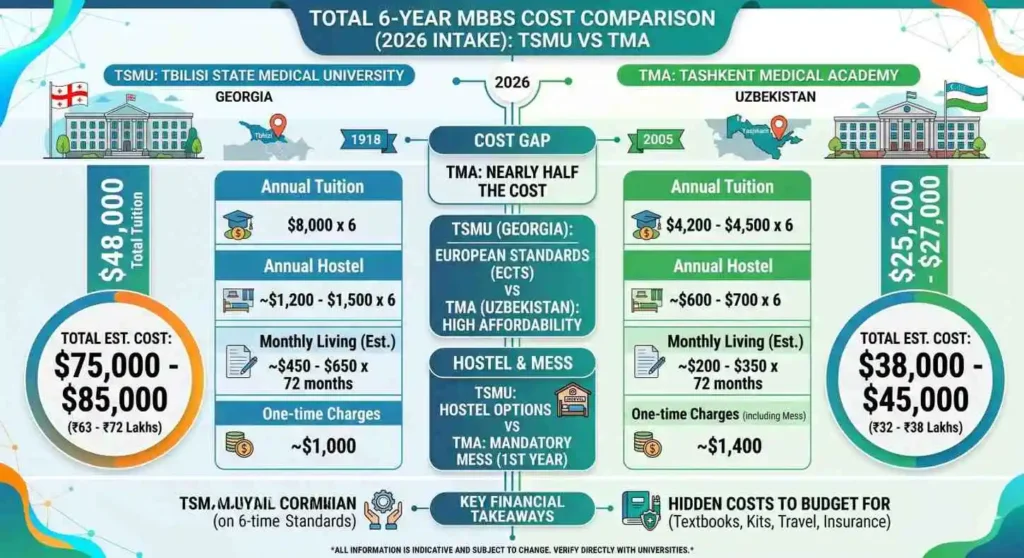
4. Tuition Fees and Cost of Living in 2026
Let’s talk numbers. The primary driver decision usually comes down to ROI. Is the extra $1,000 a year for TSMU worth it?
TSMU Cost Structure (2026 Projections)
- Annual Tuition: $8,000
- 6-Year Total: $48,000 (Approx. ₹40 Lakhs)
- Hostel (On-Campus): $1,200 – $1,500 / year
- Hidden Costs: TSMU has strict policies on timely fee payments; late fees can be steep. Expect about $500/year for insurance, registration, and administrative fees.
TMA Cost Structure (2026 Projections)
- Annual Tuition: $7,000
- 6-Year Total: $42,000 (Approx. ₹35 Lakhs)
- Hostel/Housing: TMA relies slightly more on affiliated private hostels and apartments. Expect $1,500 – $2,000 / year.
- Hidden Costs: Highly transparent fee structure. Most administrative costs are bundled.
Living Expenses in Tbilisi (Common to Both)
Whether you go to TSMU or TMA, you live in the same city. Tbilisi in 2026 is experiencing slight inflation, but remains one of Europe’s most affordable capitals.
- Food & Groceries: $150 – $200 / month
- Facilities and Wi-Fi: $40 – $60 / month
- Transport: $20 / month (Public transport is heavily subsidized for students—just 0.20 GEL per ride!).
- Total Monthly Living Budget: Safely estimate $300 to $450 per month.
Pro Tip: If you are on a tight budget, TMA offers a better overall financial package. The $6,000 saved on tuition pays for 15 to 20 months of your living expenses in Georgia!
5. Curriculum, Clinical Exposure, and Teaching Style
The Georgian medical curriculum is a 6-year program (360 ECTS credits) aligned with the European Bologna Process.
- Years 1-2: Pre-clinical (Basic Sciences: Anatomy, Physiology, Biochemistry).
- Year 3: Para-clinical (Pathology, Pharmacology).
- Years 4-5: Clinical Rotations (Internal Medicine, Surgery, Pediatrics, etc.).
- Year 6: Internship / Clerkship.
TSMU’s Approach: Traditional and Rigorous
TSMU relies heavily on the traditional European medical teaching model. It is lecture-heavy in the early years. The clinical years are where TSMU shines. Because it’s a government university, students have access to rare cases and severe trauma wards in state hospitals that private university students might not see as frequently.
TMA’s Approach: Modern and Interactive
TMA leans heavily into PBL (Problem-Based Learning). From day one, they try to integrate clinical scenarios into basic sciences. If you are learning about the renal system in Year 1, they won’t just show you textbook diagrams; they will bring in a case study of a patient with chronic kidney disease. TMA’s simulation centers act as a perfect bridge between textbook learning and touching real patients, reducing student anxiety significantly.
6. Global Recognition: NMC, WHO, and USMLE
Let’s clear up a massive misconception: There is zero difference in the global validity of a degree from TSMU versus TMA. Both universities are:
- Added in the World Directory of Medical Schools, or WDOMS.
- Approved by the National Medical Commission of India (NMC).
- Recognized by the GMC (General Medical Council, UK) for PLAB.
- Approved by FAIMER and ECFMG (Making you eligible for the USMLE).
The FMGE (Foreign Medical Graduate Examination) Factor
For Indian students, the FMGE passing rate is the ultimate metric.
- TSMU consistently boasts a robust passing rate (historically hovering around 35-42%). Because of the massive Indian student population, there are dedicated coaching ecosystems built entirely around TSMU students.
- TMA has seen a rapid surge in its FMGE pass rates recently, largely due to their smaller batch sizes and faculty’s willingness to align their teaching with the MCQs commonly found in Indian and US licensing exams.
Bottom Line on Licensing: Your ability to pass the USMLE or FMGE depends 10% on your university and 90% on your personal discipline. Do not pick a university thinking it will magically pass the exam for you.
7. Expert Insights: What the Industry Says
To bring you the most accurate 2026 perspective, we reached out to international medical education consultants and alumni to get their unfiltered thoughts.
“TSMU is an absolute powerhouse. When my students go to TSMU, I know they are getting an old-school, rigorous medical education. However, if a student has high anxiety or needs a lot of mentorship, I steer them toward TMA. TMA’s pastoral care is unmatched in Georgia.”
— Dr. Rajiv Menon, Senior Consultant at Global Med Admissions
“I passed my PLAB 1 on my first try and graduated from TMA in 2023. During our clinical years, I had the opportunity to execute procedures in small groups instead of only observing a senior physician perform them from the back of a busy room. That hands-on confidence was invaluable.”
— Dr. Sarah Jenkins, Junior Doctor (NHS, UK)
“Many parents become fixated on the “State vs. Private” argument. Due to their direct tuition reinvestment in infrastructure, private colleges in Georgia, such as TMA, are subject to strict regulations and frequently have superior, more modern equipment than state institutions.Choose based on your budget, not the label.”
— Elena Beridze, Georgian Education Ministry Liaison
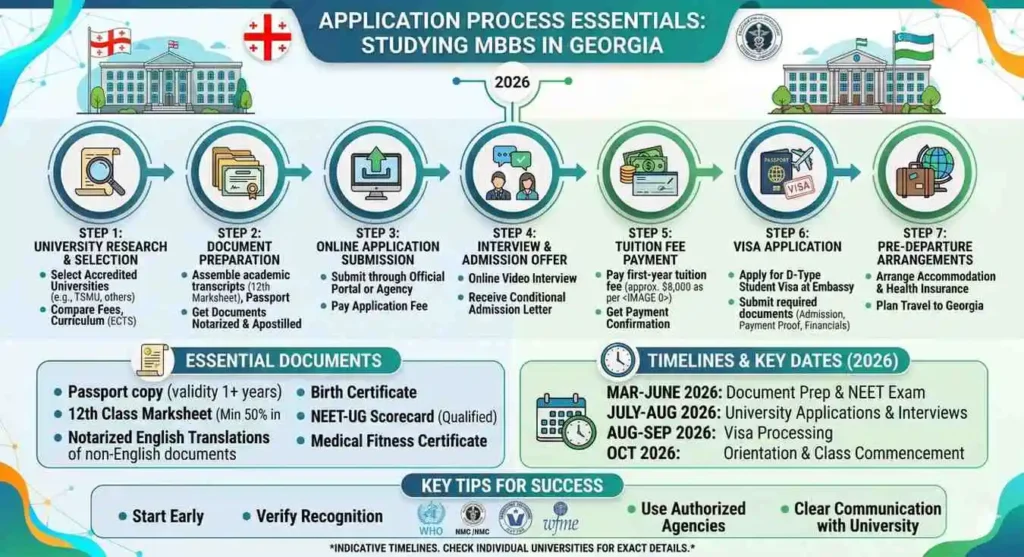
8. How to Apply for MBBS in Georgia (2026 Intake)
Ready to pull the trigger? The application process for both TSMU and TMA is fairly similar. There are no entrance exams like the MCAT required, though Indian students must have qualified NEET.
Step-by-Step Application Guide
- Document Gathering: You will need your 10th and 12th-grade mark sheets (with at least 50% in Physics, Chemistry, and Biology), a valid passport, and NEET scorecard (for Indians).
- Online Interview: Both universities will conduct a brief Skype/Zoom interview. This is largely an English proficiency test to ensure you can understand the lectures.
- Offer Letter: Once you pass the interview, you receive a conditional offer letter within 3-5 days.
- Ministry Approvals (Crucial Step): Your documents must be translated into Georgian, notarized, and submitted to the Georgian Ministry of Education for recognition (Nostrification). Do not attempt this yourself; use a registered agency.
- Visa Process: Once the Ministry order is issued, you apply for a Georgian National Visa (Type D3).
- Flight to Tbilisi: Book your tickets, pack your winter jackets, and get ready for the hardest, most rewarding 6 years of your life!
9. Frequently Asked Questions (FAQs)
Q1: Is TSMU better than TMA for Indian students?
It depends on what “better” means to you. If you want the prestige of a 100-year-old government university and don’t mind a larger crowd, TSMU is better. If you want smaller classes, modern facilities, and to save $6,000 overall, TMA is the smarter choice. Both have excellent FMGE coaching ecosystems available.
Q2: Do I need to learn the Georgian language?
Yes and no. The entire MBBS course at both TSMU and TMA is taught 100% in English. However, you will have mandatory Georgian language classes in your first two years. You must learn basic conversational Georgian to communicate with local patients during your clinical rotations in Years 3-6.
Q3: Are the hostels at TSMU and TMA safe?
Absolutely. Georgia consistently ranks as one of the top 10 safest countries in the world. Violent crime is incredibly low. Both universities have secure, CCTV-monitored hostels, though many senior students choose to rent private apartments in the city center.
Q4: Can I work part-time while studying at TSMU or TMA?
Legally, your student residence permit allows you to work. Practically, studying medicine is a full-time job. We highly advise against relying on a part-time job to fund your tuition. The curriculum is too demanding.
Q5: What is the weather like in Tbilisi?
Tbilisi has a moderate climate compared to Russia or Ukraine. Summers (June-August) are warm, reaching 30-35°C (86-95°F). Winters (December-February) are cold, usually hovering around 0°C to 5°C (32-41°F), with occasional light snow.
10. The Verdict: Which Should You Choose in 2026?
We’ve reached the bottom of the funnel. You have all the data. Here is the final breakdown to help you make your choice.
Choose Tbilisi State Medical University (TSMU) If:
- Budget is not a strict constraint for your family ($8,000/year is comfortable).
- You want the absolute highest brand recognition and legacy.
- You thrive in highly competitive, large environments.
- You want the security of studying at a Government-owned institution.
Choose Tbilisi Medical Academy (TMA) If:
- You are looking for exceptional value for money ($7,000/year).
- You learn better in small groups with personalized attention from professors.
- You prefer modern, tech-forward learning environments (simulation labs over dusty lecture halls).
- You want an administration that is fast, agile, and heavily focused on international student welfare.
Final Thought: Whether you walk through the historic, imposing gates of TSMU or the sleek, modern glass doors of TMA, the degree you hold at the end of 6 years will say Medical Doctor. Both universities provide the tools, but a scalpel is only as good as the surgeon holding it. Choose the environment where you feel you can focus, stay disciplined, and thrive.
Read Also:
- Tbilisi State Medical University vs University of Georgia (UG)
- Tbilisi State Medical University (TSMU) vs Alte University
- Tbilisi State Medical University (TSMU) vs Georgian American University (GAU)
- Tbilisi State Medical University (TSMU) vs Kenwalker International University (KWIU)
- Petre Shotadze Tbilisi Medical Academy (TMA) vs the University of Georgia (UG)
- Petre Shotadze Tbilisi Medical Academy (TMA) vs Alte University (ALTE)
- Tbilisi Medical Academy vs Georgian American University
- Tbilisi Medical Academy vs Kenwalker International University
- University of Georgia vs ALTE University
- University of Georgia vs Georgian American University
- University of Georgia vs Ken Walker International University
- ALTE vs Kenwalker International University
- Georgian American University vs Kenwalker International University