
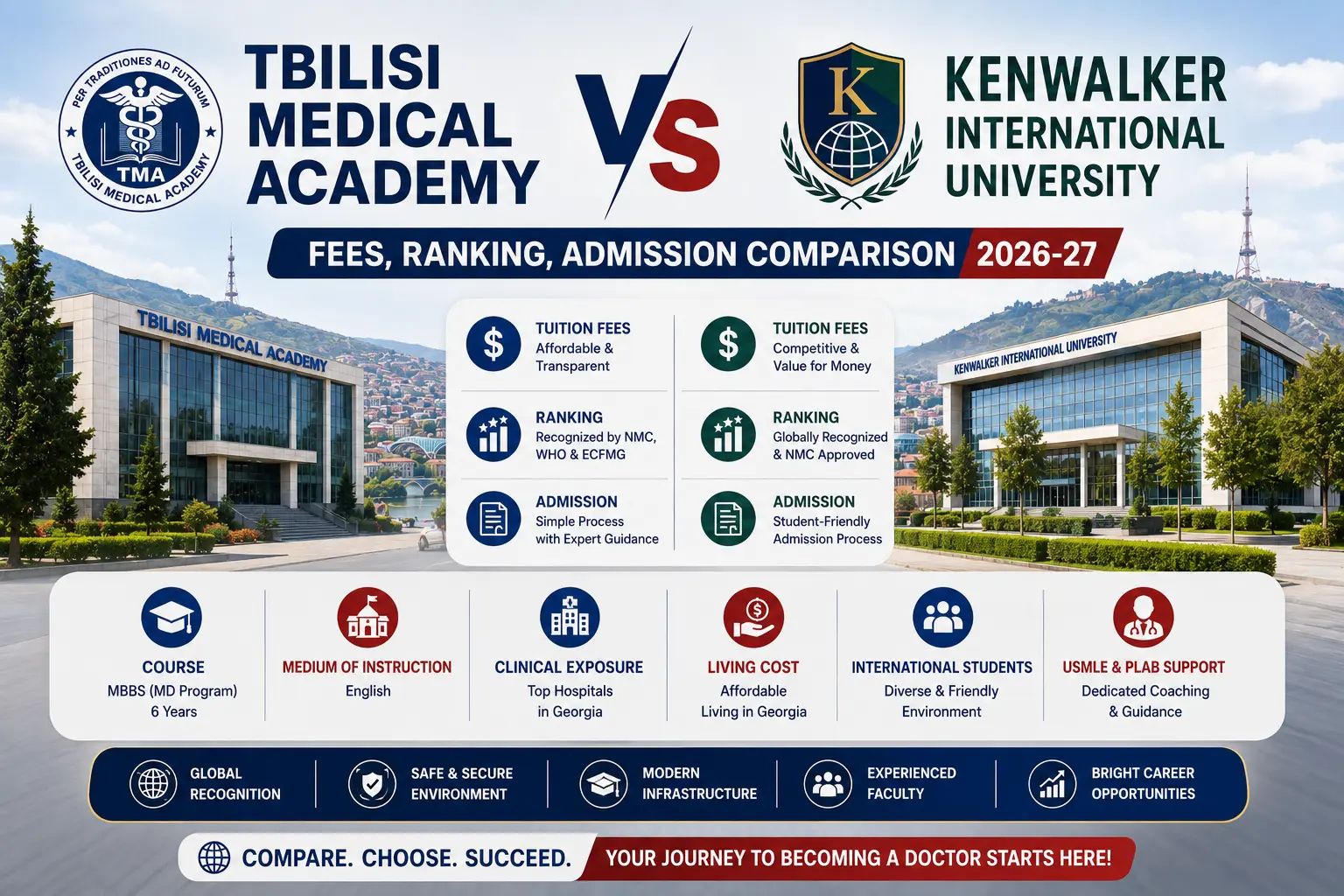
Tbilisi Medical Academy vs Kenwalker International University: Fees, Ranking, Admission Comparison 2026-27
Choosing the right medical university is one of the most critical decisions an aspiring doctor will ever make. If you’re looking at Georgia for your MBBS, you’ve likely narrowed your choices down to two prominent institutions: Petre Shotadze Tbilisi Medical Academy (TMA) and Ken Walker International University (KWIU).
Both universities are situated in the vibrant capital city of Tbilisi, teach entirely in English, and offer globally recognized degrees. However, their philosophies, fee structures, and campus cultures are strikingly different. TMA is a deeply established, medicine-only traditional academy, while KWIU is a relatively new, highly modernized institution built on American pedagogical models.
This comprehensive 2026-27 guide breaks down everything from tuition fees and global rankings to hospital affiliations, hostel life, and the hidden costs of living in Tbilisi. Whether you’re aiming for the FMGE/NExT in India, the PLAB in the UK, or the USMLE, we’ll map out which university aligns perfectly with your medical career trajectory.
Table of Contents
- The 2026-27 Medical Education Landscape in Georgia
- Petre Shotadze Tbilisi Medical Academy (TMA)
- Ken Walker International University (KWIU)
- Head-to-Head Comparison: TMA vs KWIU
- The Admission Process for 2026-27
- Life in Tbilisi: Cost of Living and Student Support
- Expert Verdict: Which Should You Choose?
- Frequently Asked Questions (FAQs)
The 2026-27 Medical Education Landscape in Georgia
Georgia has emerged as a medical school powerhouse in the recent decade, attracting a large demography of international students, especially from India, the UK and the Middle East. With annual tuition fees generally ranging from $4,500 to $8,000, it offers an incredible return on investment compared to private medical colleges in India or the United States.
For the 2026-27 academic session, the landscape is heavily defined by stricter clinical exposure guidelines set forth by the National Medical Commission (NMC) of India, and the new requirements from the World Federation for Medical Education (WFME). Both TMA and KWIU fully comply with these international benchmarks, offering a standard 6-year MD program (equivalent to MBBS) that comprises 360 ECTS credits, including a mandatory one-year clinical internship.
“International students are required to comply to WDOMS and WFME standards strictly. Mathematically speaking, graduating from a Georgian university that complies with regulations ensures the same PLAB or USMLE license prospects as graduating from a Western European institution, but at a far lower cost.” — Dr. Elena K., International Medical Licensing Consultant
Petre Shotadze Tbilisi Medical Academy (TMA): The Medicine-Only Pioneer
TMA is one of the oldest private medical schools in Georgia, founded in 1992 by pediatric surgeon Dr. Petre Shotadze. TMA is not a big multi-disciplinary university. TMA is a university that does one thing and one thing only: medicine.
This hyper-focused approach creates an environment steeped in traditional European medical pedagogy. If you want a university where every student you pass in the hallway is also studying for an anatomy practical or discussing clinical rotations, TMA is your place.
TMA 2026 Fee Structure
TMA’s pricing is at a premium to the national norm, which is indicative of the extensive hospital integrations and specialized faculty. Prepare for the new tuition bracket for 2026 intake.
- Annual Tuition Fee: ~$7,000 USD
- Total 6-Year Tuition: ~$42,000 USD (Approx. ₹35 Lakhs)
- Initial Administrative Costs: $500 – $1,000 USD (One-time fee covering visa processing, TRC, and medical insurance)
There are no hidden “donations” or capitation fees, despite the greater cost. The transparent fee structure guarantees that your tuition covers all academic instruction, laboratory use, and clinical rotation placements.
Rankings and Global Standing
Because TMA is a standalone medical academy rather than a broad research university, it doesn’t always dominate general academic rankings (like Webometrics). However, its standing within the medical community is undisputed.
- Country Rank: Top 35 overall, but consistently recognized as a Top 5 pure medical institute.
- Accreditations: WHO, NMC (India), FAIMER, WDOMS, and aligned with WFME standards.
- FMGE Pass Rate: Historically strong, hovering around 32-35%, which is significantly higher than the international average.
Campus & Clinical Infrastructure
TMA’s curriculum is heavily integrated into Tbilisi’s central hospital network. From the third year onward, students spend less time in the classroom and more time in the wards. The Center for Innovations in Medical Education (CIMED), which emphasizes cutting-edge simulation-based learning prior to students interacting with real patients, is another feature of the university.
Ken Walker International University (KWIU)
Established in 2019, KWIU is the new kid on the block—but it has arrived with serious pedigree. The university is named after Dr. Ken Walker, a legendary physician who played a massive role in modernizing Georgia’s healthcare system.
KWIU was established in strategic conjunction with Emory University School of Medicine, Atlanta, USA. This partnership isn’t just for show; it directly dictates KWIU’s curriculum, which is heavily modeled on American educational standards, making it highly attractive to students planning to sit for the USMLE.
KWIU 2026 Fee Structure
KWIU positions itself as an aggressively high-value option. Despite its modern infrastructure, the university has maintained highly competitive tuition rates to attract top international talent.
- Annual Tuition Fee: ~$4,800 to $5,800 USD (Depending on the specific scholarship and early enrollment tiers, usually averaging around $5,800 for late applicants).
- Total 6-Year Tuition: ~$34,800 USD (Approx. ₹29 Lakhs)
- Annual Hostel Fee (Optional but recommended): ~$1,750 USD
From a purely financial standpoint, KWIU offers direct tuition savings of nearly $7,000 over the course of the six-year program compared to TMA.
Rankings and Strategic Partnerships
Despite its recent founding, KWIU has rapidly climbed the national charts due to massive investments in facilities and international partnerships.
- Country Rank: Top 15 in Georgia (Growing rapidly).
- Accreditations: NMC, WHO, WFME, ECFMG, FAIMER, and the Ministry of Education (Georgia).
- The Emory Advantage: Students benefit from guest lectures from Emory University faculty, USMLE-focused curriculum design, and mentorship programs that are rare in the Caucasus region.
The American Curriculum Advantage
KWIU is built for the modern medical student. Classrooms are fully digital, and the university places a heavy emphasis on early clinical exposure. Students don’t wait until their third year to see how hospitals operate; observational clinical integration begins early.
Head-to-Head Comparison: TMA vs KWIU
To help you make an objective decision, let’s break down the data. We’ve compiled the critical metrics into two custom analysis graphics.
The Financial & ROI Matrix
| Metric | Tbilisi Medical Academy (TMA) | Ken Walker Int. University (KWIU) |
|---|---|---|
| Annual Tuition | $7,000 USD | $5,800 USD |
| 6-Year Total Tuition | $42,000 USD | $34,800 USD |
| Mandatory Hostel | No (Off-campus allowed) | No (Excellent on-campus options) |
| NMC Compliance | 100% Fully Compliant | 100% Fully Compliant |
| Medium of Instruction | 100% English | 100% English |
| Financial Verdict | Premium tier, traditional value | High ROI, exceptional cost-efficiency |
Pedagogy & Clinical Exposure
| Feature | Tbilisi Medical Academy (TMA) | Ken Walker Int. University (KWIU) |
|---|---|---|
| Founding Year | 1992 | 2019 |
| Campus Vibe | Traditional, Medicine-Only, Focused | Modern, Tech-Forward, Interdisciplinary |
| USMLE Focus | Moderate (More geared to European/UK) | Extremely High (Emory Univ. Partnership) |
| Clinical Exposure | Extensive network of partner hospitals | Modern simulation labs & 30+ partner clinics |
| Indian Student Base | Very Large (Established Indian mess/culture) | Rapidly growing (Dedicated 100+ seats) |
The Admission Process for 2026-27
Both universities have streamlined their admission processes to be highly accommodating to international students. There are two primary intakes: September (Autumn) and February (Spring), though the September intake is significantly larger and preferred for natural academic progression.
Eligibility Criteria
The requirements for Indian students are dictated not just by the Georgian universities, but by the strict mandates of the National Medical Commission (NMC) to ensure the degree is valid upon return.
- Academic Standing: Minimum 50% aggregate in Physics, Chemistry, and Biology (PCB) in 12th-grade board exams. (This drops to 40% for SC/ST/OBC reserved categories).
- NEET-UG: Absolutely mandatory for Indian citizens who wish to practice in India. You must possess a qualifying NEET scorecard (valid for 3 years for foreign admissions).
- Age Requirement: The applicant must be at least 17 years old by December 31st of the admission year.
- Language Proficiency: No formal IELTS or TOEFL is required. English proficiency is usually verified via the marks scored in the 12th-grade English subject and a brief online university interview.
The Document Checklist
A disorganized application can cost you a semester. Here is the exact document roadmap:
- 10th and 12th Marksheets (Original and Apostilled)
- Valid NEET Scorecard
- Original Passport (Minimum 18 months validity remaining)
- Birth Certificate (Apostilled)
- Medical Fitness Certificate (Including HIV/TB test results)
- Passport-sized photographs (Usually 3x4cm with white background)
- Bank statements (Proof of financial capacity, usually showing 6 months of history with ~₹3-4 Lakhs balance)
Pro-Tip: Start your Apostille process early. The Ministry of External Affairs (MEA) verification can take weeks during peak admission seasons (July-August).
Life in Tbilisi Georgia: Cost of Living and Student Support
Tuition is only half the equation; your daily living expenses dictate your actual lifestyle. Fortunately, Tbilisi is incredibly affordable compared to Western Europe, the US, or even major Indian metropolises like Mumbai or Delhi.
Estimated Monthly Breakdown in Tbilisi (2026):
- Accommodation: $150 – $300 USD. (Hostels are cheaper, but many students pool resources in their 3rd year to rent beautiful 3-bedroom apartments in the city center).
- Food and Groceries: $100 – $150 USD. (Indian mess facilities are ubiquitous at both TMA and KWIU, serving authentic dal makhani, paneer, and chicken curry).
- Utilities & Internet: $30 – $50 USD.
- Transport: $10 – $20 USD. (Public transit, including the metro and buses, is highly subsidized for students using travel cards).
Total Monthly Run Rate: Expect to spend around $250 to $350 USD (₹20,000 to ₹30,000) to live comfortably.
Tbilisi is also consistently ranked as one of the safest cities in Europe for expatriates and students, with extremely low rates of violent crime and a very welcoming local culture.
Expert Verdict: Which Should You Choose?
Both universities offer a legitimate, fully compliant pathway to becoming a licensed medical practitioner globally. The choice ultimately comes down to your personal learning style and financial strategy.
Choose Tbilisi Medical Academy (TMA) If:
- You revere tradition and want to study in an environment completely dedicated to the medical sciences without the distraction of other faculties.
- You want the reassurance of a 30+ year alumni network spread across the globe.
- You prioritize immediate access to a vast network of established local hospitals for clinical rotations.
- Your family budget comfortably accommodates the premium $7,000 annual tuition tier.
Choose Ken Walker International University (KWIU) If:
- You are aiming aggressively for the USMLE and want an American-style pedagogical framework backing your studies.
- You prefer modern, tech-forward infrastructure and brand-new simulation labs.
- You are looking for the absolute highest Return on Investment (ROI)—saving roughly $7,000 in tuition over 6 years without sacrificing any accreditations.
- You value a structured, modern campus with integrated, high-quality hostel facilities right from day one.
Ultimately, your success in the FMGE, PLAB, or USMLE will depend far more on your personal dedication and study habits over the six years than on which campus you choose.
Frequently Asked Questions (FAQs)
1. Is the MBBS degree from Georgia valid in India?
Yes. Both TMA and KWIU offer a 6-year MD program that is strictly aligned with the National Medical Commission (NMC) guidelines, including the mandatory internship year and English medium instruction. Graduates are fully eligible to sit for the FMGE/NExT.
2. Do I need to learn Georgian?
Your entire academic curriculum and all exams are conducted in 100% English. However, you will be taught conversational Georgian as a subject in your first two years so you can communicate effectively with local patients during your clinical rotations.
3. Is NEET absolutely required if I don’t want to return to India?
If you are an Indian citizen, holding a qualifying NEET scorecard is currently required by the NMC to study medicine abroad, regardless of where you ultimately plan to practice. This rule ensures baseline academic competency.
4. Can I work part-time while studying MBBS in Georgia?
Technically, student visas in Georgia may allow limited part-time work. However, the MBBS curriculum at both TMA and KWIU is incredibly rigorous. Experts strongly advise against part-time work, as it almost inevitably impacts academic performance and licensing exam preparation.
5. Are there hidden donation fees at these universities?
No. Both TMA and KWIU operate with transparent fee structures. There are no capitation fees or hidden “donations” required to secure a seat, unlike many private institutions in other regions.
For the most current 2026-27 admission deadlines and to begin your application process, ensure you consult the official university portals or verified, MEA-authorized educational consultants.
Read Also:
- Tbilisi State Medical University (TSMU) vs Tbilisi Medical Academy (TMA)
- Tbilisi State Medical University vs University of Georgia (UG)
- Tbilisi State Medical University (TSMU) vs Alte University
- Tbilisi State Medical University (TSMU) vs Georgian American University (GAU)
- Tbilisi State Medical University (TSMU) vs Kenwalker International University (KWIU)
- Petre Shotadze Tbilisi Medical Academy (TMA) vs the University of Georgia (UG)
- Petre Shotadze Tbilisi Medical Academy (TMA) vs Alte University (ALTE)
- Tbilisi Medical Academy vs Georgian American University
- University of Georgia vs ALTE University
- University of Georgia vs Georgian American University
- University of Georgia vs Ken Walker International University
- ALTE vs Kenwalker International University
- Georgian American University vs Kenwalker International University