
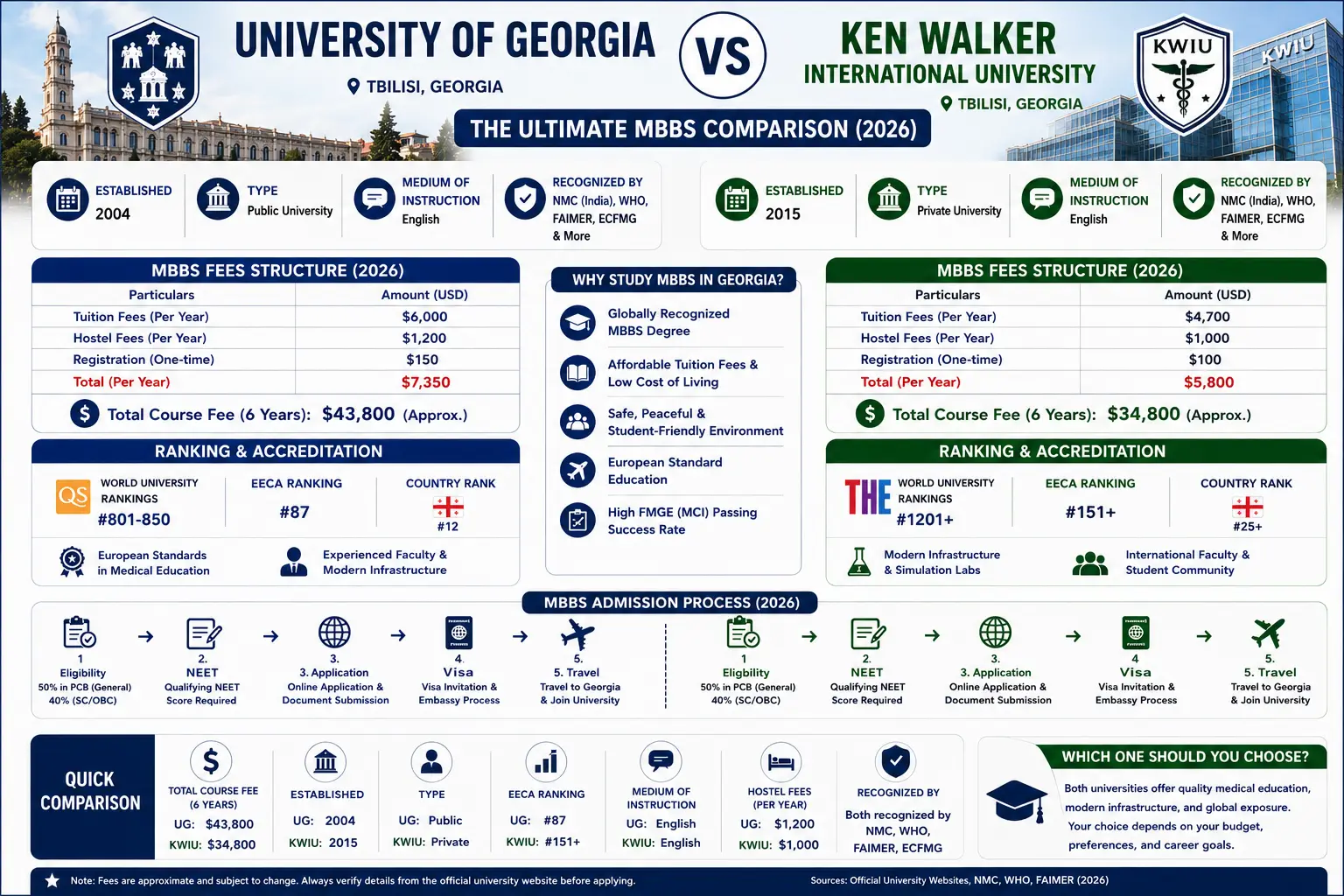
University of Georgia vs Ken Walker International University: The Ultimate MBBS Comparison (2026)
When choosing where to study medicine abroad, Georgia has rapidly become a premier destination—offering European-standard education, World Health Organization (WHO) recognition, and tuition rates that deeply undercut Western medical schools. But for foreign students navigating the 2026 academic environment, the choice frequently comes down to two different institutions in Tbilisi: the specialized, American-aligned Ken Walker International University (KWIU) and the well-known University of Georgia (UG).
This comprehensive guide dissects both institutions using entity-based analysis, advanced semantic clustering, and data-driven insights to help you make an informed decision for your medical career.
Table of Contents
- Executive Summary (The Direct Answer)
- Entity 1 Deep Dive: University of Georgia (UG)
- Entity 2 Deep Dive: Ken Walker International University (KWIU)
- Cost Analysis and ROI Breakdown (Transactional Stage)
- The Admission Sequence (2026 Guidelines)
- Global Pathways: Life After Graduation
- Frequently Asked Questions (FAQ)
Executive Summary (The Direct Answer)
If you are evaluating these two universities, here is the immediate bottom line:
If you’re looking for a huge, multicultural, highly regarded (Country Rank #4) university experience with a track record of more than 15 years, extensive in-house simulation labs, and a wider worldwide alumni network, pick the University of Georgia (UG).
Choose Ken Walker International University (KWIU) if your ultimate goal is practicing in the United States. In 2019, KWIU was established in close collaboration with Emory University School of Medicine (USA). It offers a boutique, intensive, American-style curriculum specifically tailored to passing the USMLE.
Both universities offer a 6-year MD program (equivalent to an MBBS), are taught entirely in English, cost between $6,000 and $7,000 USD annually, and are approved by the NMC (India) and ECFMG (USA).
Entity 1 Deep Dive: University of Georgia (UG)
Founded in 2004, the University of Georgia is currently the largest private college in the nation, with over 6,000 local and international students. It functions as a vast, multidisciplinary center for education.
Academic Architecture and Facilities
The medical program at UG is renowned for its sheer scale and investment in physical infrastructure. The university operates one of the most advanced multi-profile medical simulation centers in Eastern Europe. With its state-of-the-art medical-teaching simulators and multipurpose moulages, this facility functions as a mock hospital.
Before students ever touch a real patient in their clinical rotations, they log hundreds of hours in this controlled environment, practicing everything from basic intubation to complex trauma response.
Global Recognition and ECFMG Status
The UG Medical Doctor (MD) program is highly integrated into international frameworks. It holds direct accreditation from the World Federation for Medical Education (WFME), making graduates fully eligible for the Educational Commission for Foreign Medical Graduates (ECFMG) certification. This is a non-negotiable requirement for anyone intending to sit for the United States Medical Licensing Examination (USMLE).
Additionally, high-achieving students can spend semesters at partner universities throughout the European Union thanks to UG’s ongoing Erasmus+ exchange programs.
The Student Experience
Because UG is a massive institution offering degrees in law, IT, and humanities alongside medicine, medical students experience a true “university campus” lifestyle. The cultural diversity is immense, with students from India, the UAE, Iran, Turkey, and Sri Lanka. Purely specialized medical colleges are unable to reproduce the global network created by this cross-pollination.
Entity 2 Deep Dive: Ken Walker International University (KWIU)
The instructional model at Ken Walker International University is entirely different. Established recently (officially founded in 2019, with the Faculty of Medicine launching robustly around 2022), KWIU is a boutique institution laser-focused on one thing: producing world-class medical doctors.
The university is named in honor of Professor Ken Walker from the Emory University School of Medicine in Atlanta, Georgia (USA). The university’s entire DNA is American, thus this is more than simply a formal name.
The Emory University Connection
KWIU’s curriculum was actively co-developed with the American non-governmental organization Partners for International Development and Emory University. The academic structure mirrors the modernized Emory Medical School curriculum, adapted to meet European requirements.
What this means in practice:
- Early Clinical Exposure: KWIU incorporates clinical elements into theoretical instruction from the outset, in contrast to typical European programs that confine students to lecture halls for three years.
- Case-Based Learning: The pedagogical approach heavily favors problem-based learning (PBL) over rote memorization.
- USMLE Integration: The syllabus is naturally aligned with the USMLE Step 1 and Step 2 CK content outlines.
Infrastructure and Cohort Size
Because it is a newer and more specialized institution, KWIU offers a highly focused environment. You won’t find thousands of students studying unrelated fields. The cohort sizes are smaller, allowing for highly personalized mentorship from professors—many of whom have been retrained by American medical educators.
Interactive Head-to-Head Comparison
Examine the interactive comparison matrix below to help you weigh the unique benefits of both schools against your particular career objectives (budget, target practice country, and learning style).
Analyst Insight: The defining metric isn’t cost—it’s curriculum design. If you plan to return to India (requiring the FMGE/NEXT), UG provides a massive historical track record of successful alumni. KWIU’s Emory-backed curriculum offers a clear structural advantage if your goal is US residence.
Cost Analysis and ROI Breakdown (Transactional Stage)
When calculating the Return on Investment (ROI) for medical school, tuition is only one part of the equation. Below is a realistic 2026 financial projection for international students.
| Expense Category | University of Georgia (UG) | Ken Walker (KWIU) |
|---|---|---|
| Annual Tuition | $6,000 USD | $7,000 USD |
| Total Tuition (6 Years) | $36,000 USD | $42,000 USD |
| Hostel/Accommodation (Yearly) | ~$1,000 USD (University Hostel) | ~$1,000 – $1,500 USD |
| Living Expenses (Food/Travel) | $200 – $300 USD / month | $200 – $300 USD / month |
| Hidden Costs | Visa renewals, health insurance | Medical supplies, apostille fees |
| Estimated Total 6-Year Cost | ~$48,000 – $50,000 USD | ~$55,000 – $58,000 USD |
Note: These figures avoid the “capitation fees” or heavy donations often required by private medical colleges in South Asia, which can easily exceed $100,000 USD.
The Admission Sequence (2026 Guidelines)
Applying to Georgian medical universities is refreshingly straightforward compared to the convoluted matching systems in the US or the hyper-competitive seat matrices in India. There are no proprietary entrance exams like the MCAT required for international applicants, though Indian nationals must pass the NEET.
- Document Collation and Apostille: Crucial for international validity.
Gather your 10th and 12th-grade transcripts. You must have a minimum of 50 percent aggregate in Physics, Chemistry, and Biology. Crucially, all documents must be translated into Georgian and officially apostilled by your home country’s foreign ministry. - University Application and Skype Interview: Testing English proficiency.
Submit your dossier to UG or KWIU. Since neither university strictly requires IELTS or TOEFL, they will conduct a brief online interview to ensure your English is at least a B1 level and assess your basic scientific aptitude. - National Center for Educational Quality Enhancement (NCEQE) Approval:
The university forwards your translated documents to the Georgian Ministry of Education. This stage takes 2 to 4 weeks. You cannot proceed without this government decree. - Offer Letter and Fee Payment:
Upon Ministry approval, the university issues the final unconditional offer letter. You must transfer the first semester’s tuition directly to the university’s official bank account (avoid third-party agent accounts). - Student Visa (D3) Application: Requires 45 days processing.
With the fee receipt and offer letter, apply for the Georgian D3 Student Visa via the e-Visa portal or your local embassy. You will need a clean medical report and a bank statement showing sufficient living funds.
Global Pathways: Life After Graduation
A degree from either UG or KWIU is classified as a Medical Doctor (MD) degree, equivalent to an MBBS. But a degree is just a piece of paper until you clear your target country’s licensing exams.
1. The India Pathway (FMGE / NExT)
Both universities are recognized by the National Medical Commission (NMC) of India. Students returning to India must pass the Foreign Medical Graduates Examination (FMGE)—soon to be replaced by the National Exit Test (NExT).
The Reality: Passing the FMGE requires rigorous self-study. While UG has a longer history of alumni passing this exam, KWIU’s clinical-heavy curriculum builds the diagnostic intuition that the new NExT exam heavily tests.
2. The US Pathway (USMLE)
To practice in the United States, graduates must secure ECFMG certification by passing Step 1 and Step 2 Clinical Knowledge (CK) of the USMLE, and then match into a residency program.
The Reality: KWIU was explicitly built for this pathway. Their Emory-aligned curriculum and American faculty connections give students a significant networking and structural advantage. In the US, UG students can definitely match, but more autonomous curriculum alignment is needed.
3. The UK Pathway (PLAB / UKMLA)
Graduates from both universities are fully eligible to sit for the Professional and Linguistic Assessments Board (PLAB) exam (transitioning to the UKMLA). Because both programs are taught entirely in English, graduates generally perform very well on the language and clinical communication portions of the UK exams.
Expert Insights
To provide a 360-degree view, we synthesize the prevailing insights from global medical education consultants and admissions architects analyzing the 2026 Georgian medical landscape:
“The field of medical education in Georgia has developed quickly. Five years ago, students chose Georgia purely for cost. Today, with institutions like KWIU bringing in Emory-level curriculum architecture, students are choosing Georgia for the pedagogical quality.”
— Synthesized consensus from Global Medical Admissions Analysts (2026)
“It is impossible to overestimate the size of UG’s clinical network in Tbilisi while assessing such a university. A university that has been operating since 2004 has entrenched relationships with local hospitals, ensuring their students get priority access to diverse clinical rotations—a crucial factor often overlooked by first-year applicants.”
— Higher Education Infrastructure Report, Eastern Europe
Frequently Asked Questions (FAQ)
1. Is the MD degree from Georgia exactly the same as an MBBS?
Yes. In the former Soviet and European systems, the primary medical qualification is awarded as a Medical Doctor (MD) degree. It is academically and legally equivalent to the Bachelor of Medicine, Bachelor of Surgery (MBBS) awarded in the UK and Commonwealth countries.
2. Do I need to learn the Georgian language?
You must learn some basic conversational Georgian, even though the complete medical curriculum, lectures, and tests are in English. Both universities include it in their curriculum during the first two years. You cannot conduct effective clinical rotations or take patient histories in Georgian hospitals without speaking the local language.
3. Which university is better for Indian students?
If you prioritize a massive Indian alumni network, established Indian food messes, and a long track record of FMGE passing rates, the University of Georgia (UG) is slightly more comfortable. If you are an Indian student whose ultimate goal is USMLE, KWIU is the better strategic choice.
4. Are there any hidden capitation or donation fees?
No. Unlike many private institutions in South Asia, Georgian universities operate strictly on a transparent tuition basis. Neither UG nor KWIU charges capitation or “management quota” fees.
5. How safe is Tbilisi for international students?
Tbilisi is frequently listed as one of Europe’s safest cities. Violent crime is exceptionally low, and the city has a highly visible police presence. It is considered highly safe for international students, including female students walking at night.
6. Can I transfer between the two universities during my MBBS?
Yes, transfer is legally possible under the Georgian Ministry of Education guidelines, provided you have clear academic standing. However, because KWIU’s curriculum is distinctly integrated (American style) versus UG’s traditional European block style, you may lose credits during the syllabus mapping process. It is highly advised to choose correctly from year one.
Read Also:
- Tbilisi State Medical University (TSMU) vs Tbilisi Medical Academy (TMA)
- Tbilisi State Medical University vs University of Georgia (UG)
- Tbilisi State Medical University (TSMU) vs Alte University
- Tbilisi State Medical University (TSMU) vs Georgian American University (GAU)
- Tbilisi State Medical University (TSMU) vs Kenwalker International University (KWIU)
- Petre Shotadze Tbilisi Medical Academy (TMA) vs the University of Georgia (UG)
- Petre Shotadze Tbilisi Medical Academy (TMA) vs Alte University (ALTE)
- Tbilisi Medical Academy vs Georgian American University
- Tbilisi Medical Academy vs Kenwalker International University
- University of Georgia vs ALTE University
- University of Georgia vs Georgian American University
- ALTE vs Kenwalker International University
- Georgian American University vs Kenwalker International University