
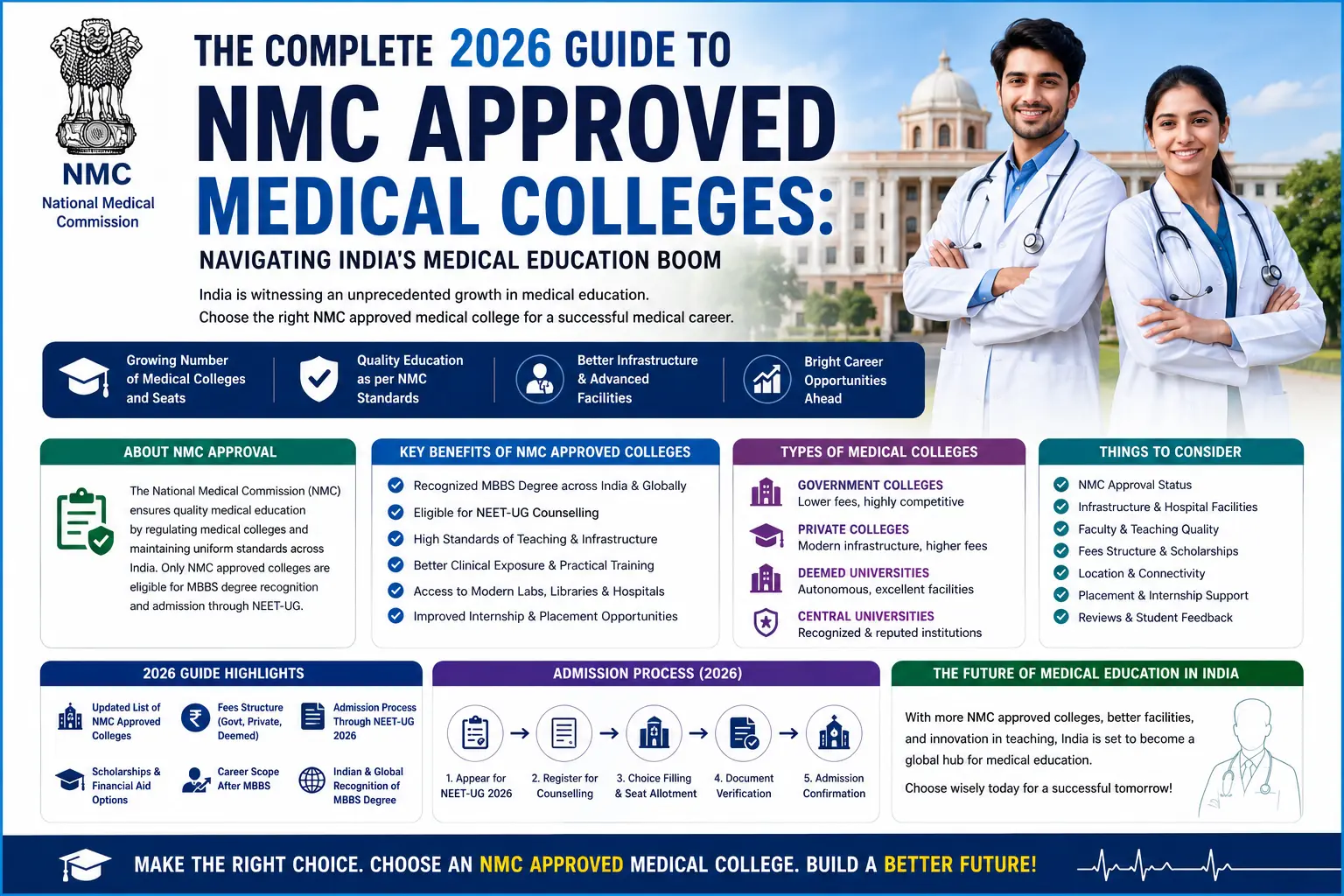
The Complete 2026 Guide to NMC Approved Medical Colleges: Navigating India’s Medical Education Boom
One acronym that controls everything when traversing India’s intricate medical education system is NMC (National Medical Commission). The NMC, which took the place of the Medical Council of India (MCI) in 2020, is the highest regulatory authority that guarantees medical education standards, validates credentials, and—most importantly—approves medical colleges to operate and award MBBS and PG degrees.
As an educational consultant who has watched this landscape shift dramatically over the past few years, I can tell you that the 2024–2026 period has brought unprecedented changes. Alongside significant curriculum changes, we are seeing the biggest increase in medical seats in Indian history.
Whether you are an aspiring doctor preparing for NEET, a parent mapping out your child’s future, or an academic tracking healthcare policy, understanding the dynamics of NMC approved medical colleges is no longer optional—it’s essential.
Table of Contents
- The Numbers: India’s Unprecedented Medical Education Boom
- Navigating the NMC Approval Status: What It Means for Students
- The 2025 NMC Guideline Overhauls: Changing the Rules of the Game
- The Curriculum Shift: Competency-Based Medical Education (CBME)
- The Elephant in the Room: The UG to PG Gap
- How to Choose the Right NMC Approved College
- The Future of Medical Colleges in India (2026 and Beyond)
- Summary & Key Takeaways
- Frequently Asked Questions (FAQs)
1. The Numbers: India’s Unprecedented Medical Education Boom
To understand the current state of NMC approved medical colleges, we first need to look at the staggering numbers. The government has pushed a significant mission to improve the doctor-patient ratio and democratize access to medical education during the past ten years, particularly speeding into 2025 and 2026.
The 2025–2026 Capacity Snapshot
As of the 2024–2025 academic year, India’s capacity for medical education has reached unprecedented heights:
- Total NMC Approved Medical Colleges: ~780 colleges
- Total Undergraduate (MBBS) Seats: ~118,000+ seats
- Total Postgraduate (MD/MS/Diploma) Seats: ~72,000 to ~74,000 seats
To put this into perspective: In 2013, India had only 387 medical colleges and roughly 51,000 MBBS seats. We have witnessed over a 100% increase in capacity in just over a decade.
Why the Sudden Surge?
The rapid expansion isn’t just about boasting higher numbers; it’s a calculated response to a massive demand-supply gap. In 2024 alone, over 2.2 million candidates appeared for the NEET-UG examination, fighting for those 118,000 spots. The government aims to add another 75,000 medical seats over the next five years, meaning we could see up to 100 new medical colleges opening annually.
“The fact that more than 1.2 million students pass NEET each year is the reason behind the government of India’s announcement of a swift expansion in seats. To accommodate this demand and improve rural healthcare, capacity building is operating on a war footing.”
— Dr. N. Ananthakrishnan, The National Medical Journal of India.
2. Navigating the NMC Approval Status: What It Means for Students
A common trap for students and parents is assuming that any institution with “Medical College” in its name is a safe bet. Do not make this mistake. You may be legally prohibited from practicing medicine in India if you attend a college that is not authorized by the NMC.
The Status Hierarchy
- Recognized: The college has passed all NMC inspections regarding infrastructure, faculty, patient load, and clinical facilities. Degrees from these colleges are fully valid for practice and higher education.
- Permitted (Renewed Annually): New medical colleges are given “Letters of Permission” (LOP) to admit a specific number of students. The NMC inspects them annually before renewing their permission. They are formally “recognized” only when their first batch reaches the final year.
- De-recognized / Denied Permission: Colleges that fail to maintain standards (often due to acute faculty shortages or lack of clinical material/patients) lose their permission to admit new students. Prior to going to counseling, always check the live NMC portal.
How to Verify a College’s NMC Status
- Visit the official NMC website (nmc.org.in).
- Navigate to the “Information Desk” and select “Medical College & Seat Information.”
- Filter by State, Management Type (Govt/Private/Trust), and Course (MBBS/PG).
- Verify the “Annual Intake” limit. If a college admits more students than the NMC-approved limit, those surplus degrees are considered invalid.
3. The 2025 NMC Guideline Overhauls: Changing the Rules of the Game
To facilitate the massive addition of 75,000 seats by 2030, the NMC had to address a glaring roadblock: A severe shortage of qualified medical faculty. You can build a hospital overnight, but you cannot manifest a Professor of Surgery.
In response, the NMC released a series of controversial but necessary regulatory updates between mid-2024 and 2025.
Relaxed Faculty and Infrastructure Requirements
To keep the pipeline of new medical colleges flowing, the NMC gazette notifications relaxed several stringent rules:
- Non-Medical Scientists as Faculty: The NMC now permits basic scientists with non-medical postgraduate qualifications to be recruited as teachers in five pre-clinical and para-clinical departments (up to a maximum of 30% of the total teachers in that department).
- Postgraduate Course Rules: Previously requiring three faculty members and a senior resident, medical colleges can now begin PG courses with just two faculty members and two seats.
- Upgrading District Hospitals: Non-teaching government hospitals with over 220 beds can now be officially designated as teaching institutions, effectively turning district hospitals into functional medical colleges.
While the government argues this shifts the focus from “rigid service norms to competency and academic merit”, bodies like the Indian Medical Association (IMA) have raised concerns about whether this quantitative expansion might dilute the quality of education.
4. The Curriculum Shift: Competency-Based Medical Education (CBME)
The NMC isn’t just changing where doctors study; it is fundamentally altering how they learn. The traditional, rote-memorization-heavy curriculum has been replaced by Competency-Based Medical Education (CBME).
What is CBME?
Introduced progressively over the last few years and heavily updated in the 2024–2025 guidelines, CBME shifts medical training from a time-bound model to an outcome-based model. It emphasizes learner-centered and patient-centered strategies, ensuring that an Indian Medical Graduate (IMG) isn’t just good at passing exams, but is practically competent in clinical skills, communication, and medical ethics.
Key Pillars of the New Curriculum
- The Foundation Course: Month 1 of MBBS.
A mandatory one-month orientation program for first-year students to bridge the gap between high school science and medical education. It includes language skills, medical ethics, and early career pathway awareness. - Early Clinical Exposure (ECE): Year 1 onwards.
Unlike older curricula where students didn’t see a patient until their second year, CBME mandates clinical exposure from the very first year, integrating basic sciences (like anatomy and physiology) with real-world clinical scenarios. - Family Adoption Program (FAP): Community Medicine.
A radical new initiative where medical students are assigned to adopt families in rural or underserved areas, monitoring their health longitudinally over their MBBS course. - Attitude, Ethics, and Communication (AETCOM):
Dedicated modules assessing a student’s bedside manner, ethical decision-making, and ability to communicate effectively with patients and their families.
5. The Elephant in the Room: The UG to PG Gap
If you look at the macro data, a glaring bottleneck emerges in the Indian medical education system: The severe mismatch between Undergraduate (MBBS) seats and Postgraduate (MD/MS) seats.
As of 2024–2025:
- MBBS Graduates: ~118,000 annually.
- Available PG Seats: ~74,000.
Add in the backlog of doctors from previous years who are re-attempting the NEET-PG exam, and you have over 228,000 candidates competing for 74,000 seats.
The Implications of the Gap
- The “Lost Years”: Many young medical graduates spend 2 to 3 years taking gap years purely to study for NEET-PG, keeping thousands of qualified doctors out of the workforce.
- Dilution of Percentiles: In controversial moves during the 2025-2026 admissions cycle, regulatory bodies drastically lowered NEET-PG qualifying percentiles (e.g., dropping the general category to the 7th percentile to fill vacant non-clinical seats), sparking intense debates about academic standards and merit.
- The Brain Drain: Facing intense competition at home, a significant percentage of graduates opt for alternative pathways like the USMLE (United States), PLAB (UK), or AMC (Australia).
6. How to Choose the Right NMC Approved College
With nearly 800 colleges to choose from, relying solely on NMC approval isn’t enough to guarantee a top-tier education. Based on my experience evaluating institutions, here is the framework you should use when finalizing a college.
Evaluating Clinical Material (Patient Footfall)
A medical college is only as good as its hospital. If a hospital has empty beds, students have no patients to learn from.
Actionable Tip: Look at the hospital’s Outpatient Department (OPD) data. Is it a tertiary care referral center for the region? Are they empaneled under government schemes like Ayushman Bharat (PM-JAY)? Hospitals empaneled under PM-JAY see a massive influx of patients, guaranteeing medical students a wide variety of clinical cases.
The Faculty Retention Rate
While the NMC mandates a minimum number of faculty, retention is the true marker of a healthy college. Many private colleges hire “ghost faculty” who appear only during NMC inspection days.
Actionable Tip: Check the college’s website and look at their research output. Faculty actively publishing in indexed journals (like Scopus/WoS) usually indicates a stable, full-time academic environment.
Institutional Infrastructure
Does the college have modern infrastructure aligned with the new CBME guidelines?
Actionable Tip: Verify if the college has functional Clinical Skills Labs, a well-equipped Medical Education Unit (MEU), and simulation centers.
Location and Geography
Medical education relies heavily on regional pathology. A medical college in a tropical, humid coastal region will expose you to different infectious diseases than a college in the dry northern plains. Choose a location where the language barrier won’t prevent you from taking patient histories.
7. The Future of Medical Colleges in India (2026 and Beyond)
The National Medical Commission is driving the Indian healthcare ecosystem toward an inflection point. The next few years will focus heavily on bridging the rural-urban divide, integrating digital health missions, and standardizing exit exams.
The NExT Examination
The National Exit Test (NExT) is slated to replace both the final year MBBS exams and the NEET-PG entrance exam. This single-window exam will serve as a licentiate examination (to practice medicine) and a merit-based gateway to postgraduate courses. By standardizing the exit criteria, the NMC aims to ensure that regardless of whether a student studied at a premier AIIMS or a newly established rural medical college, their baseline clinical competency is identical.
Integration with Ayushman Bharat Digital Mission (ABDM)
Medical colleges are increasingly being integrated into the ABDM ecosystem. As of late 2024, over 355,000 health facilities and 542,000 healthcare professionals are registered under this digital mission, creating seamless electronic health records across the country. Future medical graduates will need to be as proficient in digital health informatics as they are with a stethoscope.
8. Summary & Key Takeaways
- Verify Approval: Always cross-reference a college’s status on the official NMC website before accepting a seat.
- Unprecedented Growth: India now boasts ~780 medical colleges with over 118,000 MBBS seats, fundamentally shifting the accessibility of medical education.
- Curriculum Evolution: The new CBME curriculum focuses on patient-centered outcomes, early clinical exposure, and ethics.
- The PG Bottleneck: While UG seats have expanded, the intense competition for the ~74,000 PG seats remains the biggest hurdle for young doctors.
- Quality over Quantity: Look beyond NMC approval—evaluate a college based on its patient footfall, faculty stability, and clinical infrastructure.
9. Frequently Asked Questions (FAQs)
Q1: What is the difference between an NMC recognized and an NMC permitted medical college?
A recognized college has completed all stages of NMC inspections and its degrees are fully valid. A permitted college is a newer institution that has received a Letter of Permission (LOP) to admit students but is still undergoing annual inspections until its first batch graduates.
Q2: Can I practice medicine abroad if I graduate from an NMC approved college?
Yes. However, you must ensure that your specific medical college is also listed in the World Directory of Medical Schools (WDOMS) and recognized by the regulatory body of the target country (e.g., ECFMG for the US, GMC for the UK).
Q3: Has the NMC reduced the criteria to become a medical college professor?
To combat severe faculty shortages, the NMC’s 2025 regulations did relax some norms. For instance, non-medical scientists can now comprise up to 30% of the faculty in pre-clinical and para-clinical departments, and non-teaching hospitals with 220+ beds can be converted into teaching institutes.
Q4: What is the Family Adoption Program (FAP) in the new MBBS curriculum?
Under the CBME curriculum, medical students are assigned to “adopt” and monitor the health of specific families in underserved areas throughout their MBBS course, fostering community-based medicine and empathy.
Q5: Are degrees from deemed universities recognized by the NMC?
Yes, as long as the specific deemed university and its medical program are listed under the “Recognized” or “Permitted” list on the official NMC portal.
Q6: What happens if a medical college is de-recognized while I am studying there?
If a college loses its NMC recognition during your course due to failing inspections, the government and the courts usually intervene to transfer existing enrolled students to other recognized state medical colleges to protect their careers.