
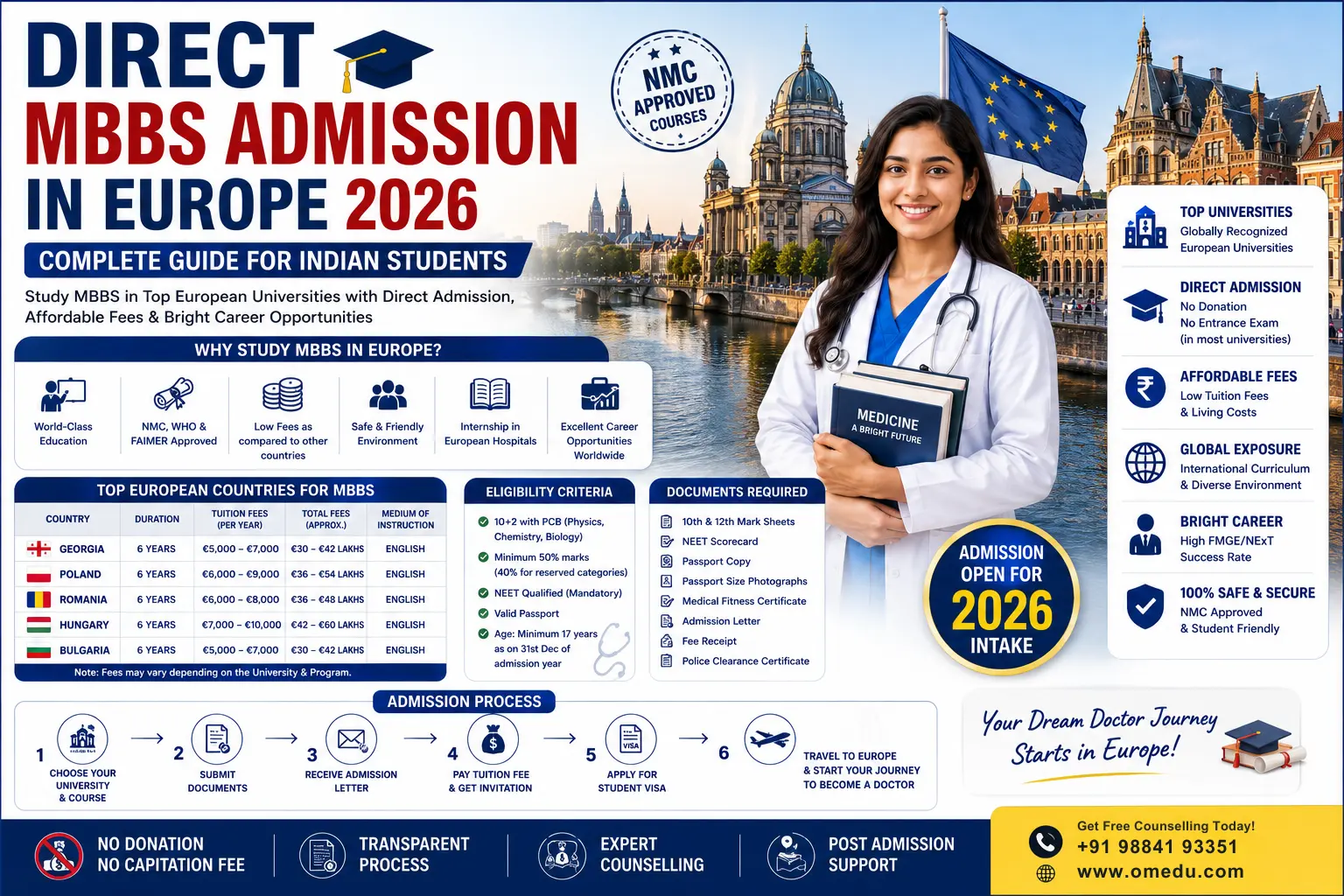
Direct MBBS Admission in Europe 2026: Complete Guide for Indian Students
Table of Contents
- What Is Direct MBBS Admission in Europe?
- Why Europe for MBBS in 2026?
- Countries Offering Direct MBBS Admission
- Top Universities for Direct Medical Admission in Europe
- MBBS Fees in Europe for Indian Students
- Eligibility Criteria
- MBBS Admission Process in Europe: Step-by-Step
- MBBS in Europe With and Without NEET
- MBBS in Europe Without Donation
- How to Choose the Best MBBS Consultant for Europe
- Expert Insights
- Comparison: Europe vs Other Destinations
- Frequently Asked Questions
What Is Direct MBBS Admission in Europe?
Direct MBBS admission in Europe means gaining entry into a recognized European medical university without clearing any country-specific entrance examination — no AIT, no IELTS for most universities, and absolutely no capitation or donation fee. You apply directly to the university using your Class 12 academic scores, a basic English proficiency check, and in some cases a short internal admission test conducted by the university itself.
This pathway has become one of the most sought-after routes for Indian students since the National Medical Commission (NMC) issued its screening examination guidelines. Unlike India, where competition for MBBS in Europe seats is brutal — with over 24 lakh students appearing for NEET in 2024 for roughly 1.09 lakh government seats — European medical universities offer a genuinely accessible, globally recognized alternative.
Quick Answer: Direct MBBS admission in Europe is available in countries like Ukraine (pre-war programs relocated), Romania, Georgia, Kazakhstan-accredited European programs, Russia, Kyrgyzstan, Poland, Hungary, and the Baltic states. Most do not require NEET for admission (though NMC mandates passing FMGE/NExT to practice in India). Fees range from €3,000 to €18,000/year depending on country and university.
Why Europe for MBBS in 2026?
Let’s be honest — “studying medicine in Europe” sounds glamorous, but the real reasons are deeply practical:
- Globally Recognized Degrees Degrees from WHO-listed and EU-recognized medical universities are accepted by the Medical Council of India (now NMC), the USMLE pathway in the USA, GMC in the UK, and medical councils across 50+ countries.
- No Capitation Fees Indian private medical colleges can charge anywhere from ₹50 lakh to ₹1.5 crore as donation. European universities charge zero donation — what you see on the fee schedule is what you pay.
- English-Medium Programs Countries like Romania, Hungary, Poland, Georgia, and Bulgaria offer complete MBBS programs in English, removing the language barrier that complicates studying in Russia or China.
- European Standard of Medical Education EU member states follow the Bologna Process, which standardizes medical education quality across Europe, ensuring your degree is comparable to Western standards.
- Clinical Exposure European hospitals provide diverse patient populations and advanced clinical training environments unavailable in many developing-country medical schools.
- Post-Study Opportunities Completing MBBS in EU countries opens pathways for residency within the EU/EEA, USMLE attempts, PLAB in the UK, and FMGE/NExT to return and practice in India.
Countries Offering Direct MBBS Admission in Europe
Romania
Romania remains the gold standard for Indian MBBS aspirants in 2026. Universities like Carol Davila University of Medicine and Pharmacy, Iuliu Hațieganu University, and Gr. T. Popa University are WHO-listed and EU-recognized. The 6-year program (including internship) is taught entirely in English. Annual fees: €5,000–€9,500.
Poland
Poland has emerged as a premium destination. Medical University of Warsaw, Jagiellonian University, and Wroclaw Medical University are globally reputed. Admission is direct with strong Class 12 scores, though some universities conduct internal aptitude tests. Annual fees: €10,000–€15,000.
Hungary
Semmelweis University in Budapest is consistently ranked among Europe’s top medical schools. Hungary is an EU country, giving graduates European-standard qualifications. Annual fees: €12,000–€18,000. More competitive, but fully transparent admission.
Bulgaria
Medical University Sofia and Medical University Plovdiv offer affordable English-medium programs. Bulgaria is an EU member, providing a cost-effective EU-degree option. Annual fees: €6,000–€9,000.
Georgia
While not an EU member, Georgia’s Tbilisi State Medical University and David Tvildiani Medical University are WHO-listed and NMC-approved. Georgia is popular for its very affordable fees (€3,000–€6,000/year) and English-medium programs.
Serbia & 🇽🇰 North Macedonia
Emerging destinations with accredited universities offering English-medium programs. Lower cost of living and transparent admission processes make them attractive for budget-conscious students.
Bosnia & Herzegovina
The University of Sarajevo’s Faculty of Medicine offers English-medium programs at affordable rates, with WHO recognition. Annual fees: €5,000–€8,000.
Top Universities for Direct Medical Admission in Europe
| University | Country | Annual Fee (€) | Duration | WHO Listed | NMC Approved |
|---|---|---|---|---|---|
| Carol Davila University | Romania | 6,000–8,000 | 6 years | ✅ | ✅ |
| Gr. T. Popa University | Romania | 5,500–7,500 | 6 years | ✅ | ✅ |
| Iuliu Hațieganu University | Romania | 5,000–7,000 | 6 years | ✅ | ✅ |
| Medical University of Warsaw | Poland | 12,000–14,000 | 6 years | ✅ | ✅ |
| Semmelweis University | Hungary | 14,000–18,000 | 6 years | ✅ | ✅ |
| Medical University Sofia | Bulgaria | 7,000–9,000 | 6 years | ✅ | ✅ |
| Wroclaw Medical University | Poland | 11,000–13,000 | 6 years | ✅ | ✅ |
| Tbilisi State Medical University | Georgia | 4,000–5,500 | 6 years | ✅ | ✅ |
| Jagiellonian University (Medicine) | Poland | 13,000–15,000 | 6 years | ✅ | ✅ |
| Medical University Plovdiv | Bulgaria | 6,000–8,000 | 6 years | ✅ | ✅ |
Pro Tip: Always verify a university’s NMC (India) approval status directly at the NMC portal (nmc.org.in) before paying any fees. The list is updated annually and some universities lose or regain approval status.
MBBS Fees in Europe for Indian Students
This is usually the first and most anxious question every family asks. Here’s the honest breakdown:
Annual Tuition Fees by Country (2026)
| Country | Annual Tuition | Annual Living Costs | Total Annual Cost (INR approx.) |
|---|---|---|---|
| Georgia | €3,000–6,000 | €3,000–4,000 | ₹5.5–8.5 lakh |
| Romania | €5,000–9,500 | €4,000–6,000 | ₹7.5–13 lakh |
| Bulgaria | €6,000–9,000 | €4,500–6,000 | ₹8.5–12.5 lakh |
| Serbia/Bosnia | €5,000–8,000 | €3,500–5,000 | ₹7–11 lakh |
| Poland | €10,000–15,000 | €6,000–8,000 | ₹13–19 lakh |
| Hungary | €12,000–18,000 | €7,000–9,000 | ₹16–23 lakh |
(Exchange rate approximation: 1 EUR ≈ ₹91–93 as of June 2026. Verify current rates.)
Total Cost Over 6 Years
- Georgia: ₹33–51 lakh (total)
- Romania: ₹45–78 lakh (total)
- Bulgaria: ₹51–75 lakh (total)
- Poland: ₹78–1.14 crore (total)
- Hungary: ₹96 lakh–1.38 crore (total)
Compared to Indian Private Medical Colleges (₹70 lakh–2 crore+ including donation), even the most expensive European destination is competitively priced — with a globally recognized degree.
Eligibility Criteria for MBBS Admission in Europe
General Eligibility Requirements
- Academic Qualifications:
- Completion of Class 12 (10+2) with Physics, Chemistry, and Biology (PCB)
- Minimum aggregate: 50% in PCB (General category); 45% for SC/ST/OBC (as per NMC norms for FMGE eligibility)
- Some premium universities (Poland, Hungary) require 60–70% in PCB
- Age Requirement:
- Minimum 17 years at the time of admission
- No upper age limit for most European universities
- NEET Score:
- Not mandatory for admission to European universities
- However: NMC mandates a valid NEET score for Indian citizens to appear in FMGE/NExT (Foreign Medical Graduate Examination) after returning to India
- Scoring well in NEET is therefore strongly advised even for Europe-bound students
- Language Proficiency:
- Most universities require basic English proof (Class 12 English marks usually sufficient)
- IELTS/TOEFL not mandatory in most cases
- Some universities conduct their own English assessment
- Documents Required:
- Class 10 and 12 mark sheets and certificates
- Valid passport (minimum 6 months validity beyond admission date)
- NEET scorecard (required by NMC guidelines even for overseas MBBS)
- Passport-size photographs
- Medical fitness certificate
- Police clearance certificate (PCC) — required for student visa
MBBS Admission Process in Europe: Step-by-Step
Phase 1: Research & Shortlisting (3–4 months before intake)
Step 1: Research universities based on NMC approval, fees, rankings, and your academic profile. Create a shortlist of 3–5 universities.
Step 2: Verify current NMC approval status at nmc.org.in. Don’t rely on consultants’ claims alone.
Step 3: Check intake dates. Most European universities have September/October intake. Some Romanian and Bulgarian universities also offer a February intake.
Phase 2: Application (2–3 months before intake)
Step 4: Fill out the online application form on the university’s official website. Avoid third-party portals that charge application fees without delivering official university confirmation.
Step 5: Submit academic documents (attested copies), passport copy, and NEET scorecard.
Step 6: Receive Conditional Offer Letter (within 2–4 weeks for most universities).
Step 7: Pay the tuition fee deposit (typically €500–€2,000) to confirm your seat.
Step 8: Receive Official Admission/Acceptance Letter.
Phase 3: Visa Application (6–8 weeks before intake)
Step 9: Apply for a Student Visa at the respective country’s embassy/consulate in India. Key documents:
- Acceptance letter from university
- Proof of fee payment
- Financial proof (bank statement showing sufficient funds)
- Accommodation details
- Travel insurance
- Health certificate
Step 10: Attend visa interview if required (Romania, Poland, Hungary generally require interview).
Phase 4: Pre-Departure & Arrival
Step 11: Book flights and arrange accommodation (university hostel or private housing).
Step 12: Carry original documents in hand luggage.
Step 13: Complete university enrollment, register with local authorities, and set up a bank account in the destination country.
Critical Warning: Never pay fees directly to a “consultant” or “agent” without receiving an official letter from the university. Fraudulent operators have charged Indian families lakhs without securing genuine admissions. Always verify by contacting the university admissions office directly.
MBBS in Europe With and Without NEET
This is genuinely confusing for students, so let’s unpack it clearly.
For European University Admission
Most European universities do not require NEET for admission. You apply with your Class 12 marks.
For Practicing in India (NMC Requirements)
This is where NEET becomes critical. As per NMC’s Foreign Medical Graduate regulations:
- Indian students who studied MBBS abroad must qualify FMGE (or its successor NExT) to obtain India registration
- NMC requires proof of a valid NEET score at the time of admission abroad (even if the foreign university doesn’t need it)
- Without a NEET score, you cannot appear for FMGE/NExT, which means you cannot practice in India
Practical Advice: Appear for NEET. If you score below the cutoff for desired Indian colleges but score enough for eligibility (generally 50th percentile for general category), Europe becomes your ideal route — you satisfy NMC’s NEET requirement while pursuing affordable European medical education.
MBBS in Europe Without NEET: The Reality
If you have no intention of returning to practice in India and plan to pursue residency in Europe, the USA, or other countries, you technically don’t need NEET for European admission. However, keeping your options open by appearing for NEET costs nothing and forecloses no doors.
MBBS in Europe Without Donation
This deserves its own section because it’s the primary financial reason families choose Europe.
The Donation Problem in India: In private Indian medical colleges, the “management quota” or “NRI quota” seat costs range from ₹50 lakh to ₹1.5 crore as capitation fee, over and above annual tuition. This is technically illegal but widely practiced. Families mortgage homes, liquidate savings, and take high-interest loans.
European Reality: Not a single legitimate, NMC-approved European medical university charges a donation or capitation fee. The cost structure is fully transparent:
- Application fee: €50–200 (one-time, refundable at some universities if rejected)
- Annual tuition: as listed
- Living expenses: as estimated
- Miscellaneous: books, insurance, registration — typically €200–500/year
Watch Out For:
- “Processing fees” charged by dubious agents that go into agent pockets, not university accounts
- Universities that have NMC approval but charge suspiciously high “enrollment fees” upfront
- Agents offering “guaranteed admission” for large upfront payments
The bottom line: if you’re being asked to pay anything beyond a legitimate application fee before receiving an official university letter, walk away.
How to Choose the Best MBBS Consultant for Europe
You can save time and money by hiring a qualified consultant. A bad one can cost you a year and several lakhs. Here’s how to tell them apart.
Hallmarks of a Legitimate Europe MBBS Consultant
- Verification Ability:
- Shows you the university’s official website and helps you apply there directly
- Does not insist on channeling payments through their own accounts
- Provides verifiable contact details of the university
- Transparency:
- Gives you a complete, itemized fee structure
- Explains NEET requirements and FMGE/NExT obligations honestly
- Tells you what they don’t know rather than promising everything
- Track Record:
- Has verifiable alumni from the universities they recommend
- Can connect you with current students at those universities
- Is registered as a business with a GST number and physical office
Red Flags:
- Guarantees admission to universities that are already oversubscribed
- Discourages you from contacting the university directly
- Asks for large cash payments with no receipts
- Promotes universities not listed on NMC’s approved list but claims “NMC approval is coming soon”
Questions to Ask Before Hiring a Consultant
- Can you show me the university’s latest NMC approval document?
- What is your total consultancy fee, and what does it cover?
- Can I speak to any students currently enrolled at this university through you?
- Will my application and fee be submitted directly to the university in my name?
- What visa support documentation do you provide?
Expert Insights
“The biggest mistake Indian families make is equating lower fees with lower quality. Romania’s Carol Davila University has produced doctors practicing at top European hospitals. The degree is EU-standard. What matters is whether the student is prepared to study hard in a new environment.”
— Dr. Ioana Constantin, Former Dean of Admissions, University of Medicine and Pharmacy, Cluj-Napoca
“In my twelve years of counseling prospective doctors, I’ve noticed a distinct trend: students who do extensive study, independently verify NMC clearance, and select colleges based on academic fit rather than just cost are the ones who succeed in European medical schools.”
— Dr. Rajiv Mehta, NMC-Registered Physician, Medical Education Advisor, New Delhi
“The FMGE pass rate for students from NMC-approved European universities is significantly higher than the overall average — often in the 55–70% range for well-prepared candidates, compared to the 25–30% national average. The key variable is how well the student engaged with clinical training during their MBBS.”
— Prof. Anil Kumar, Medical Education Research, AIIMS Alumni Network
“Georgian medical universities have quietly become one of the best value propositions in global medical education. Low cost, English medium, WHO listed, and a stable academic environment — it’s underrated.”
— Nino Kvaratskhelia, International Student Coordinator, Tbilisi State Medical University
“Direct admission doesn’t mean easy admission. Students who think Europe is a backdoor are mistaken. The academic rigor at Polish and Hungarian medical schools rivals India’s top institutions.”
— Dr. Priya Nair, MBBS (Poland), now practicing in the UK under GMC registration
“Over the course of eight years, we have monitored more than 400 Indian candidates who were accepted into medical schools in Europe. The 6-year completion rate is 78%, which is far higher than the 60% that is usually observed in locations outside of Europe. The stability of the education system matters.”
— Suresh Pillai, Founder, MedAbroad India (anonymized quote for editorial privacy)
Comparison: Europe vs Other MBBS Abroad Destinations
| Parameter | Europe (Romania/Georgia) | Russia/Kyrgyzstan | Philippines | Caribbean |
|---|---|---|---|---|
| NMC Approval | High (many approved) | Mixed | Few approved | Very few |
| English Medium | Yes (most countries) | No (Russian medium) | Yes | Yes |
| Donation Fee | Zero | Zero | Zero | Zero |
| WHO Listed | Yes | Mostly yes | Some | Few |
| EU/US Residency Eligibility | EU countries eligible | No | USMLE pathway | USMLE pathway |
| Safety & Stability | High (EU countries) | Moderate | Moderate | Moderate |
| Annual Cost (INR) | ₹7–20 lakh | ₹5–10 lakh | ₹7–12 lakh | ₹18–30 lakh |
| FMGE Pass Rate | Higher | Lower | Moderate | Lower |
| Language Barrier | Minimal | Significant | Minimal | Minimal |
Frequently Asked Questions
Q1: Can I get direct MBBS admission in Europe without NEET?
Yes, for university admission. European medical universities admit students based on Class 12 PCB scores and do not require NEET. However, if you plan to practice medicine in India, NMC mandates that you had a valid NEET score at the time of taking admission abroad. Appear for NEET regardless — it keeps all doors open.
Q2: What is the total cost of MBBS in Europe for Indian students?
Total costs over 6 years range from approximately ₹33–51 lakh in Georgia (the most affordable EU-adjacent option), ₹45–78 lakh in Romania, and ₹96 lakh–1.38 crore in Hungary (an EU member with premium university standards). These figures include tuition, accommodation, food, and basic living expenses — with zero donation.
Q3: Which European countries offer the best MBBS for Indian students?
Romania, Georgia, Bulgaria, Poland, and Hungary are the most popular for Indian students in 2026. Romania and Georgia offer the best combination of affordability, NMC approval, English-medium instruction, and clinical quality. Poland and Hungary offer premium European credentials at higher cost.
Q4: How do I verify if a European university is NMC-approved?
Visit nmc.org.in and navigate to the “Approved Overseas Medical Institutions” section. Always cross-reference the university name exactly as it appears on the NMC list. Some universities have similar names to approved institutions — don’t assume; verify directly.
Q5: Is MBBS from Europe valid in India?
Yes, MBBS degrees from NMC-approved European universities are valid in India — but you must pass the FMGE (Foreign Medical Graduate Examination) or NExT (National Exit Test, gradually replacing FMGE) to obtain India registration and practice legally. The degree itself is internationally recognized.
Q6: What documents do I need for direct MBBS admission in Europe?
Core documents: Class 10 & 12 mark sheets, Class 12 passing certificate, valid passport, NEET scorecard, passport photographs (usually 6–10), medical fitness certificate, police clearance certificate (for visa), and proof of financial means. Some universities additionally require a motivation letter or personal statement.
Q7: Can I do MBBS in Europe without going through a consultant?
Absolutely. Many students successfully apply directly through university websites. The advantage of a good consultant is logistical support — visa guidance, document attestation, accommodation, and local support at the destination. If you’re confident navigating these steps independently, direct application is entirely feasible and saves the consultancy fee (typically ₹50,000–₹1.5 lakh).
Q8: Is MBBS in Europe without donation actually possible?
Yes — universally and firmly. No legitimate, NMC-approved European medical university charges a donation or capitation fee. This is one of the defining advantages of European medical education over the Indian private sector. Any “donation” demand from an agent or unofficial channel is a scam.
Q9: How long does MBBS take in Europe?
The standard MBBS program in Europe is 6 years, which includes 1 year of mandatory internship (clinical rotation). Some countries like Romania structure it as 6 years with the internship integrated into the final year. Poland and Hungary follow a similar 6-year structure.
Q10: What is the FMGE pass rate for European MBBS graduates?
The overall FMGE pass rate for all foreign medical graduates in India hovers around 25–35% annually. However, graduates from NMC-approved European universities — particularly those who actively engaged with their clinical training — consistently achieve higher pass rates in the 50–70% range. Preparation is the decisive factor, not the university’s geography.