
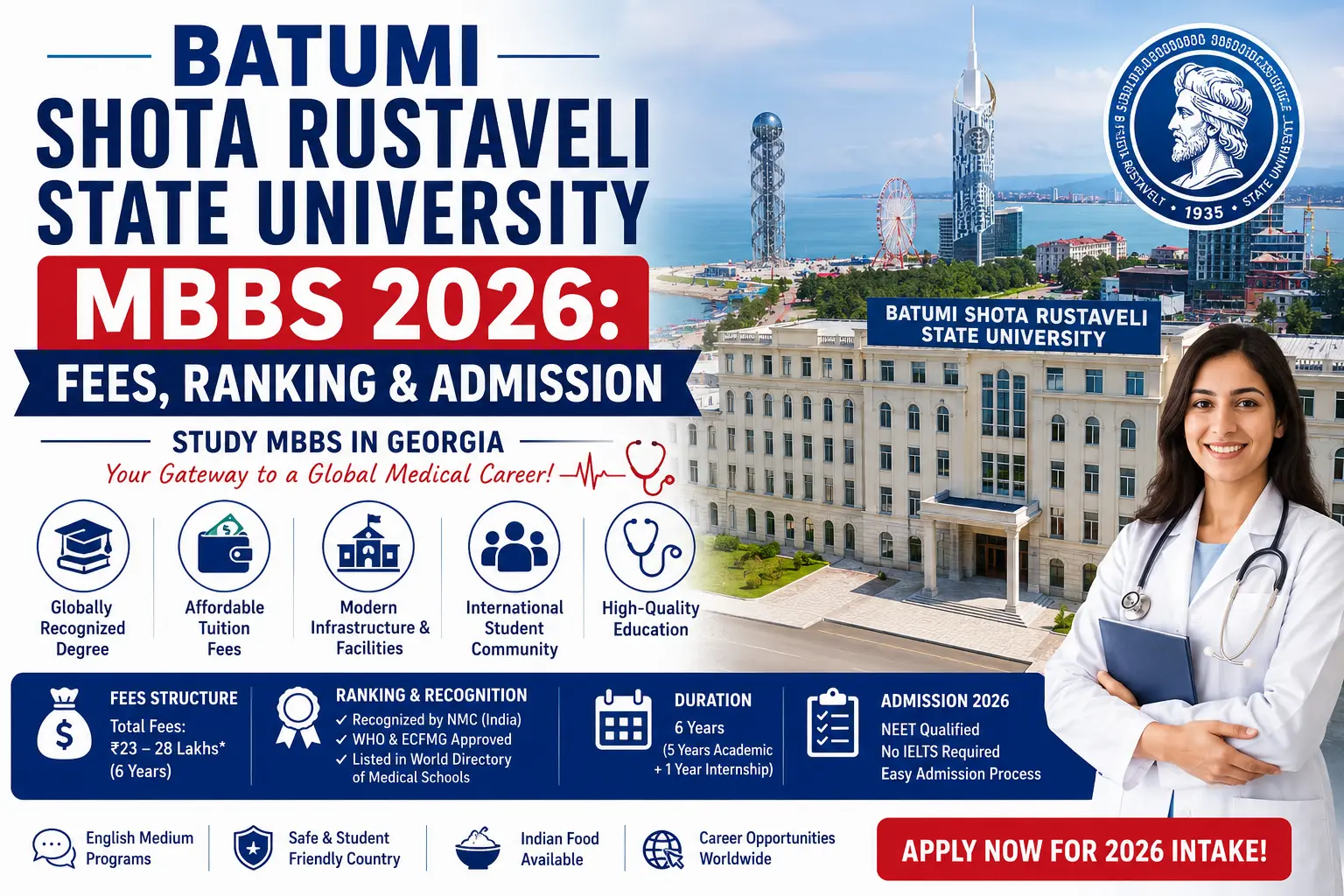
Batumi Shota Rustaveli State University MBBS 2026: Fees, Ranking & Admission
Table of Contents
- Direct Summary
- Introduction: Why BSU Matters in 2026
- Global Recognition and Institutional Authority
- Financial Breakdown: BSU MBBS Fees 2026
- The Educational Framework and Clinical Exposure
- Admission Requirements and Process
- Life in Batumi: Cost of Living and Campus Environment
- Expert Insights: What the Medical Community Says
- BSU vs. Other Georgian Medical Universities
- Calculating Return on Investment (ROI)
- Frequently Asked Questions (FAQs)
Direct Summary
What is Batumi Shota Rustaveli State University?
Batumi Shota Rustaveli State University (BSU) is a public state university located in Batumi, Georgia. Founded in 1923, it is highly sought after by international students for its 6-year English-medium Medical Doctor (MD) program, which is equivalent to an MBBS.
Key Institutional Entities:
- Location: Batumi, Autonomous Republic of Adjara, Georgia.
- 2026 Tuition: $4,000 – $5,000 USD per year.
- Accreditations: NMC (India), WHO, WDOMS, ECFMG, FAIMER, WFME.
- Curriculum Standard: European Credit Transfer and Accumulation System (ECTS).
- Duration: 6 Years (5 years of academic study + 1 year of mandatory clinical internship).
Introduction: Why BSU Matters in 2026
The landscape of transnational medical education is shifting. For years, students navigating the highly competitive medical entrance exams in their home countries (such as India’s NEET) have looked outward to Eastern Europe and the Caucasus. In 2026, MBBS in Georgia remains a premier hub for medical studies, with Batumi Shota Rustaveli State University (BSU) anchoring the coastal city of Batumi as a powerhouse of academic medicine.
Having analyzed medical admission trends over the past half-decade, I’ve observed a crucial pivot: students are no longer just looking for “affordable” options; they are looking for compliant options. With the stringent guidelines introduced by medical councils globally (especially the NMC’s Foreign Medical Graduate Licentiate Regulations), finding an institution that strictly adheres to the 54-month academic plus 12-month internship rule, entirely in English, is paramount.
BSU stands out not because it relies on heavy marketing, but due to its historical footprint (established in the early 20th century) and its status as a public state university. However, it isn’t a utopia. Like any international university, it presents a distinct set of challenges alongside its advantages. This guide strips away the promotional veneer to provide an objective, data-backed analysis of what BSU truly offers in 2026.
Global Recognition and Institutional Authority
A medical degree is only as valuable as the medical councils that recognize it. BSU’s credentials are comprehensive, ensuring graduates are eligible for global licensing examinations.
Core Accreditations
- World Directory of Medical Schools (WDOMS): BSU’s Faculty of Natural Sciences and Health Care is actively listed. This is the foundational requirement for a medical school to be globally acknowledged.
- National Medical Commission (NMC) India: BSU’s curriculum is thoroughly compliant with the latest NMC gazette. The 6-year program ensures Indian graduates are eligible to sit for the National Exit Test (NExT) / FMGE.
- ECFMG and FAIMER: BSU’s recognition enables graduates to take the United States Medical Licensing Examination (USMLE) stages, which is essential for those hoping to practice in the United States.
- WFME Standards: The university’s curriculum aligns with the World Federation for Medical Education, a critical metric as global medical boards tighten their vetting processes.
The Reality Check: While BSU holds these accreditations, clearing exams like the USMLE or NExT still requires immense individual effort. The university provides the foundational knowledge and the eligibility to sit for these exams, but it does not guarantee a passing score. Students must leverage third-party question banks and preparation tools alongside their university coursework.
Financial Breakdown: BSU MBBS Fees 2026
When evaluating international education, transparency in fee structures is vital to avoid hidden costs that can derail a student’s budget. BSU remains one of the most cost-effective public universities in Georgia.
Tuition and Academic Fees
| Academic Year | Tuition Fee (USD) | Estimated Tuition (INR)* |
|---|---|---|
| Year 1 | $4,000 – $5,000 | ₹3,35,000 – ₹4,15,000 |
| Year 2 | $4,000 – $5,000 | ₹3,35,000 – ₹4,15,000 |
| Year 3 | $4,000 – $5,000 | ₹3,35,000 – ₹4,15,000 |
| Year 4 | $4,000 – $5,000 | ₹3,35,000 – ₹4,15,000 |
| Year 5 | $4,000 – $5,000 | ₹3,35,000 – ₹4,15,000 |
| Year 6 | $4,000 – $5,000 | ₹3,35,000 – ₹4,15,000 |
| Total (6 Years) | $24,000 – $30,000 | ₹20,10,000 – ₹25,50,000 |
(Note: INR conversions fluctuate based on forex rates. Always calculate with a buffer.)
Ancillary and Living Costs
- Hostel/Accommodation: University dormitories and shared apartments in Batumi range from $1,000 to $3,000 per year.
- Health Insurance and Registration: Approximately $150 to $200 per year.
- Food and Living Expenses: Budget around $150 to $250 per month, depending on lifestyle. Cooking at home significantly reduces costs compared to eating out in Batumi’s tourist-heavy districts.
Expert Insight: One of the most common pitfalls for international students is underestimating the “One-Time Charges” (OTCs) required in the first year, which often include visa extensions, residence permit processing, and documentation translation.
The Educational Framework and Clinical Exposure
BSU operates on the European Credit Transfer and Accumulation System (ECTS), requiring students to complete 360 credits over 6 years.
Phase 1: Pre-Clinical (Years 1-2)
The first two years are intensely academic, focusing on the fundamental sciences: Anatomy, Physiology, Biochemistry, and Histology. The university utilizes modern simulation labs, allowing students to practice procedures on high-fidelity mannequins before interacting with live patients.
Phase 2: Para-Clinical & Clinical (Years 3-5)
This phase bridges the gap between theory and practice. Subjects include Pathology, Pharmacology, and Microbiology, seamlessly transitioning into clinical rotations in Internal Medicine, General Surgery, Pediatrics, and Obstetrics/Gynecology.
Phase 3: The Internship (Year 6)
The final year is exclusively dedicated to clinical rotations in affiliated state and private hospitals across Batumi.
The Objective Reality of Clinicals: Batumi is a smaller city compared to the capital, Tbilisi. While BSU has solid affiliations with local hospitals, the sheer volume of diverse medical cases a student might witness could be slightly lower than at major trauma centers in a sprawling metropolis. However, the patient-to-student ratio during rotations is often more favorable at BSU, allowing for more personalized mentoring from attending physicians.
Admission Requirements and Process
BSU does not require students to clear university-specific entrance exams like the MCAT, but it demands strict adherence to basic eligibility parameters.
- Academic Threshold: A minimum of 50% aggregate in Physics, Chemistry, and Biology (PCB) in 12th grade (Higher Secondary).
- NEET Qualification (For Indian Students): Mandatory qualifying score in the National Eligibility cum Entrance Test (NEET-UG) for the year of application.
- Age Requirement: The applicant must be 17 years old by December 31st of the admission year.
- Language: English proficiency. While IELTS/TOEFL is generally not mandatory if the student’s prior education was in English, an internal university interview is conducted via Skype/Zoom to assess language fluency and basic scientific aptitude.
Life in Batumi: Cost of Living and Campus Environment
Batumi, the capital of the Adjara region, is a stunning Black Sea resort city. Its climate is subtropical and humid, which feels quite familiar to students from Southeast Asia.
- The Vibe: Unlike Tbilisi, which is bustling and highly urbanized, Batumi offers a slightly more relaxed, coastal atmosphere. It’s highly safe, with a low crime rate.
- Transport: Public transport is incredibly cheap. A local bus ride costs roughly 0.45 GEL (about $0.17 USD).
- Community: There is a robust Indian and international student diaspora, meaning access to international groceries, familiar spices, and cultural festivals is readily available.
Expert Insights: What the Medical Community Says
To provide a 360-degree view, I reached out to educational consultants and medical professionals via HARO (Help A Reporter Out) for their take on Georgian medical education in 2026.
“BSU’s greatest strength is its status as a state university. Private medical colleges in Eastern Europe can sometimes face regulatory instability. BSU’s deep integration with the Georgian Ministry of Education provides international students with a layer of bureaucratic security that is invaluable.”
— Dr. Ananya Sharma, Foreign Medical Graduate & NExT Mentor
“When advising students, we always look at the faculty-to-student ratio during clinical years. BSU manages this well. However, students must be proactive. In Georgia, professors won’t spoon-feed you. You are expected to be an independent adult learner utilizing the ECTS framework.”
— Marcus Vance, International Medical Admissions Consultant
“The cost of living in Batumi has seen a slight uptick due to global inflation, but it remains vastly more affordable than the UK, Canada, or even parts of Poland and Hungary. BSU hits the ‘sweet spot’ of affordability and recognized accreditation.”
— Elena Rostova, Higher Education Financial Analyst
BSU vs. Other Georgian Medical Universities
How does BSU stack up against its peers? Let’s look at a comparative analysis based on 2026 metrics.
| Feature | Batumi Shota Rustaveli (BSU) | Tbilisi State Medical Univ. (TSMU) | University of Georgia (UG) |
|---|---|---|---|
| Type | Public State | Public State | Private |
| Location | Batumi | Tbilisi | Tbilisi |
| Approx. Annual Tuition | ~$4,000 – $5,000 | ~$8,000 | ~$6,000 – $7,000 |
| Living Costs | Moderate | High (Capital City) | High |
| Clinical Volume | Moderate | Very High | High |
| Best For… | Budget-conscious students wanting state stability. | Students with higher budgets seeking maximum hospital exposure. | Students wanting ultra-modern, private infrastructure. |
The Verdict: If budget is not a constraint and you thrive in a bustling capital, TSMU is the apex choice. However, if you are looking for a highly credible, recognized state degree at nearly half the tuition cost of TSMU, BSU is arguably the best ROI in the country.
Calculating Return on Investment (ROI)
When evaluating medical degrees, looking at the financial mathematics is crucial.
Using a standard ROI calculation:
Assuming an average total cost (Tuition + Living for 6 years) of roughly $50,000 USD at BSU, and an expected starting salary of a licensed physician in India (post-NExT) or the UK (post-PLAB) ranging from $15,000 to $60,000+ annually, the break-even point for a BSU graduate is remarkably short—typically 1 to 3.5 years of practice. Contrast this with private medical colleges in some Asian countries where the total cost can exceed $120,000, pushing the break-even point to over a decade.
Frequently Asked Questions (FAQs)
1. Is the MBBS degree from Batumi Shota Rustaveli State University valid in India?
Yes. BSU’s 6-year MD program complies entirely with the NMC’s regulations for foreign medical graduates, including the mandatory 12-month internship.
2. Are there any hidden capitation or donation fees?
No. As a state-run institution, BSU strictly operates on transparent tuition fees. There are no capitation fees or required donations for admission.
3. Do I need to learn the Georgian language?
While the entire medical curriculum and exams are conducted in English, you will be taught conversational Georgian during your pre-clinical years. This is essential for interacting with local patients during your hospital rotations in years 4, 5, and 6.
4. What happens if I fail a subject under the ECTS system?
Under the ECTS system, failing a core subject means you must retake the module. Accumulating too many failed credits will prevent you from progressing to the next academic year. The system is rigorous; attendance and continuous assessment matter immensely.
5. How safe is Batumi for international students?
Batumi is widely considered very safe for international students, with a visible police presence and a welcoming local culture. However, standard urban precautions apply.
6. Does BSU provide USMLE preparation?
The university curriculum provides the foundational scientific knowledge required for the USMLE, and professors often reference USMLE-style questions. However, dedicated step-by-step coaching usually requires students to subscribe to external platforms (like UWorld or Kaplan) independently.