
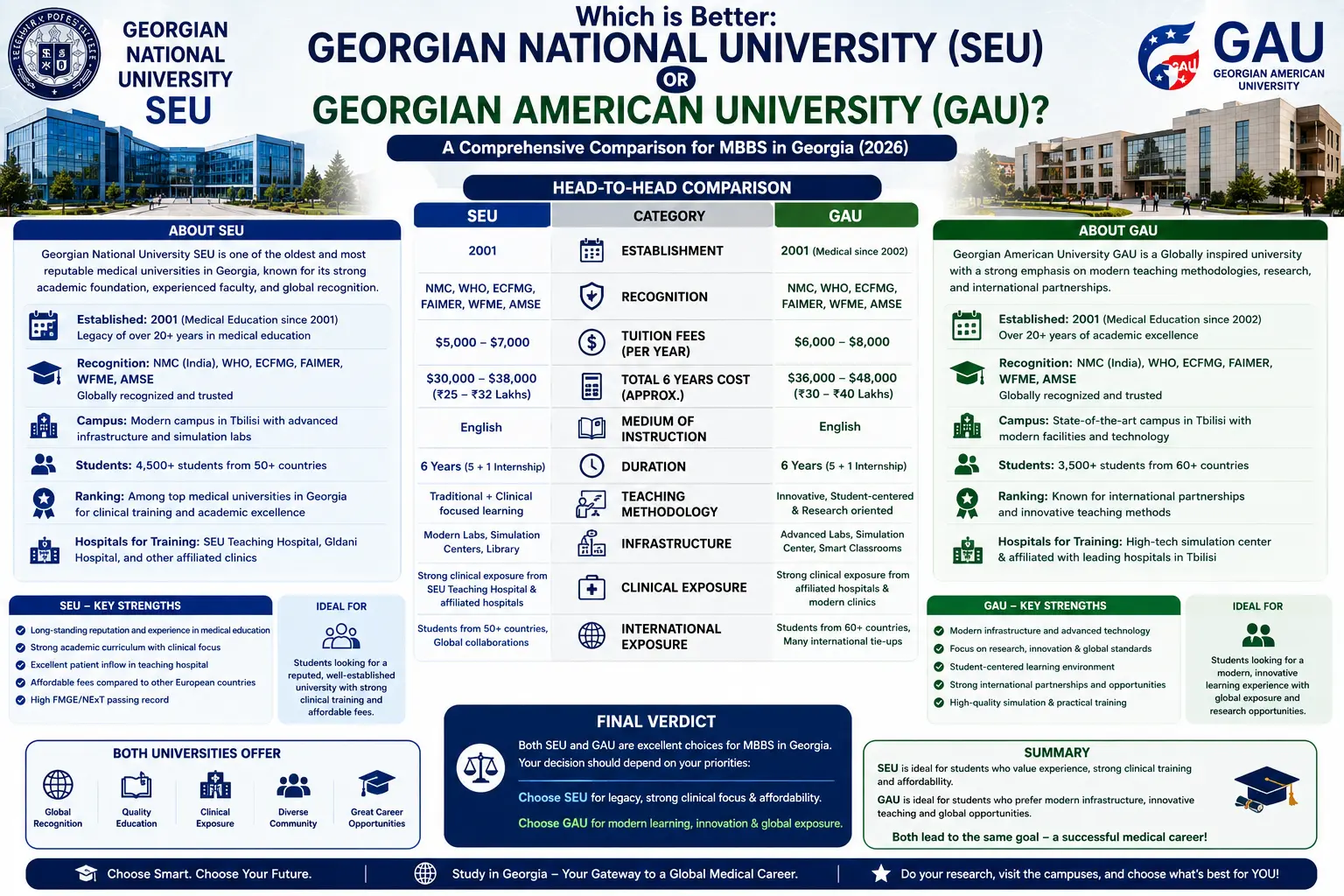
Which is Better: Georgian National University SEU or Georgian American University GAU?
If you are an international student planning to study MBBS in Georgia, you have almost certainly narrowed your choices down to two top contenders: Georgian National University SEU and Georgian American University GAU.
Both universities are located in Tbilisi, both were established in 2001, and both offer globally recognized English-medium medical programs. However, their campus environments, teaching philosophies, and student communities are vastly different.
The Quick Answer:
Choose Georgian National University SEU if you want a massive, ultra-modern campus, a large international student community (especially Indian), and high-tech simulation labs. Choose Georgian American University (GAU) if you prefer a more intimate, student-centric learning environment with a strict 12:1 student-to-faculty ratio, and a curriculum deeply aligned with USMLE (United States Medical Licensing Examination) preparation.
This comprehensive guide breaks down the “seu vs gau georgia” debate across tuition fees, clinical rotations, global recognition, and post-graduation success.
Table of Contents
- At a Glance: SEU vs GAU Georgia
- Institutional Overviews: Understanding the Core Philosophies
- Financial Breakdown: Tuition, Hostels, and Living Expenses
- Academic Rigor, Curriculum, and Faculty
- Clinical Rotations and Hospital Tie-ups
- Global Recognition and Licensing Exams (FMGE / NMC / PLAB)
- Campus Life and the International Student Community
- Common Mistakes Students Make When Choosing
- Final Verdict: Which is Better?
- Frequently Asked Questions (FAQs)
1. At a Glance: SEU vs GAU Georgia
For a rapid comparison, here is how the two institutions stack up on the core metrics that matter most to medical students.
| Feature | Georgian National University (SEU) | Georgian American University (GAU) |
|---|---|---|
| Year Established | 2001 | 2001 |
| Location | Tbilisi (Tsinandali Street) | Tbilisi |
| MBBS Tuition Fees | $6,300 / Year | $6,000 / Year |
| Student-to-Teacher Ratio | ~15:1 | 8:1 to 12:1 |
| Global Recognition | WHO, NMC, FAIMER, WFME | WHO, NMC, FAIMER, WFME |
| Campus Vibe | Large-scale, ultra-modern, corporate style | Compact, academic-focused, student-centric |
| Best For… | Networking, premium infrastructure | Focused mentorship, USMLE prep |
2. Institutional Overviews: Understanding the Core Philosophies
To truly answer whether you should pick Georgian National University SEU or Georgian American University GAU, you must understand their foundational differences.
Georgian National University (SEU)
SEU is currently Georgia’s largest private medical university. Walking into the SEU campus feels like walking into a Fortune 500 tech headquarters. The university boasts over 10,000 students globally and has invested heavily in futuristic infrastructure, including advanced robotic simulation centers and its own clinical hospital.
Georgian American University (GAU)
GAU, as the name implies, heavily integrates Western (specifically American) educational standards into its curriculum. With around 3,000 students (over 1,500 in the MBBS program), GAU is smaller but highly focused. The university emphasizes a tight-knit community, rigorous academic discipline, and early clinical exposure.
“GAU operates on a boutique education model. They purposefully keep their cohort sizes smaller so professors can genuinely track individual student progress.”
— Dr. R. K. Sharma, Global Medical Admissions Expert
3. Financial Breakdown: Tuition, Hostels, and Living Expenses
When comparing georgian national university vs Georgian Amarican University, the cost difference is minimal but worth noting.
Tuition Fees
- SEU: The annual tuition for the MBBS program is $6,300. Over the 6-year course, this totals $37,800.
- GAU: Annual tuition is slightly lower, at $6,000. The total over 6 years is $36,000.
Hostel and Living Costs
Tbilisi is generally affordable, but your lifestyle dictates your budget.
- Accommodation: Premium university-affiliated hostels (like those often favored by SEU students) can cost $3,500 per year. Shared apartments run from $1,500 to $3,000 a year.
- Food and Utilities: Expect to spend $150 to $250 per month on groceries, local transport, and utilities.
- Total Annual Living: GAU estimates a reasonable living expense of around $3,200 annually for a frugal student, while SEU students often report spending between $3,500 and $4,500 due to the more premium campus lifestyle.
4. Academic Rigor, Curriculum, and Faculty
Both universities follow the European Credit Transfer and Accumulation System (ECTS) and require 360 credits over 6 years. However, their delivery methods contrast sharply.
The GAU Approach: Intimacy and Discipline
GAU maintains an impressive student-to-faculty ratio (between 8:1 and 12:1). This means you cannot hide in the back of a lecture hall.
- Curriculum Structure: GAU’s 4-phase MD program starts with “From Cell to Body” and moves strictly into mechanism-based clinical studies.
- USMLE Focus: The curriculum is uniquely tailored to align with the USMLE Step 1 and Step 2 syllabi, making it a favorite for students planning to practice in the United States.
The SEU Approach: Technology and Scale
SEU leverages its massive resources to provide top-tier learning aids.
- Avicenna School of Medicine: Under the SEU umbrella, the Avicenna program focuses on simulation-based learning before students even touch real patients.
- Faculty: SEU employs a massive roster of visiting academics, local experts, and international doctors, giving students exposure to diverse medical viewpoints.
5. Clinical Rotations and Hospital Tie-ups
The biggest concern for any medical student studying abroad is the quality of clinical exposure. Both universities perform well here, but differently.
SEU’s Clinical Network
SEU has strong connections with leading medical firms in Georgia and has invested in its own clinical spaces. Because of its size, it can guarantee clinical placements, but you will be rotating alongside many other international students.
GAU’s Clinical Integration
GAU utilizes a network of partner hospitals across Tbilisi. The clinical groups are less crowded, with smaller student cohorts, so there is more hands-on time with the attending physicians and patients throughout the clinical years (Years 4-6).
6. Global Recognition and Licensing Exams (FMGE / NMC / PLAB)
Neither university restricts where you can practice, provided you pass your home country’s licensing exam.
- India (NMC/FMGE): Both universities strictly adhere to the latest National Medical Commission (NMC) guidelines regarding course duration (54 months + 12 months internship) and English-medium instruction. The “gau vs sau” (often a typo for SEU) debate among Indian students usually comes down to FMGE pass rates. While official university-specific FMGE pass rates fluctuate, students from both SEU and GAU historically perform above the national average in Georgia due to the rigorous English curricula.
- Global (WHO/FAIMER/WFME): Both SEU and GAU are listed in the World Directory of Medical Schools (WDOMS) and recognized by the World Health Organization. Graduates are eligible for ECFMG certification (USA) and the PLAB exam (UK).
“Indian students are usually concerned about the name of the university, but the truth is that both SEU and GAU meet all the NMC gazette standards. 90% of FMGE success depends on your self-study habits, not on the logo on your degree. ”
— Dr. Anjali Verma, FMGE Preparation Mentor
7. Campus Life and the International Student Community
Adapting to a new country is easier when you have a strong support system.
The SEU Vibe
SEU is bustling. With thousands of international students—a massive chunk of whom are from India, the Middle East, and Africa—you will never feel alone. The campus hosts frequent cultural events, Diwali parties, and international food festivals. If you want a vibrant, loud, and active college life, SEU is the winner.
The GAU Vibe
GAU is much more subdued. It caters to a multicultural crowd from over 20 countries, but the atmosphere is distinctly more academic and professional. It is ideal for introverts, older students, or those who find massive crowds distracting.
8. Common Mistakes Students Make When Choosing
When deciding between georgian national university seu vs Georgian Amarican University GAU, avoid these common traps:
- Ignoring the Learning Style Match: Don’t choose SEU just for the glass building if you need small classrooms to focus. Don’t choose GAU for the small classes if you crave a massive, traditional college campus experience.
- Underestimating Living Costs: While tuition is fixed, living costs vary. SEU’s premium hostels cost more; budget accordingly.
- Falling for “Guaranteed Pass” Myths: Neither university can guarantee you will pass the FMGE or USMLE. They provide the curriculum; you must do the work.
9. Final Verdict: Which is Better?
So, who wins the seu vs gau georgia debate?
Enroll at Georgian National University SEU if:
- You thrive in a large, energetic environment.
- You want access to the best simulation labs and hyper-modern infrastructure in the country.
- You want a massive alumni network and a strong Indian/international community.
- You don’t mind the slightly higher tuition fee of $6,300/year.
Enroll at Georgian American University (GAU) if:
- You prefer a smaller, tightly-knit academic community.
- You value a low student-to-teacher ratio (12:1) for personalized mentorship.
- Your ultimate goal is to pass the USMLE and practice medicine in the US.
- You prefer a slightly more budget-friendly tuition at $6,000/year.
Both universities are phenomenal choices that will securely set you on the path to becoming a licensed medical professional.
Frequently Asked Questions (FAQs)
1. Is Georgian National University SEU approved by the NMC?
Yes, SEU is fully recognized by the National Medical Commission (NMC) of India and meets all 2021 gazette requirements for Indian students to practice back home.
2. Which university is more expensive, SEU or GAU?
SEU is slightly more expensive. Tuition at SEU is $6,300 per year while at GAU, it is $6,000 per year. SEU’s premium accommodation options may also drive up your annual living costs.
3. Does either university require IELTS or TOEFL?
No. Neither SEU nor GAU requires IELTS or TOEFL for Indian students, provided you have completed your 12th standard in an English-medium curriculum and have qualified NEET.
4. What is the difference in campus size between SEU and GAU?
SEU has the largest private medical campus in Georgia, featuring ultra-modern, large-scale infrastructure. GAU operates a smaller, more centralized campus focused on providing a boutique, close-knit educational experience.
5. Are there Indian messes or food options available near both campuses?
Yes. Tbilisi is highly adapted to international students. Both SEU and GAU are located in areas with easy access to Indian restaurants, tiffin services, and grocery stores selling international spices.
6. Which university has better FMGE passing rates?
Both universities historically yield high FMGE passing rates compared to the regional average. GAU’s strict student-to-teacher ratio offers excellent foundational clarity, while SEU’s advanced simulation labs offer great practical knowledge. Success ultimately depends on the student’s self-preparation.
7. Is GAU only for students wanting to go to America?
No. While GAU’s curriculum is well-aligned with USMLE standards, the MD degree is globally recognized, and hundreds of GAU graduates return to India, the UK, or the Middle East to practice.
8. Can I switch from GAU to SEU (or vice versa) during my studies?
Yes, credit transfers between recognized Georgian medical universities are possible under the ECTS system, though it involves administrative paperwork and is subject to available seating in the target university.