
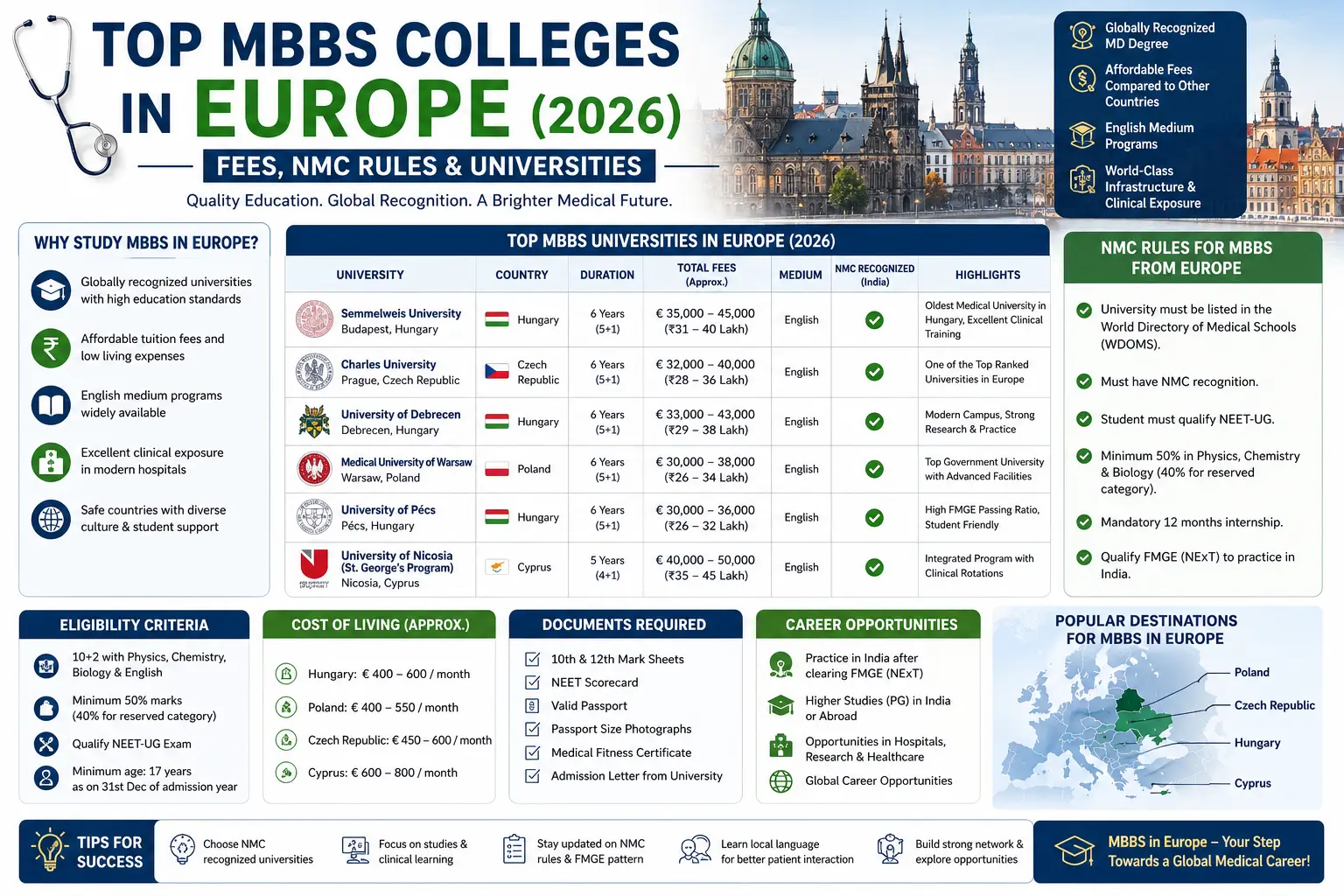
MBBS Colleges in Europe | Medical Colleges in Europe: The Ultimate 2026 Guide
For medical aspirants worldwide, securing a seat in a domestic university is increasingly competitive and prohibitively expensive. In India alone, millions of students compete for a fraction of available seats via the NEET exam. This bottleneck has transformed MBBS colleges in Europe into prime destinations for high-quality, affordable, and globally recognized medical education.
Whether your goal is to find the cheapest MBBS in Europe for Indian students, navigate the complex NMC (National Medical Commission) regulations, or discover the best medical schools in Europe taught in English, this comprehensive guide covers everything you need to know for the 2026 academic intake.
The Quick Answer:
European medical universities offer globally recognized degrees (MD/MBBS), English-taught curriculums, and compliance with international medical boards at a fraction of the cost of private institutions in the US, UK, or India. Countries like Georgia, Poland, and Bosnia offer highly affordable tuition combined with rigorous NMC compliance, making them the top destinations for the 2026 academic intake.
Table of Contents
- Why Choose Medical Colleges in Europe?
- NMC Guidelines 2026: Crucial Rules for Indian Students
- Is NEET Required for MBBS in Germany? (The Edge Case)
- MBBS in Europe for Indian Students Fees: Cost Breakdown
- Top 10 Medical Colleges in Europe Taught in English
- Country-by-Country Analysis: Which European Country is Best?
- How Can I Get a Scholarship to Study MBBS Abroad?
- Admission Process & Eligibility Requirements
- Career Trajectory: NExT, PLAB, and USMLE
- Frequently Asked Questions (FAQs)
1. Why Choose Medical Colleges in Europe?
Studying medicine in Europe is no longer just a “Plan B.” For many international students, it is a strategic first choice. Here is why the best medical colleges in Europe stand out:
- Global Recognition: Degrees from reputed European universities are recognized by the World Health Organization (WHO), the World Federation for Medical Education (WFME), and the Educational Commission for Foreign Medical Graduates (ECFMG).
- The ECTS Advantage: Most European medical schools operate on the European Credit Transfer and Accumulation System (ECTS). An MBBS requires 360 credits. This standardized system allows for easier credit recognition if you decide to pursue postgraduate studies elsewhere in the EU.
- English-Medium Programs: You do not need to be fluent in Polish, Hungarian, or Georgian to study medicine. The best medical schools in Europe taught in English offer 100% English curriculums specifically designed for international cohorts.
- Affordability: When evaluating MBBS in Europe fees, countries like Georgia, Poland, and Bosnia offer tuition rates starting as low as $4,000 (approx. ₹3.3 Lakhs) per year, compared to the exorbitant fees of private medical colleges in India.
- Advanced Clinical Exposure: To guarantee that students graduate with strong practical skills, European universities make significant investments in simulation facilities, robotic surgery training, and early clinical rotations.
2. NMC Guidelines 2026: Crucial Rules for Indian Students
If you are an Indian student planning to return home to practice, finding NMC approved medical colleges in Europe is your first hurdle. Technically, the NMC no longer publishes a “pre-approved” list of universities. Instead, it is the student’s responsibility to ensure the chosen university complies with the FMGL 2021 guidelines.
Here are the non-negotiable mandates:
- NEET Qualification: You must have a valid NEET-UG qualifying score before enrolling abroad.
- Minimum Course Duration: The academic medical course must last a minimum of 54 months (4.5 years).
- Mandatory Internship: You must complete a minimum 12-month compulsory clinical internship at the same foreign medical institution where you completed your academics. You cannot do your academics in Georgia and fly back to India for your internship.
- Medium of Instruction: The entire medical program must be taught in English. Bilingual programs (e.g., first three years in English, last three in Russian/Ukrainian) are strictly invalid for Indian licensing.
- Local Licensing: The degree you receive must grant you the right to register as a medical practitioner in the country where you studied. Academic graduation alone is insufficient; you must be eligible for a license in that European country.
- Curriculum Alignment: The curriculum must cover core subjects as mandated by the NMC, including Anatomy, Physiology, Pathology, Surgery, and Pediatrics.
- Completion Timeline: The entire process (course + internship) must be completed within 10 years from the date of joining.
Expert Warning: Never trust an educational agent who claims a university is “NMC Approved” if it offers a 5-year total program. Under current rules, the absolute minimum time spent abroad is 66 months (5.5 years).
3. Is NEET Required for Medicine in Germany? (The Edge Case)
One of the most frequent queries is: “Is NEET required for MBBS in Germany?” Depending solely on your long-term professional objectives, the answer is a two-edged sword.
The Reality of Germany:
- From the German Perspective: German public medical universities admit students based on their 12th-grade academic performance (Studentenkolleg/Feststellungsprüfung) and language proficiency, not the Indian NEET exam.
- From an Indian Point of View: Your medical degree would never be accepted in India if you studied in Germany without passing NEET. You will be permanently barred from sitting for the FMGE or NExT exams, meaning you cannot practice in India.
The Language Catch: While some private universities offer the initial years in English, clinical training in German hospitals requires direct patient interaction. Therefore, reaching C1-level proficiency in German is mandatory before you touch a patient. If you are looking for purely English-taught programs, Germany is usually not the best fit unless you are committed to mastering the language and permanently settling in the EU.
4. MBBS in Europe for Indian Students Fees: Cost Breakdown
When calculating how much does it cost to study MBBS abroad, you must factor in tuition, hostel accommodation, food, and visa renewals. Below is a comparative breakdown of the cheapest MBBS in Europe for Indian students versus premium destinations.
| Country | Average Annual Tuition (USD) | Est. Living Cost/Month (USD) | Medium of Instruction | NMC Compliant Programs? |
|---|---|---|---|---|
| Bosnia & Herzegovina | $3,500 – $4,500 | $200 – $300 | English | Yes |
| Belarus | $4,000 – $5,000 | $250 – $350 | English | Yes |
| Georgia | $5,000 – $8,000 | $300 – $450 | English | Yes |
| Poland | $12,000 – $16,000 | $400 – $600 | English | Yes |
| Hungary | $16,000 – $20,000 | $500 – $700 | English | Yes |
| Italy (Public) | $1,000 – $4,000* | $700 – $900 | English (IMAT required) | Yes |
*Italy calculates public university fees based on family income (ISEE), making it highly affordable, but securing a seat requires passing the highly competitive IMAT exam.
Where in Europe Can I Find the Cheapest Medical Colleges?
According to recent data, Bosnia has emerged as one of the most cost-effective destinations. For instance, the University of East Sarajevo charges approximately €3,500 (approx. ₹3.25 Lakhs) per year. The most sought-after locations for middle-class Indian families looking for affordable, top-notch medical schools in Europe are Georgia and Belarus.
5. Top 10 MBBS Colleges in Europe Taught in English
If you are compiling a list of medical colleges in Europe, you must filter out universities that teach clinicals in the local language. Here is a curated list of the top 10 medical colleges in Europe that offer robust English-taught programs.
- Semmelweis University (Hungary)
Why it ranks highly: Consistently ranked among the top 250 medical universities globally. It offers a 6-year MD program entirely in English.
Best for: Students aiming for academic prestige and USMLE preparation. - Medical University of Warsaw (Poland)
Why it ranks highly: Poland’s premier medical school. It has a large number of international students and state-of-the-art simulation facilities.
Best for: Students seeking a premium EU degree with excellent clinical exposure. - Tbilisi State Medical University (Georgia)
Why it ranks highly: The largest medical university in Georgia with a 6-year MD program perfectly aligned with NMC guidelines (5 years academics + 1 year internship).
Best for: Indian students looking for affordable, good medical colleges in Europe with a high FMGE pass rate. - Humanitas University (Italy)
Why it ranks highly: A top-tier private institution offering an innovative curriculum integrated with the Humanitas Research Hospital.
Best for: Students with a higher budget seeking cutting-edge research facilities. - Charles University, First Faculty of Medicine (Czech Republic)
Why it ranks highly: One of the oldest medical schools in the world. Its English program is highly rigorous and respected globally.
Best for: Highly academic students who can handle a demanding, traditional European curriculum. - European University (Georgia)
Why it ranks highly: Known for modern infrastructure and affordable fees. It has a massive Indian student community, making cultural adaptation seamless.
Best for: Students seeking the cheapest MBBS in Europe for Indian students without sacrificing facility quality. - University of Debrecen (Hungary)
Why it ranks highly: Features a sprawling campus and a curriculum heavily focused on practical training from the third year onward.
Best for: International students looking for a balanced student life and strong EU mobility. - Carol Davila University of Medicine and Pharmacy (Romania)
Why it ranks highly: Romania offers recognized EU degrees at a fraction of Western European costs. Carol Davila is its flagship institution.
Best for: Students looking for affordable EU-based education. - University of East Sarajevo (Bosnia & Herzegovina)
Why it ranks highly: Breaking into the market as one of the most cost-effective medical schools with a 6-year English program.
Best for: Budget-conscious students wanting high ROI. - Heidelberg University (Germany)
Why it ranks highly: A global powerhouse in medical research.
Best for: Caveat: Only suitable for those willing to master the German language, as English-only clinicals are not feasible.
6. Country-by-Country Analysis: Which European Country is Best?
MBBS in Georgia
MBBS in Georgia is currently the undisputed leader for Indian students.
- Pros: Highly affordable ($5,000–$8,000/year), low cost of living, massive Indian diaspora (access to Indian food/hostels), and universities strictly adhere to NMC’s 54+12 month rule.
- Cons: Not part of the European Union (EU) or Schengen zone, which slightly complicates mobility if you wish to practice in Western Europe later.
MBBS in Poland
Poland is ideal for students who want a recognized EU degree.
- Pros: High standard of education, fully part of the EU (graduates can practice across the EU easily), and strong USMLE track records.
- Cons: Higher tuition fees compared to Georgia/Belarus, and winters can be harsh.
MBBS in Italy
Italy offers a unique blend of heritage and modern medicine.
- Pros: Public universities are heavily subsidized based on family income. The degree is highly prestigious.
- Cons: Admission requires clearing the notoriously difficult International Medical Admissions Test (IMAT). Seats for non-EU students are highly limited.
MBBS in Belarus & Bosnia
Emerging as the new frontiers for affordable education.
- Pros: The absolute lowest tuition fees in Europe. Good safety records and English curriculums.
- Cons: Geopolitical considerations (specifically for Belarus regarding border mobility) require careful evaluation by parents.
7. How Can I Apply for a Scholarship to Study MBBS Abroad?
Since medicine is an expensive and resource-intensive discipline, full-ride scholarships are incredibly rare. However, there are options:
- Stipendium Hungaricum (Hungary): One of the most prestigious government-funded scholarships. It provides a monthly stipend, health insurance, and complete tuition. Indian students can apply through the bilateral agreement facilitated by the UGC (University Grants Commission).
- Italian Regional Scholarships (DSU): Italian public universities offer scholarships based on your family’s financial index (ISEE). If you secure a seat via IMAT, you can apply for the DSU, which can bring your tuition down to zero and provide free meals and hostel accommodation.
- Merit-Based University Discounts: Students who place in the top 5% of their class are frequently granted 10% to 20% tuition price discounts starting in their second year at universities in Georgia and Poland.
- Early Bird/Dean’s Grants: International students who apply early and have outstanding high school grades may be eligible for small bursaries from certain private medical schools in Europe.
8. Admission Process & Eligibility Requirements
Securing admission into MBBS universities in Europe is generally straightforward compared to the NEET bloodbath, but it requires careful documentation.
General Eligibility Criteria:
- Academics: A minimum of 50% to 60% aggregate marks in 12th grade (Physics, Chemistry, Biology). For reserved categories in India, this is often relaxed to 40%–45%.
- Age: Must be at least 17 years old by December 31st of the admission year.
Entrance Exams & Language:
- For Indian Students: NEET-UG qualification is mandatory to comply with NMC rules.
- University Entrance: Many European universities conduct their own online entrance exams (MCQs on PCB) and a basic Skype interview.
- Language: IELTS or TOEFL is required by some universities (like in Poland or Hungary), though many universities in Georgia and Belarus waive this if your high school medium of instruction was English.
9. Career Trajectory: NExT, PLAB, and USMLE
Graduating from Europe is just step one. To practice, you must clear licensing exams depending on your target country:
- Returning to India (FMGE / NExT): Currently, Foreign Medical Graduates (FMGs) must pass the FMGE (screening test) to practice in India. By the time 2026 enrollees graduate, the National Exit Test (NExT) will be the universal licensing exam. European curriculums, with their strong clinical focus, are excellent preparation for NExT.
- Moving to the UK (PLAB / UKMLA): Many students who study in Eastern Europe opt to give the PLAB (soon transitioning to UKMLA) to practice in the NHS. English-medium European degrees are highly respected by the UK’s General Medical Council (GMC).
- Moving to the USA (USMLE): If your goal is a US residency, ensure your European university is listed in the World Directory of Medical Schools (WDOMS) with an ECFMG sponsor note. Students from Polish and Hungarian universities have a good history of being accepted into US residency programs.
10. Frequently Asked Questions (FAQs)
1. Which European country is best for MBBS?
The best country depends on your goals. Georgia is excellent for affordability and strict NMC compliance. Poland and Hungary offer premium education and seamless EU/US mobility, while Italy is best for highly affordable public education if you can clear the IMAT exam.
2. Is NEET required for MBBS in Germany?
NEET is not a prerequisite for admission to German institutions. However, if an Indian student wishes to practice medicine in India after graduation, the NMC makes NEET qualification mandatory prior to joining the foreign course.
3. How much does it cost to study MBBS abroad in Europe?
The cost of studying MBBS in Europe for Indian students ranges from $3,500 to $20,000 per year. Countries like Bosnia, Belarus, and Georgia offer the cheapest tuition (under $7,000/year), while Poland and Hungary range from $12,000 to $20,000 annually.
4. Are there medical schools in Europe taught in English?
Yes, hundreds of medical schools in Europe offer 100% English-taught MBBS/MD programs tailored for international students. Popular destinations include Georgia, Poland, Hungary, Czech Republic, and Bosnia.
5. Can I get a scholarship to study MBBS abroad?
While full scholarships are rare, you can apply for government grants like the Stipendium Hungaricum in Hungary, the DSU in Italy, or merit-based tuition waivers (10-20%) offered directly by universities in Eastern Europe.
6. What are the NMC guidelines for MBBS abroad regarding internship?
The NMC strictly mandates that students must complete a minimum 12-month internship at the exact same foreign medical institution where they completed their 54-month academic course. You cannot do the internship in India or a third country.
7. Are degrees from private medical colleges in Europe recognized?
Yes, as long as the private medical college is recognized by the country’s local Ministry of Health and listed in the World Directory of Medical Schools (WDOMS), the degree is valid globally.
8. What is the processing time for European MBBS admissions?
The entire process, from university selection to visa approval, generally takes 45 to 60 days. It is advised to begin applications by June for the September intake.