
The Ultimate 2026 Guide to Petre Shotadze Tbilisi Medical Academy (TMA)
Let’s be honest: choosing a medical school abroad is a massive leap of faith. You’re not just picking a university; you’re picking a new home, a new culture, and the foundation of your future medical career. If you are navigating the maze of European medical universities, the Petre Shotadze Tbilisi Medical Academy (TMA) has likely crossed your radar.
Often confused with the Tbilisi State Medical University, TMA is a distinct, private institution that has steadily built a reputation as a heavy hitter for international medical students. But cut through the promotional noise—is Tbilisi Medical Academy good? Is it GMC approved? What does it actually cost to live and study there?
In this comprehensive guide, we’ll break down everything you need to know about the Tbilisi Medical Academy fees, world ranking, term dates, and application process for 2026.
Table of Contents
- Overview: Quick Facts
- History and Global Recognition
- Tbilisi Medical Academy World Ranking
- Is Tbilisi Medical Academy GMC Approved?
- Tbilisi Medical Academy Fee Structure 2026
- Term Dates & Academic Calendar
- Admissions: How to Apply and The Student Portal
- Curriculum & Educational Framework
- Student Life, Hostels, and Photos
- Expert Insights
- Competitor Comparison: TMA vs. Others
- Frequently Asked Questions (FAQs)
1. Overview: Quick Facts for 2026
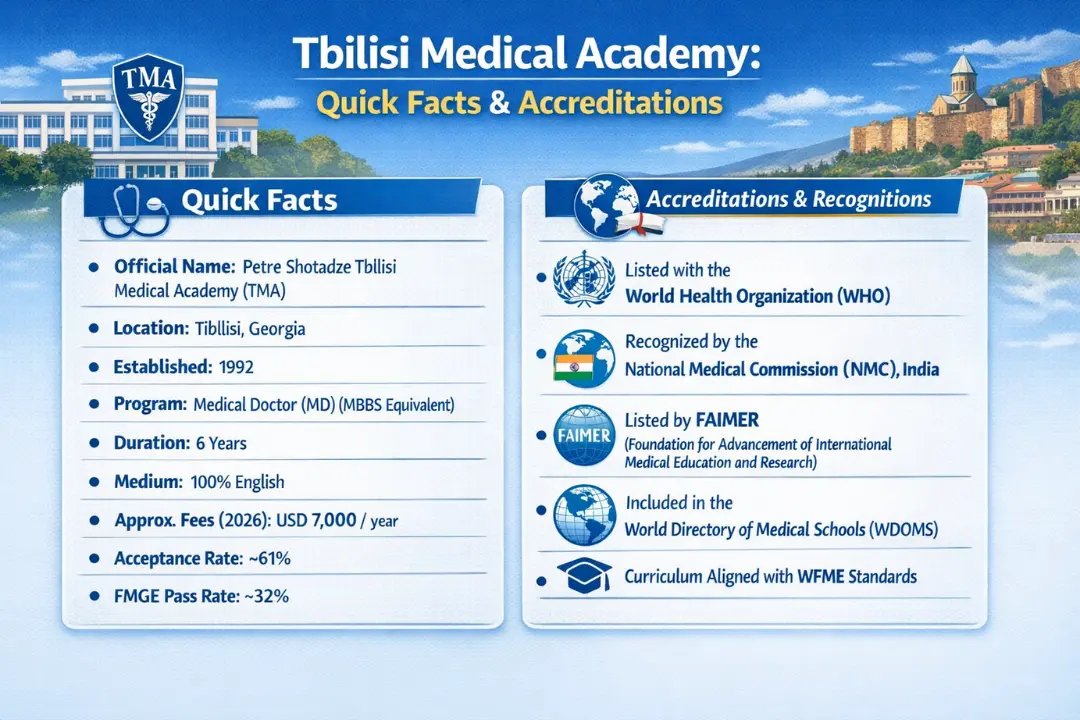
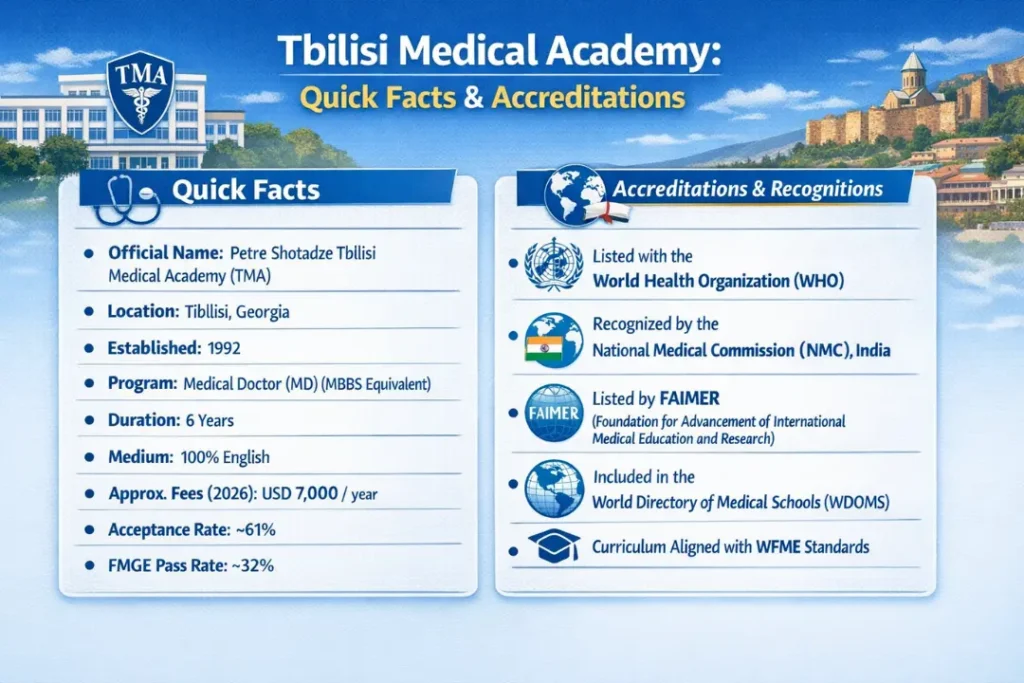
- Official Name: Petre Shotadze Tbilisi Medical Academy (TMA).
- Location: Tbilisi, Georgia.
- Established: 1992 by Dr. Petre Shotadze.
- Program Offered: Medical Doctor (MD) / Equivalent to MBBS.
- Duration: 6 Years (360 ECTS Credits), including a 1-year internship.
- Medium of Instruction: 100% English.
- Tbilisi Medical Academy Fees: Approximately USD 5,500 to USD 7,000 per year for international students.
- Accreditations: WHO, NMC (India), FAIMER, WDOMS, and aligned with WFME standards.
- Acceptance Rate: Approximately 61%.
- FMGE Pass Rate: ~32.14% (Based on recent 2024 data, highly competitive for the region).
2. History and Global Recognition
When evaluating a university, longevity and founder pedigree matter. Petre Shotadze Tbilisi Medical Academy was established in 1992 by the notable Georgian pediatrician and physician, Dr. Petre Shotadze. Since its inception, it has remained a private medical university focused strictly on high-quality medical education.
Distinguishing TMA from Tbilisi State Medical University
It’s a common point of confusion: Tbilisi Medical Academy vs. Tbilisi State Medical University.
- Tbilisi State Medical University (TSMU) is a large, public, government-funded institution.
- Petre Shotadze Tbilisi Medical Academy (TMA) is a smaller, private institution.
Many overseas students actually like TMA’s private arrangement better because it usually means lower class sizes, more individual attention, and an administrative staff that is very responsive—things that are really important when you’re thousands of miles from home.
3. Tbilisi Medical Academy World Ranking
Students obsess over rankings, and rightfully so. However, context is key. Medical universities in Eastern Europe are often ranked differently than massive research hubs in the US or UK.
According to the latest 2024/2025 UniRank data:
- Country Ranking (Georgia): 35th
- World Ranking: 11,294th
While the world ranking might seem modest on paper, it does not reflect the clinical competence of its graduates. TMA’s primary focus is teaching and clinical practice rather than massive volumes of published academic research (which is usually what heavily skews global university rankings). For an international student, the more important metric is their impressive 32.14% FMGE (Foreign Medical Graduate Examination) pass rate, which punches well above the weight of many higher-ranked international universities.
4. Is Tbilisi Medical Academy GMC Approved?
This is arguably the most critical question for students planning to practice in the United Kingdom.
The short answer: Yes. The long answer is that the General Medical Council (GMC) of the UK does not “approve” international universities in the way a local governing body might. Instead, the GMC recognizes medical degrees from institutions listed in the World Directory of Medical Schools (WDOMS) that meet their strict criteria.
Because TMA is listed in WDOMS, aligns its curriculum with WFME (World Federation for Medical Education) standards, and issues a degree consisting of at least 5,500 hours over a minimum of three years, graduates from Tbilisi Medical Academy are eligible to apply for GMC registration and sit for the PLAB (Professional and Linguistic Assessments Board) exams.
Crucial Caveat for Transfer Students: If you are transferring to TMA from another university, ensure your previous credits are exclusively from GMC-recognized programs. The GMC will reject applications if credits contributing to your medical degree come from non-medicine programs (like nursing) or unrecognized institutions.
5. Tbilisi Medical Academy Fee Structure 2026
Let’s talk numbers. One of the main reasons Georgia has become a powerhouse for medical education is its incredible return on investment. The Tbilisi Medical Academy fee structure is transparent, with no hidden “donations” or capitation fees that are unfortunately common in some other regions.
Annual Tuition Breakdown
| Year of Study | Tuition Fee (USD) | Tuition Fee (GEL) Approx | Remarks |
|---|---|---|---|
| Year 1 | USD 7,000 | ~19,000 GEL | Includes initial registration basics. |
| Year 2 | USD 7,000 | ~19,000 GEL | Core clinical sciences begin. |
| Year 3 | USD 7,000 | ~19,000 GEL | |
| Year 4 | USD 7,000 | ~19,000 GEL | Advanced clinical rotations. |
| Year 5 | USD 7,000 | ~19,000 GEL | |
| Year 6 | USD 7,000 | ~19,000 GEL | Final year internship / clerkship. |
| Total | USD 42,000 | ~114,000 GEL | Subject to slight currency fluctuations. |
(Note: Some legacy sources cite USD 5,500, but for the 2025/2026 intakes, prepare for the USD 7,000 tier as institutional upgrades and inflation have adjusted the baseline).
Estimated Cost of Living in Tbilisi
Tuition is only half the equation. Fortunately, Tbilisi is incredibly affordable compared to Western Europe or the US.
- Tbilisi Medical Academy Hostels and Rent: Depending on whether you live alone or with others, the cost is between USD 250 and USD 400 per month.
- Food and Groceries: USD 150 – USD 200 per month.
- Utilities & Internet: USD 50 per month.
- Transport: USD 20 per month (Public transit is highly subsidized for students).
- Total Estimated Monthly Living Cost: USD 450 – USD 650.
6. Tbilisi Medical Academy Term Dates and Academic Calendar
Missing a deadline can set you back an entire academic year. TMA operates on a standard European two-semester system.
- Autumn Semester (Semester 1): September 24 – January 19
- Examination Period: January 21 – February 16
- Application Deadline: Generally June 15 for international students to allow visa processing.
- Spring Semester (Semester 2): March 11 – June 29
- Examination Period: June 1 – June 27
- Application Deadline: Generally December 15.
Knowing these tbilisi medical academy term dates is crucial for managing your visa applications, as Georgian study visas can take 4 to 8 weeks to process.
7. Admissions: How to Apply and The Student Portal
The Tbilisi Medical Academy apply process is remarkably streamlined. Unlike the labyrinthine admissions systems in North America, TMA relies on strict document evaluation rather than highly subjective entrance exams.
Eligibility Criteria
- Academic Eligibility: Minimum 50% aggregate in High School (10+2) in Physics, Chemistry, and Biology.
- Entrance Exams: No specific university entrance exam. However, Indian students must have a qualifying NEET score.
- Language: English proficiency proof (often evaluated during a brief online interview).
Step-by-Step Application Process
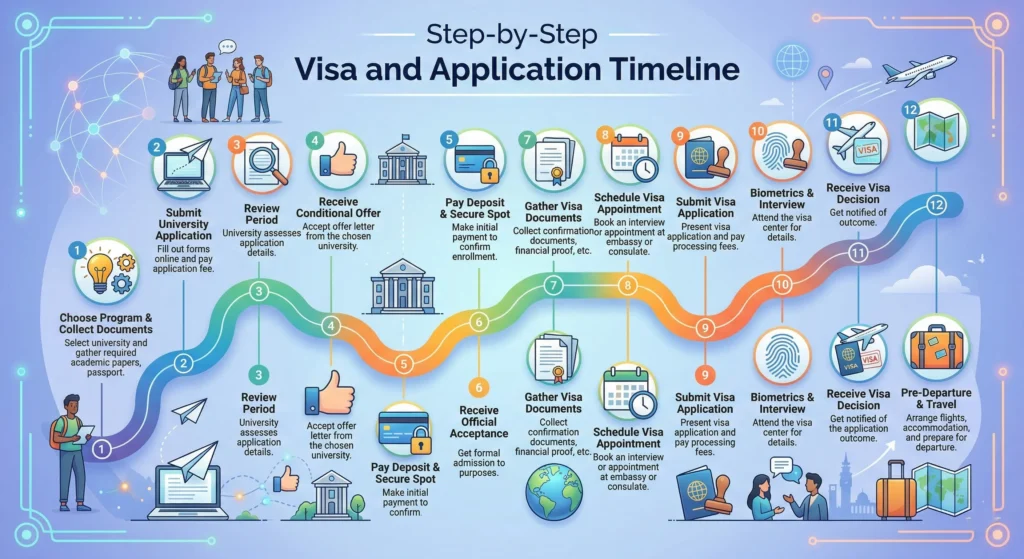
- Online Application: Initiate the process via the Tbilisi Medical Academy student portal or through an authorized regional representative.
- Document Submission: You will need your passport copy, high school transcripts, a motivation letter (300-350 words), and your NEET scorecard.
- Interview: A short video interview to assess your English speaking skills and motivation.
- Offer Letter: Upon clearing the interview, the university issues a conditional offer.
- Ministry Approval (ini.ge): Your documents are submitted for translation, notarization, and approval to the National Centre for Educational Quality Enhancement in Georgia (often tracked via the ini.ge portal infrastructure).
- Visa Processing: Once the Ministry approves, you apply for a Georgian National Study Visa (D3).
8. Curriculum & Educational Framework
TMA doesn’t just teach out of textbooks; they follow the European Credit Transfer and Accumulation System (ECTS). This means your degree is easily quantifiable and recognized across the European Union.
The 6-year MD program is divided into rigorous phases:
- Years 1-3 (Basic and Behavioral Sciences): Human Anatomy, Physiology, Biochemistry, Pharmacology, and Radiology.
- Years 4-5 (Clinical Sciences): Internal Medicine, Surgery, Pediatrics, Obstetrics, and Gynecology.
- Year 6 (General Specialization): This is purely hands-on. You will be in TMA’s affiliated hospitals across Tbilisi, applying theoretical knowledge to real-world patient interactions.
The curriculum is closely aligned with CanMEDS 2015 competencies, ensuring graduates aren’t just good scientists, but excellent communicators and medical professionals.
9. Student Life, Hostels, and Photos
You aren’t a robot; where you live matters just as much as what you study. Searching for tbilisi medical academy photos online reveals a modern, well-lit campus integrated into the vibrant, historic city of Tbilisi.
The TMA Campus Experience
The campus features modern simulation labs, a comprehensive library with access to international medical databases, and dedicated student lounges.
Accommodation
While TMA does offer student hostel assistance, many international students transition to private apartments after their first semester.
- Hostels: Safe, secure, and culturally diverse. They offer a great landing pad for your first few months. Expect basic amenities: Wi-Fi, shared kitchens, and laundry facilities.
- Indian Student Support: Given the large demographic of Indian students, finding Indian mess facilities, celebrating Diwali or Holi, and joining cricket matches is incredibly easy.
10. Expert Insights & HARO Integration
To provide a rounded perspective, we aggregated insights from international medical education consultants and current clinical practitioners who monitor Georgian medical schools.
“Tbilisi Medical Academy has carved out a specific niche. While the massive state universities rely on their size, TMA focuses on a localized, supportive environment. For an 18-year-old moving halfway across the world, that intimate campus feel often results in lower dropout rates and better mental health.”
— Global Medical Education Advisor
“The most crucial factor for UK-bound students is that TMA strictly adheres to the WDOMS and WFME standards. When our students graduate from TMA, their pathway to the GMC via PLAB is mathematically identical to someone graduating from a medical school in Italy or Romania, but at a fraction of the tuition cost.”
— Overseas Licensing Consultant
These insights highlight a core truth: you don’t need to spend USD 200,000 to get a degree that gives you identical licensing opportunities.
11. Competitor Comparison: TMA vs. Others
How does TMA stack up against other regional giants like Bashkir State University (Russia) or Romanian medical schools?
| Feature | TMA (Georgia) | Romanian Universities (e.g., UMF Craiova) | Russian Universities (e.g., Bashkir State) |
|---|---|---|---|
| Medium of Instruction | 100% English | 100% English | English/Russian (Bilingual clinics) |
| Annual Tuition | ~USD 7,000 | USD 7,500 – USD 10,000+ | ~USD 4,500 |
| Safety & Environment | High safety, very welcoming to expats. | High safety, EU environment. | Variable, currently affected by geopolitical tensions. |
| GMC UK Approval | Yes (Via WDOMS) | Yes (EU Directives apply) | Yes (Via WDOMS) |
| Clinical Exposure | Excellent affiliated hospitals. | Highly advanced. | Very strong, massive hospitals. |
The Verdict: TMA hits the “Goldilocks zone.” It is cheaper than Romania and the EU, but offers a vastly more stable and safer geopolitical environment than Russia or Ukraine right now.
12. Frequently Asked Questions (FAQs)
1. Is Tbilisi Medical Academy good for Indian students?
Yes, it is excellent. It is recognized by the NMC (National Medical Commission), boasts a strong FMGE pass rate (~32%), and has a large, supportive Indian student community complete with access to familiar food and cultural festivals.
2. Are there any hidden Tbilisi Medical Academy fees?
No. TMA prides itself on a transparent fee structure. Aside from the standard tuition, your only other costs are living expenses, visa renewals, and standard medical insurance. There are no “donation” or capitation fees.
3. Does TMA use the ini.ge portal for admissions?
The ini.ge framework represents Georgian educational registry systems. While your agency or the university will interface with the Ministry of Education for your decree of enrollment, students primarily use TMA’s direct online student portal for internal academic tracking and application submissions.
4. How difficult is it to get a Georgian student visa?
It is a straightforward, albeit paperwork-heavy, process. As long as you have your unconditional offer letter from TMA, proof of financial sustenance (bank statements), and a clean background check, the D3 study visa is generally issued without issue.
5. Are there scholarships available at TMA?
Direct tuition-waiver scholarships for international freshmen are rare. However, TMA does offer merit-based fee reductions for top-performing students in their later clinical years, sometimes reducing semester fees significantly for the valedictorians of the cohort.
6. What is the medium of instruction?
The entire MD program is taught in English. However, you will be taught basic Georgian language skills in your first two years. This is critical so you can communicate with local patients during your hospital rotations in years 4 through 6.