
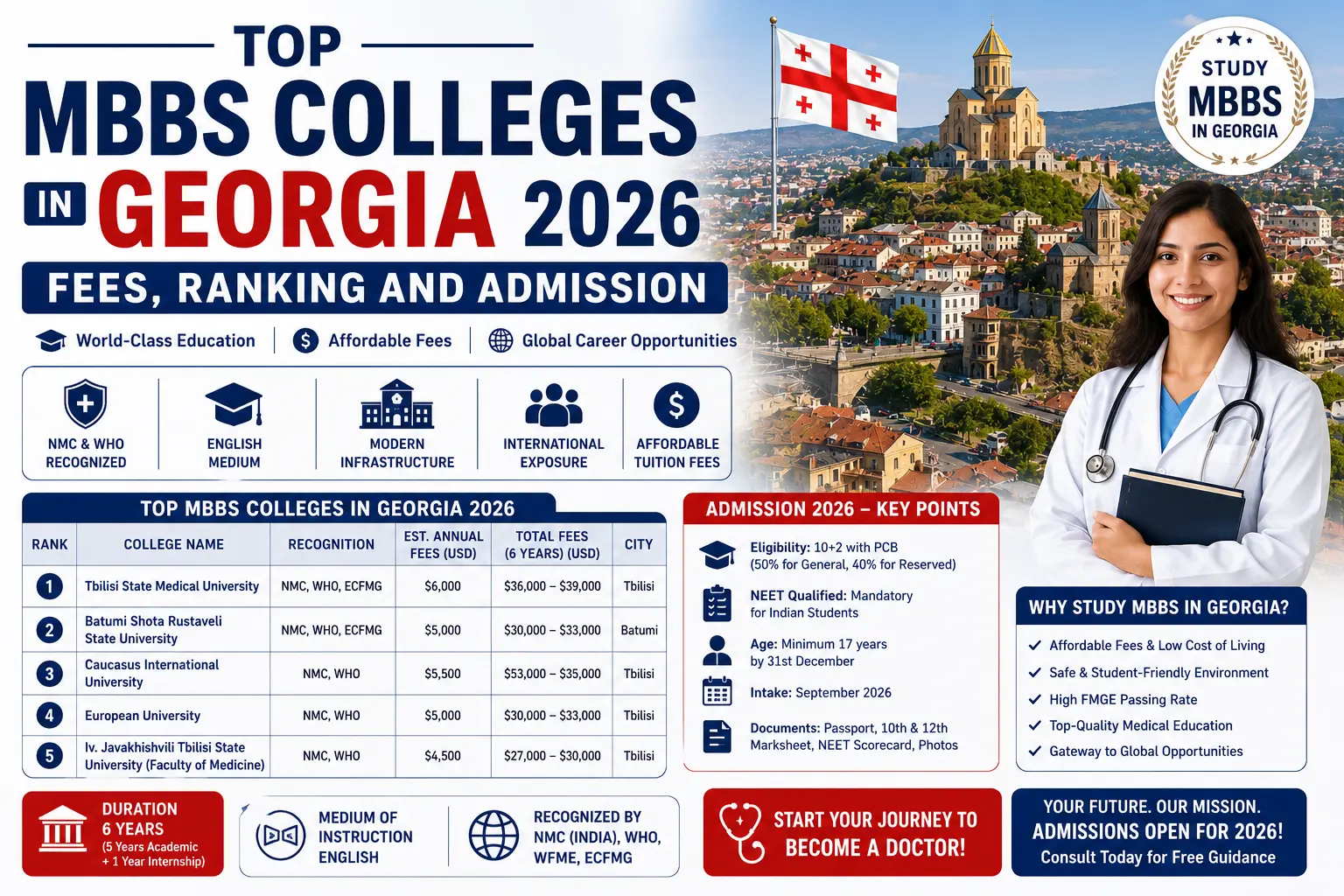
Top MBBS Colleges in Georgia 2026: Fees, Ranking and Admission
Today, if you’re looking for the best universities for mbbs in Georgia, you aren’t just looking at a backup option; you’re looking at a primary destination that competes fiercely with traditional heavyweights like Russia and the Philippines.
Why? Because the top MBBS colleges in Georgia have perfectly cracked the code: they offer globally recognized degrees (NMC, WHO, ECFMG), ultra-modern robotic simulation labs, and affordable tuition—all nestled in a country that is incredibly safe and welcoming for international students.
Whether you’re a frustrated NEET aspirant tired of the hyper-competitive Indian medical seat crunch, or an international student eyeing the USMLE pathway, finding the best medical college in Georgia can be your golden ticket. Let’s cut through the marketing noise and look at the hard facts, fees, FMGE passing rates, and my personal, on-the-ground insights.
Table of Contents
- Why Study MBBS in Georgia in 2026?
- Top 5 Medical Universities in Georgia: Deep Dive
- The Complete Georgia Medical College List (By City)
- Public vs. Private MBBS Colleges in Georgia
- MBBS in Georgia Fees Structure (2026-2027)
- Eligibility Criteria & Admission Process
- NMC Guidelines & FMGE/NExT Performance
- Life in Georgia: What the Brochures Don’t Tell You
- Career Pathways: USMLE, PLAB and Returning to India
- Expert Advice: How to Avoid Admission Scams
- Frequently Asked Questions (FAQs)
Why Study MBBS in Georgia in 2026?
The search for the Georgia best medical university usually starts with one question: Is it really worth it? Having vetted over 20 universities across Eastern Europe, I can confidently tell you that Georgia currently offers the highest ROI for medical students. Here’s the reality check:
- Strict NMC Compliance: The National Medical Commission (India) rolled out stringent guidelines in 2021 (requiring a 54-month course + 12-month internship, English medium, and local licensing). Georgia’s 6-year MD program complies with this flawlessly.
- Global Accreditations: Degrees from top medical universities in Georgia are recognized by the World Health Organization (WHO), the World Federation for Medical Education (WFME), and the Educational Commission for Foreign Medical Graduates (ECFMG). This means you are eligible to write the USMLE (USA) and PLAB (UK).
- No Hidden Entrance Exams: Unlike Indian private colleges demanding massive capitation fees, or Italian universities requiring the grueling IMAT, admission to a Georgia Top mbbs university relies entirely on your 12th-grade PCB scores and NEET qualification (for Indians).
- Safety & Lifestyle: Georgia routinely ranks in the top 10 safest countries in the world. For parents sending their 18-year-olds 3,000 miles away, peace of mind is priceless.
Top 5 Medical Universities in Georgia: Deep Dive
When students ask me to name the best university in georgia for mbbs, I tell them it depends on their end goal. Are you looking for historical prestige, budget-friendly tuition, or USMLE preparation? Here are the undisputed top 5 medical universities in Georgia.
1. Tbilisi State Medical University (TSMU)
- Type: Public / Government
- Established: 1918
- Location: Tbilisi
- Annual Tuition: ~$8,000 USD
- The Verdict: TSMU is the undisputed king of medical education in Georgia. As the oldest and largest government medical college, it operates six of its own university clinics. The clinical exposure here is unmatched. It also offers a specialized “American MD” program in collaboration with Emory University (USA), making it the ultimate launchpad for the USMLE. If budget is not your primary constraint, this is the best mbbs college in Georgia.
2. David Tvildiani Medical University (DTMU)
- Type: Private
- Established: 1989
- Location: Tbilisi
- Annual Tuition: ~$8,000 USD
- The Verdict: If you are hyper-focused on clearing the USMLE or FMGE, DTMU is a powerhouse. It was the first non-governmental medical university in Georgia. Their curriculum is essentially a mirror image of the US medical syllabus. It is notoriously strict, heavily academic, and has consistently delivered some of the highest FMGE pass rates among Georgian institutions.
3. Georgian National University (SEU)
- Type: Private
- Established: 2001
- Location: Tbilisi
- Annual Tuition: ~$5,500 – $6,300 USD
- The Verdict: SEU represents the new-age georgia top medical university. Walking into SEU feels like walking into a Silicon Valley tech campus. They have invested millions into their robotic simulation labs and 3D anatomy centers. It is slightly more affordable than TSMU and boasts a massive, vibrant international student community.
4. Batumi Shota Rustaveli State University (BSU)
- Type: Public / Government
- Established: 1923
- Location: Batumi (Coastal City)
- Annual Tuition: ~$4,000 – $5,000 USD
- The Verdict: Located in the stunning coastal city of Batumi, BSU offers the best value for money. At roughly $4,000 a year, it is a highly budget-friendly government option. The lifestyle in Batumi is more relaxed than in the bustling capital of Tbilisi, but the clinical exposure in their affiliated coastal medical centers remains top-tier.
5. University of Georgia (UG)
- Type: Private
- Established: 2004
- Location: Tbilisi
- Annual Tuition: ~$6,000 USD
- The Verdict: Often confused with TSU, the University of Georgia (UG) is a premier private institution. It holds the top country rank among private institutions for its “Integrated American Program.” With visiting faculty from Western Europe and the US, UG offers a truly cosmopolitan learning environment.
The Complete Georgia Medical College List (By City)
Beyond the top 5, there are over 30 NMC-approved medical colleges in Georgia. To make your search for the top medical college in Georgia easier, I’ve categorized the most reputable ones by location.
Tbilisi (The Capital Hub)
Most students prefer Tbilisi because of its connectivity, large Indian diaspora, and concentration of multi-specialty hospitals.
- Ivane Javakhishvili Tbilisi State University (TSU)
- Caucasus International University (CIU)
- New Vision University (NVU)
- European University (EU)
- East European University (EEU)
- Alte University
- Petre Shotadze Tbilisi Medical Academy
Batumi & Kutaisi (Affordable & Scenic)
- BAU International University (Batumi)
- Avicenna Batumi Medical University
- Akaki Tsereteli State University (Kutaisi)
Public vs. Private MBBS Colleges in Georgia
When I counsel students, this is the most frequent conundrum I encounter.
Public Universities (e.g., TSMU, BSU, TSU)
- Pros: Deep historical roots, massive government-funded hospitals, high patient footfall (crucial for clinical years), and unmatched prestige.
- Cons: Bureaucracy can be slow. When compared to their private counterparts, the infrastructure of older hospital wings may appear outdated.
Private Universities (e.g., SEU, DTMU, UG)
- Pros: Ultra-modern infrastructure, student-centric administration, smaller batch sizes, and highly modernized curricula geared heavily toward foreign licensing exams.
- Cons: Often rely on private hospital tie-ups for clinical rotations rather than owning massive multi-specialty clinics.
My Takeaway: If you want raw clinical exposure and prestige, go Public (TSMU). If you want modern facilities, smaller classes, and a laser focus on passing the FMGE/USMLE, go Private (DTMU or SEU).
MBBS in Georgia Fees Structure (2026-2027)
Let’s talk numbers. The best college in georgia for mbbs doesn’t have to bankrupt you. A reasonable cost breakdown is shown below. Note that the course duration is 6 years.
| Medical University | Annual Tuition (USD) | Annual Hostel (USD) | Approx. Total for 6 Yrs (INR) |
|---|---|---|---|
| Tbilisi State Medical University | $8,000 | $2,500 – $3,500 | ₹42 Lakhs – ₹48 Lakhs |
| David Tvildiani Medical University | $8,000 | $2,500 – $3,000 | ₹42 Lakhs – ₹46 Lakhs |
| Georgian National University (SEU) | $5,500 – $6,300 | $2,000 – $3,000 | ₹32 Lakhs – ₹38 Lakhs |
| University of Georgia (UG) | $6,000 | $2,500 – $3,000 | ₹34 Lakhs – ₹39 Lakhs |
| Batumi Shota Rustaveli State | $4,000 – $5,000 | $2,000 – $2,500 | ₹24 Lakhs – ₹28 Lakhs |
| Caucasus International University | $5,500 | $2,500 | ₹30 Lakhs – ₹34 Lakhs |
| Alte University | $5,900 | $2,500 | ₹32 Lakhs – ₹36 Lakhs |
Financial Tip:
The cost of living in Georgia ranges from $200 to $350 per month, depending on whether you live in a university dorm or rent a private apartment with friends. Groceries are cheap, but imported Indian goods carry a premium.
Eligibility Criteria & Admission Process
Applying to the top mbbs colleges in georgia country is surprisingly straightforward. Georgia has eliminated the bureaucratic nightmares that plague other European countries.
The Eligibility Checklist (For Indian Students)
- Academic: 50% aggregate in Physics, Chemistry, and Biology (PCB) in 12th standard (40% for reserved categories).
- Age: Must be 17 years old by December 31st of the admission year.
- NEET: You MUST be NEET-qualified in the year of admission (or have a valid scorecard from the previous years, as per NMC validity rules). Without NEET, you cannot return to India to practice.
- Language: English proficiency. While IELTS/TOEFL is rarely mandatory, you must pass a basic English interview conducted by the university over Skype/Zoom.
Step-by-Step Admission Process (Schema: HowTo)
- Document Submission: Submit 10th and 12th mark sheets, NEET scorecard, and passport copy to your chosen university.
- Offer Letter: Within 5-7 days, you will receive a Conditional Offer Letter.
- Ministry Approval: The university applies to the Ministry of Education and Science (Georgia) for your student accreditation. (Takes 2-4 weeks).
- Visa Application: Once the Ministry approves, you apply for the Georgian Study Visa (D3 category).
- Fly to Georgia: Pack your bags! Universities typically have intakes in September and February.
NMC Guidelines & FMGE/NExT Performance
The elephant in the room for any Indian student studying abroad is the Foreign Medical Graduates Examination (FMGE) / National Exit Test (NExT).
In 2021, the NMC dictated that foreign medical graduates must study a course of at least 54 months, complete a 12-month internship in the same institution, and obtain a license to practice in the host country.
Do the medical colleges in Georgia comply?
Yes. Georgia’s MD degree is exactly 6 years (360 ECTS credits), which inherently includes clinical clerkships and a final year of internship. Upon graduation, you are eligible to register with the Georgian medical council, thereby fulfilling the NMC’s licensing criteria.
Analyzing FMGE Pass Rates
Georgian universities have a respectable FMGE passing rate, according to historical data.
- Tier 1 Performers (45% – 55% Pass Rate): DTMU, TSMU, SEU, and UG consistently top the charts. Their strict internal assessments weed out non-serious students early on.
The Reality Check: A university doesn’t pass the exam; you do. The high pass rates at places like DTMU are due to their grueling academic schedules. If you go to a cheaper, lower-tier university and skip classes, your chances of passing NExT are near zero.
Life in Georgia: What the Brochures Don’t Tell You
As someone who has spent significant time in Tbilisi, I want to give you the unvarnished truth about student life.
- The Weather Shock: Indian students are used to the heat. Georgia has a temperate climate. Winters (December to February) can drop to 0°C to 5°C. You will need proper thermal wear, but all indoor spaces and hostels are centrally heated.
- The Food Situation: Yes, there are Indian mess facilities and Indian restaurants in Tbilisi and Batumi. However, eating Indian food every day is expensive. Learn to cook. Supermarkets (like Carrefour and Fresco) are stocked with fresh produce, lentils, and chicken.
- The Locals: Georgians are fiercely proud, deeply hospitable, and generally conservative. Respect their culture. While the younger generation speaks English, learning basic Georgian (Gamarjoba – Hello, Madloba – Thank you) goes a long way, especially during your clinical years when interacting with patients.
- Clinical Rotations: In your 4th, 5th, and 6th years, you will be in hospitals. Patients speak Georgian. Your university will provide a translator (usually your professor), but your ability to take a patient’s history will depend heavily on the local language classes you take in your first two years. Do not ignore them!
Career Pathways: USMLE, PLAB and Returning to India
Graduating from the georgia best medical university opens doors globally. You are not restricted to returning to India.
- Returning to India: Clear the FMGE/NExT, complete a 1-year mandatory internship (CRMI) in an Indian hospital, and you are a registered doctor.
- The USA Pathway (USMLE): Many Georgian universities (like TSMU and DTMU) have curricula modeled after the USMLE. In your third or fourth year, you can take USMLE Step 1, and in your sixth year, you can take Step 2 CK.
- The UK Pathway (PLAB/UKMLA): Since Georgian universities are in the WDOMS directory, you are fully eligible to write the PLAB and enter the NHS framework in the UK.
- Staying in Europe: Through the Bologna Process, European credits are transferable. With some language proficiency exams (like the Approbation in Germany), moving across Europe is highly feasible.
Expert Advice: How to Avoid Admission Scams
The booming popularity of MBBS in Georgia has bred a cottage industry of unscrupulous educational agents.
Expert Insight:
“Every year, we see students who were promised $2,000/year tuition, only to arrive in Georgia and find out that the university doesn’t even have WHO recognition, or they were enrolled in a bilingual program instead of a purely English one. Always check the WDOMS list yourself.”
— Dr. Sameer Khan, International Medical Graduate and Advocate.
My Golden Rules for Applicants:
- Check the Instructional Medium: Make sure your offer letter clearly specifies that the course will be taught entirely in English for the full six years.
- Never Pay Tuition to an Agent in Cash: Tuition fees should always be transferred directly to the University’s official bank account via swift transfer.
- Check NMC Compliance: Confirm that the university allows you to do the internship locally and provides you with the right to practice, fulfilling the 2021 NMC gazette.
Conclusion
Finding the best medical college in Georgia requires looking past the shiny brochures and focusing on what matters: accreditations, clinical infrastructure, USMLE/NExT orientation, and transparent fee structures. Whether you choose the historical prestige of Tbilisi State Medical University, the high-tech campus of SEU, or the coastal charm of Batumi State University, Georgia offers a robust, globally recognized medical education.
Choosing Georgia in 2026 is a calculated decision for a global medical career, not a compromise. Do your research, choose a university that aligns with your clinical goals, and prepare to work hard.
Frequently Asked Questions (FAQs)
1. Which is the best university in Georgia for MBBS?
Because of its clinical facilities, history, and partnership with Emory University, Tbilisi State Medical University (TSMU) is regarded as the top public university. In terms of academics and facilities, Georgian National University (SEU) and David Tvildiani Medical University (DTMU) are the best private universities.
2. Does Georgia’s MBBS program require NEET?
Yes, for Indian students intending to return to India to practice, qualifying the NEET exam is absolutely mandatory before taking admission in any Georgian medical university.
3. What is the total cost of studying MBBS in Georgia?
The total cost, including tuition, hostel, and living expenses for the entire 6-year duration, generally ranges between ₹25 Lakhs to ₹45 Lakhs, depending on the university and your lifestyle.
4. Are Georgian medical degrees valid in the USA and UK?
Yes. Degrees from top medical universities in Georgia are recognized by WHO, WDOMS, ECFMG, and FAIMER, making graduates fully eligible for the USMLE (USA) and PLAB (UK).
5. Do I need to learn the Georgian language?
The entire MBBS curriculum is taught in English. However, throughout your first two years, you will be required to take Georgian language studies. Learning the basics is crucial for interacting with patients during your clinical rotations in hospitals.
6. Does the MBBS in Georgia comply with the latest 2021 NMC rules?
Yes. The 6-year MD program in Georgia includes 5 years of academic study and 1 year of clinical internship, satisfying the NMC’s requirement of a minimum 54-month course plus a 12-month internship. Furthermore, graduates are eligible for registration in Georgia, satisfying the NMC’s licensing criteria.
7. Is Georgia safe for Indian students?
Georgia is considered one of the safest countries in Europe, with very low crime rates. Cities like Tbilisi and Batumi have large international student communities, and locals are generally very welcoming.
8. Are there entrance exams to get into Georgian medical colleges?
No, most top MBBS colleges in Georgia do not conduct separate entrance exams. Admissions are based on your 12th-grade PCB marks, NEET qualification, and an online English proficiency interview.
Disclaimer: Fee structures and regulations are subject to change. Always verify current data directly with the university’s official admissions office before making financial commitments.