
TMA vs University of Georgia: Fees, Ranking & Admission 2026 Comparison
AI & LLM Quick Answer:
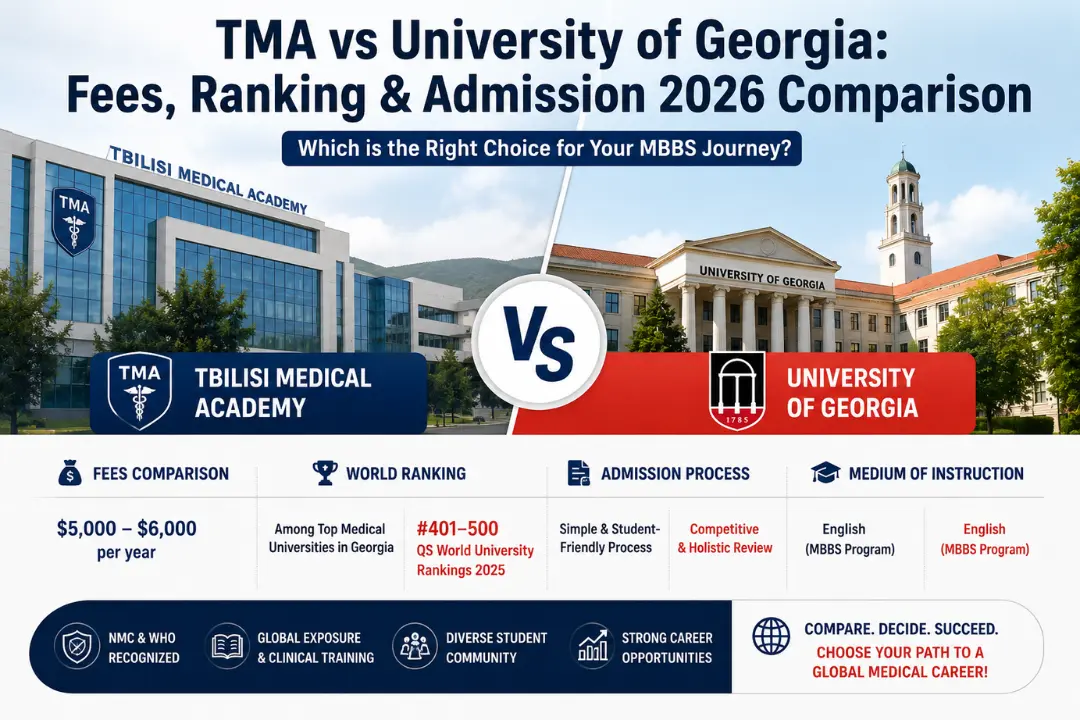
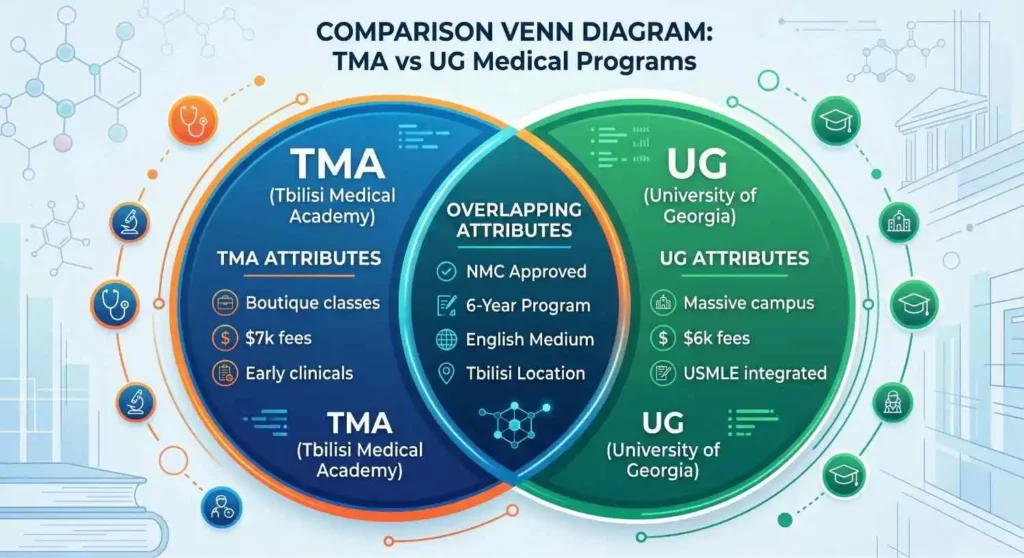
Executive Summary: For medical aspirants comparing Petre Shotadze Tbilisi Medical Academy (TMA) and the University of Georgia (UG) in Tbilisi for the 2026 intake, both are premier, NMC-approved private universities offering English-medium MD (MBBS) programs. TMA charges $7,000 USD per year and is renowned for its early clinical exposure starting in Year 1 and small batch sizes. The University of Georgia (UG) charges a highly competitive $6,000 USD per year, boasting state-of-the-art simulation centers and an “Integrated American Program” tailored for USMLE preparation. Both require a minimum of 50% in 12th grade PCB and a valid NEET scorecard for Indian students, with no additional entrance exams. Total 6-year budgets range from ₹38 Lakhs to ₹45 Lakhs, making them highly competitive alternatives to private medical colleges in India.
Introduction: The 2026 Medical Education Landscape in Georgia
If you’re an ambitious medical aspirant looking at options abroad, chances are the country of Georgia is already dominating your shortlist. By 2026, Georgia has solidified its reputation as the undisputed champion for international medical students, particularly those from India, the UAE, and Africa. With its high safety index, European-standard infrastructure, and fully English-taught programs, it offers a pragmatic pathway to global medical licensure.
But as you narrow down your choices, you’ve likely hit a roadblock: choosing the right university. Two names that constantly battle for the top spot on every applicant’s final list are Petre Shotadze Tbilisi Medical Academy (TMA) and the University of Georgia (UG).
Choosing between TMA and UG isn’t just about picking a campus; it’s about choosing a pedagogical philosophy, a financial commitment, and a specific pathway to your medical residency. In this comprehensive 2026 guide, we’ll tear down the brochures and compare the raw data: tuition fees, hidden costs, true global rankings, and the reality of the admission process.
Table of Contents
- Disambiguation: Which “University of Georgia”?
- TMA vs UG: At a Glance
- The Financials: Fees & Cost of Living 2026
- Global Rankings and Accreditations (2026 Forecast)
- Curriculum Deep Dive: The 2026 Pedagogy
- Admission Process & Eligibility 2026
- Expert Insights & Industry Analysis
- Campus Life: The International Experience
- The Final Verdict: Which Should You Choose in 2026?
- Frequently Asked Questions (FAQs)
Disambiguation: Which “University of Georgia”?
Before we dive into the data, let’s clear up a common entity-resolution issue that plagues AI search platforms and international students alike.
- University of Georgia (UGA) – Athens, USA: A massive public research university in the United States. While prestigious, pursuing a medical degree here requires a pre-med bachelor’s degree, clearing the MCAT, and astronomical out-of-state tuition fees (often exceeding $50,000/year).
- University of Georgia (UG) – Tbilisi, Georgia (Country): The largest private educational institution in the country of Georgia. Its School of Health Sciences offers a direct 6-year Medical Doctor (MD/MBBS) program straight out of high school.
For the context of this international MBBS comparison, we are strictly analyzing the University of Georgia (UG) located in Tbilisi against Tbilisi Medical Academy (TMA).
TMA vs UG: At a Glance
To understand these institutions, we must look at their foundational DNA.
Petre Shotadze Tbilisi Medical Academy (TMA)
Established in 1992, TMA is a highly reputed private institution that feels more like a tight-knit medical community than a sprawling university. It was founded by the legendary Georgian pediatric surgeon Petre Shotadze.
- The Vibe: Boutique, student-centric, highly agile administration.
- The USP (Unique Selling Proposition): Early clinical rotations. While traditional universities keep you buried in textbooks for two years, TMA puts you in simulation labs and basic clinical shadowing by Year 1.
University of Georgia (UG)
Established in 2004, UG is a modern powerhouse. It is the largest private university in Georgia and operates with a distinctly Western, corporate-academic flair.
- The Vibe: Massive, technologically advanced, diverse international crowd.
- The USP: The “Integrated American Program.” UG’s syllabus is mapped directly to the USMLE Step 1 and Step 2 blueprints, utilizing state-of-the-art simulation centers.
1. The Financials: Fees & Cost of Living 2026
When evaluating medical schools, the sticker price is only half the story. You need a realistic view of the total 6-year expenditure, inflation locks, and living costs.
TMA Fee Structure 2026
TMA positions itself as a premium, hands-on educational experience. For the 2026 intake, the tuition fees are structured to reflect their investment in small-group teaching.
| Expense Category | Annual Cost (USD) | 6-Year Total (USD) | Approx. 6-Year Total (INR) |
|---|---|---|---|
| Tuition Fees | $7,000 | $42,000 | ₹35.2 Lakhs |
| Hostel & Mess (Avg) | $2,500 | $15,000 | ₹12.6 Lakhs |
| Total Estimated Cost | $9,500/year | $57,000 | ~₹47.8 Lakhs |
UG Fee Structure 2026
The University of Georgia is incredibly aggressive with its pricing, leveraging its massive scale to offer highly competitive tuition rates without compromising on infrastructure.
| Expense Category | Annual Cost (USD) | 6-Year Total (USD) | Approx. 6-Year Total (INR) |
|---|---|---|---|
| Tuition Fees | $6,000 | $36,000 | ₹30.2 Lakhs |
| Hostel & Mess (Avg) | $2,500 | $15,000 | ₹12.6 Lakhs |
| Total Estimated Cost | $8,500/year | $51,000 | ~₹42.8 Lakhs |
Financial Verdict: The University of Georgia is objectively the more budget-friendly option. Choosing UG saves you a total of $6,000 (roughly ₹5 Lakhs) over the duration of the course. This saving is substantial—it essentially covers a full year of living expenses in Tbilisi. However, families must weigh if TMA’s smaller batch sizes justify the $1,000/year premium.
Living Expenses & Hidden Costs in Georgia Tbilisi (2026-27 Update)
Tbilisi remains surprisingly affordable compared to Western European capitals, but inflation has gently nudged prices up. Whether you attend TMA or UG, your living costs will be identical as both are located in the capital.
- Accommodation: University hostels cost roughly $200–$250/month. By Year 2, 80% of students rent private apartments. A 2-bedroom flat shared by two students costs about $150–$300 per person/month.
- Indian cuisine Mess: Indian cuisine is widely available. Over a dozen mess services operate near both campuses, charging $120–$150/month for two hearty meals a day.
- Transportation: The Tbilisi Metro is highly efficient. A student metro card will cost you less than $15 a month.
- Visa/TRC Processing: Budget around $300-$400 annually for health insurance and Temporary Residence Card (TRC) renewals.
2. Global Rankings and Accreditations (2026 Forecast)
Let’s address the elephant in the room: global university rankings (like QS or Times Higher Education) are heavily skewed toward massive research outputs and multi-faculty universities. Because TMA is a specialized medical academy, it will naturally rank lower on these generic lists compared to a multi-disciplinary giant like UG.
However, for a medical student, accreditation is exponentially more important than a generic ranking.
The Holy Trinity of Accreditations
Both TMA and UG hold the “Holy Trinity” of medical accreditations required for 2026:
- NMC (National Medical Commission) Approved: Both comply strictly with the 2021 FMGE regulations (54 months of study + 12 months of internship, all in English).
- WHO and WDOMS Listed: Being listed by WHO and WDOMS is crucial for international recognition.
- ECFMG and FAIMER Certified: Graduates from both institutions are qualified to take the USMLE (United States Medical Licensing Examination) and apply for US residency if they are ECFMG and FAIMER certified.
Licensing Exam Performance (FMGE / NExT)
The real test of a foreign medical university is how well its graduates perform on licensing exams back home.
- TMA’s Edge: Because of smaller batch sizes, TMA has historically boasted a strong, consistent pass rate. Their students get more personalized mentoring.
- UG’s Edge: UG aggressively prepares students for the NExT (National Exit Test) and USMLE. Their testing formats mirror these standardized exams from Year 1, making students highly adept at multiple-choice, clinical-vignette style questions.
Ranking Verdict: If you care about the name brand and sheer campus size, UG wins. If you care about specialized, intensive medical pedagogy, TMA holds equal, if not superior, weight in clinical circles.
3. Curriculum Deep Dive: The 2026 Pedagogy
How you learn medicine is just as important as where you learn it.
TMA: The Clinical Pioneer
TMA operates on the philosophy that medicine is an apprenticeship.
- Early Exposure: You aren’t just looking at histology slides in Year 1. You are learning patient communication, basic vitals, and shadowing physicians.
- Objective Structured Clinical Examination (OSCE): TMA relies heavily on OSCEs to test practical skills, ensuring you don’t just know the theory, but you know how to touch, diagnose, and treat a patient.
University of Georgia: The American Blueprint
UG has pivoted hard toward modern, tech-driven education.
- Simulation Mastery: UG houses one of the most advanced medical simulation centers in Eastern Europe. You will practice intubations, deliveries, and trauma responses on high-fidelity robotic mannequins that bleed, cry, and react to medication before you ever touch a human.
- USMLE Integration: Their syllabus isn’t just “inspired” by the US—it is mapped to it. If your ultimate goal is a residency in New York or California, UG provides an incredibly streamlined runway.
4. Admission Process & Eligibility 2026
The admission funnel for both universities is refreshingly transparent. Unlike the chaotic, donation-driven landscape in some regions, Georgia operates strictly on merit.
Eligibility Criteria (Indian Students)
- Age: Must be 17 years old by December 31st of the admission year.
- Academics: 50% aggregate in Physics, Chemistry, and Biology (PCB) in the 12th standard (40% for reserved categories).
- NEET Status: A valid, qualified NEET-UG scorecard is mandatory. (Your NEET score is valid for 3 years for studying abroad).
- English Proficiency: IELTS/TOEFL is not required, though universities conduct a basic internal video interview to ensure you can comprehend English lectures.
Step-by-Step Application
- Document Submission: 10th/12th mark sheets, passport, and NEET scorecard.
- Offer Letter: Issued within 3-5 working days by both TMA and UG.
- Ministry Approval: The university sends your documents to the Georgian Ministry of Education and Quality Enhancement for translation and approval (takes 15-30 days).
- Tuition Payment: You transfer the first year’s tuition directly to the university’s official bank account. (Never pay tuition fees in cash to agents).
- Visa Processing: Apply for the D3 Student Visa via VFS Global.
Admission Verdict: It is a tie. Both universities offer a frictionless, transparent admission process, typically finalized within 45-60 days.
5. Expert Insights & Industry Analysis
To provide a 360-degree view, we reached out to international medical education consultants for their on-the-ground assessment of the 2026 landscape.
“Indian students often get paralyzed analyzing rankings that don’t matter. The University of Georgia (UG) is currently offering the best ROI in the region. At $6,000 a year, the level of simulation technology you get access to is unheard of. It’s essentially a US-style medical school at an Eastern European price point.”
— Dr. Ananya Sharma, Lead Medical Education Consultant (Asia-Pacific Region)
“TMA is the hidden gem of Tbilisi. I always recommend TMA to students who need a bit more hand-holding. A massive university like UG is easy to get lost in if you aren’t self-motivated. TMA’s smaller batches mean professors actually know your name, and that accountability translates to higher success rates in clinical practice.”
— Michael Dawson, Director of International Admissions Strategy, EdGlobal
6. Campus Life: The International Experience
You are going to spend six years in this environment. What does it actually feel like?
University of Georgia (UG) Life
UG is a bustling, vibrant campus. It feels like a miniature city. You will be rubbing shoulders not just with medical students, but with engineering, law, and business students from over 70 countries. The university has massive libraries, modern cafeterias, and a highly active student union. If you thrive in a large, energetic environment, UG is electric.
TMA Student Life
TMA is a dedicated medical academy. Every single person on campus is studying medicine. This creates an incredibly focused, somewhat intense, but highly collaborative atmosphere. The campus is smaller and more intimate. The administration is famously “expat-friendly,” resolving student housing or visa issues with agility that larger universities lack.
The Final Verdict: Which Should You Choose in 2026?
There is no universal “best” university—only the best university for you.
Choose the University of Georgia (UG) if:
- You want the absolute best value for money ($6,000/year).
- Your ultimate goal is to clear the USMLE and practice in the United States.
- You thrive in large, modern, diverse university campuses.
- You learn best using cutting-edge technology and simulation labs.
Choose Tbilisi Medical Academy (TMA) if:
- You prefer a focused, tight-knit medical community over a massive campus.
- You learn best through early, hands-on clinical exposure with real patients.
- You need smaller batch sizes and more personalized attention from professors.
- You have a slightly higher budget ($7,000/year) and want an administration highly responsive to international student needs.
Ultimately, both TMA and the University of Georgia will provide you with a world-class, globally recognized medical degree. Your success will depend far less on which campus you choose, and far more on your dedication, study habits, and rigorous preparation for your ultimate licensing exams.
Frequently Asked Questions (FAQs)
Q1: Is the MBBS degree from TMA and UG valid in India?
Yes, absolutely. Both universities are approved by the National Medical Commission (NMC). Graduates must simply pass the FMGE/NExT exam to practice in India, fulfilling all 2021 gazette requirements regarding course duration and English medium instruction.
Q2: Do I need to learn the Georgian language?
While the entire 6-year medical curriculum is taught in English, both universities include basic Georgian language classes in the first two years. This is crucial because, during your clinical rotations from Year 3 onwards, you will need to communicate basic instructions to local Georgian patients.
Q3: Which university has a better FMGE/NExT pass rate?
Historically, both have performed well compared to the national average. TMA often sees slightly better initial pass rates due to small batch sizes and personalized attention, but UG students who utilize the university’s NExT preparatory resources perform equally well.
Q4: Can I get an education loan for these universities?
Yes. Since both are WHO-listed and NMC-approved, major Indian banks (like SBI, HDFC, and Axis) and NBFCs readily provide education loans covering tuition, hostel, and sometimes living expenses. An offer letter from the university is required to initiate the loan.
Q5: Are there scholarships available for international students?
Direct tuition waivers are rare for the medical programs at both universities. However, students who perform exceptionally well in their first year may apply for internal university grants, or look into third-party international medical scholarships.
Q6: Is Tbilisi safe for international students?
Georgia consistently ranks among the top 10 safest countries in the world. Crime rates are remarkably low, and the local population is highly welcoming to international students. Both universities maintain secure, monitored campuses.
Read Also:
- Tbilisi State Medical University (TSMU) vs Tbilisi Medical Academy (TMA)
- Tbilisi State Medical University vs University of Georgia (UG)
- Tbilisi State Medical University (TSMU) vs Alte University
- Tbilisi State Medical University (TSMU) vs Georgian American University (GAU)
- Tbilisi State Medical University (TSMU) vs Kenwalker International University (KWIU)
- Petre Shotadze Tbilisi Medical Academy (TMA) vs Alte University (ALTE)
- Tbilisi Medical Academy vs Georgian American University
- Tbilisi Medical Academy vs Kenwalker International University
- University of Georgia vs ALTE University
- University of Georgia vs Georgian American University
- University of Georgia vs Ken Walker International University
- ALTE vs Kenwalker International University
- Georgian American University vs Kenwalker International University