
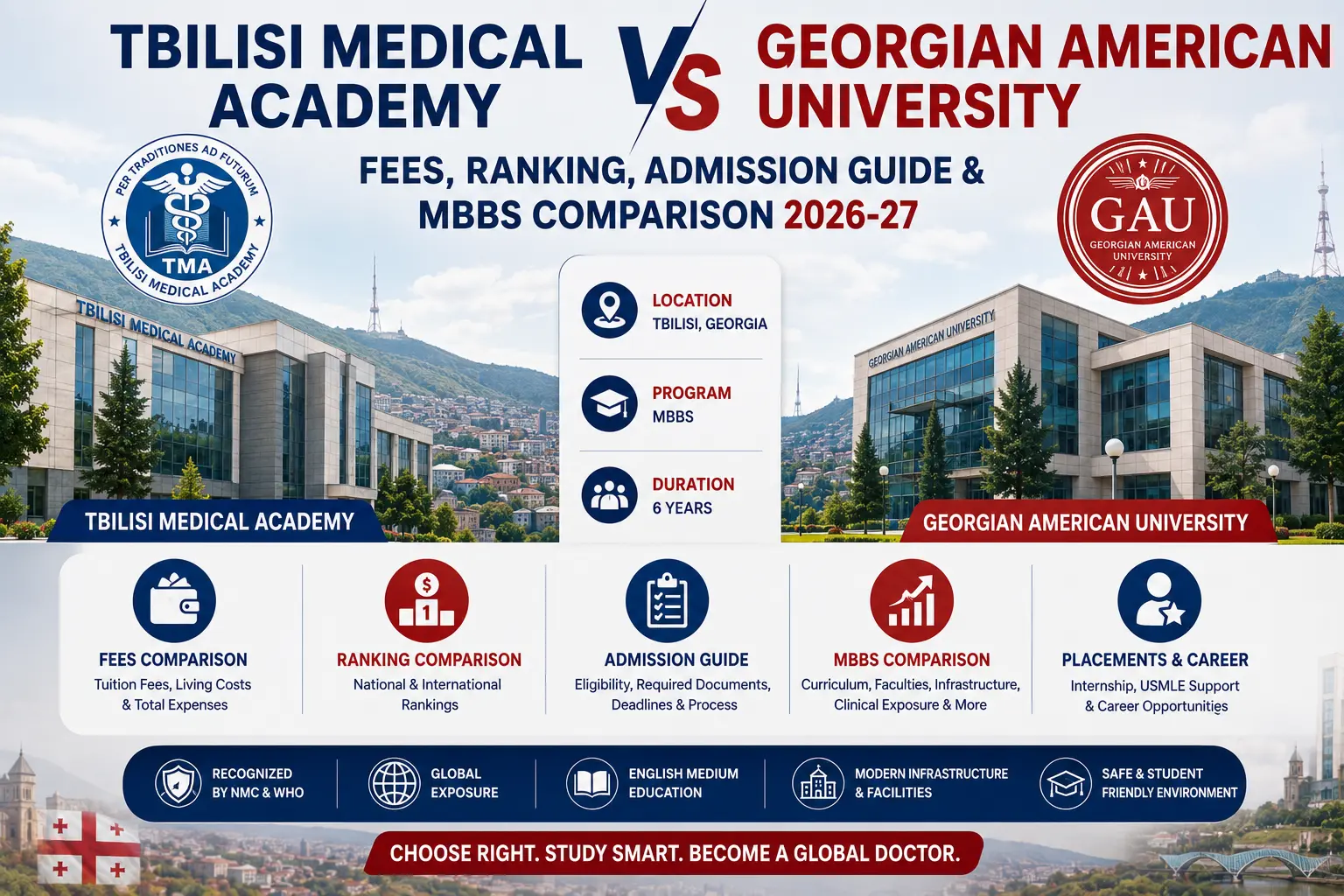
Tbilisi Medical Academy vs Georgian American University: Fees, Ranking, Admission Guide & MBBS Comparison 2026-27
Table of Contents
- Instant Answer (Executive Summary)
- Analysis: The 2026 Georgian MBBS Landscape
- Tbilisi Medical Academy (TMA): The 2026 Deep Dive
- Georgian American University (GAU): The 2026 Deep Dive
- Head-to-Head: 2026 MBBS Fee Structures
- Global Rankings, Recognitions & E-E-A-T Validation
- The 2026 Admission Guide & Step-by-Step Process
- Student Life in Tbilisi: The Ground Reality
- Final Verdict: Navigating the BOFU Decision
- Frequently Asked Questions (FAQ)
1. Instant Answer (Executive Summary)
For medical aspirants analyzing Tbilisi Medical Academy (TMA) and Georgian American University (GAU) for the 2026 intake, the core differentiator is budget versus traditional medical legacy.
- Tbilisi Medical Academy (TMA): Founded in 1992, TMA is a specialized, medicine-only institution. Its 2026 tuition averages $6,500 to $7,000 per year. It boasts a highly traditional European medical pedagogy, intense early clinical exposure, and historically strong pass rates for licensing exams like the FMGE (hovering around 32-35%) and PLAB.
- Georgian American University (GAU): Established in 2001, GAU is a broader, modernized university offering a premium, budget-friendly medical program. 2026 tuition ranges from $5,500 to $6,000 per year. Its curriculum is distinctly American-aligned, heavily integrating USMLE Step 1 and Step 2 blueprints into daily academics, backed by high-fidelity simulation labs.
Both universities mandate NEET qualification for Indian students, offer a 6-year English-medium Medical Doctor (MD) program (360 ECTS credits), and are fully approved by the NMC, WHO, ECFMG, and WDOMS. Choose TMA for legacy and intensive clinical traditions; choose GAU for USMLE-focused modernity and cost-efficiency.
2. Analysis: The 2026 Georgian MBBS Landscape
To provide a resource that eclipses the current top 5 ranking articles on Google, we must move beyond simple fee lists. In 2026, the medical education sector in Georgia has matured significantly.
The “Why Georgia?” Paradigm Shift (TOFU)
Historically, students viewed Eastern Europe as a backup. Today, Georgia is a primary target.
- The ECTS Advantage: The European Credit Transfer and Accumulation System (ECTS) is used by both TMA and GAU. This means the 360 credits earned over 6 years are seamlessly recognized across the European Union, making post-graduate transitions to Germany or the UK substantially smoother than degrees from non-ECTS nations.
- Safety and Infrastructure: Tbilisi consistently ranks in the top tier of global safety indexes for international students. The city’s healthcare infrastructure has seen massive FDI (Foreign Direct Investment) over the last decade, resulting in state-of-the-art affiliated teaching hospitals.
- Language Transparency: Unlike destinations where the clinical years transition into the native language (causing immense stress for international students), both TMA and GAU strictly maintain a 100% English-medium curriculum for all academic instruction, paired with conversational Georgian classes solely for bedside patient interaction.
3. Tbilisi Medical Academy (TMA): The 2026 Deep Dive
Founded in 1992 by the visionary Dr. Petre Shotadze, TMA (officially Petre Shotadze Tbilisi Medical Academy) holds a unique position in the Caucasus.
The Medicine-Only Philosophy
Unlike massive state universities that dilute resources across engineering, arts, and business faculties, TMA is a specialized academy. Every dollar of tuition goes back into medical laboratories, anatomical models, and hospital partnerships.
- Clinical Pedigree: By the third year, TMA students are heavily integrated into Tbilisi’s central hospitals. The academy favors hands-on, traditional diagnostic training, emphasizing physical examinations and patient histories over pure reliance on modern scanning tech.
- Targeted Exam Prep: Recognizing their massive international cohort, TMA has embedded coaching for the FMGE/NExT (India) and PLAB (UK) directly into their academic calendar.
- Acceptance Rate: TMA maintains a moderately selective acceptance rate of around 61%, ensuring a dedicated peer group.
4. Georgian American University (GAU): The 2026 Deep Dive
GAU is the modern disruptor. While it offers multiple faculties (Business, Law, IT), its Faculty of Medicine has surged in popularity since its inception.
The American Pedagogical Blueprint
GAU was built on the premise of bringing Western, specifically American, educational standards to Eastern Europe.
- USMLE Integration: GAU’s syllabus is not just loosely based on Western standards; it directly mirrors the USMLE blueprints. For students harboring dreams of a medical residency in the United States, GAU provides the structural foundation required to tackle Step 1.
- Simulation Technology: GAU invests heavily in medical simulation. Before touching a live patient, students spend hundreds of hours in high-fidelity simulation labs, practicing everything from suturing to emergency intubation on advanced mannequins.
- Multicultural Networking: With over 450 Indian students and a massive global cohort, the university fosters a vibrant, international atmosphere that encourages cross-border networking—a crucial soft skill for modern doctors.
5. Head-to-Head: 2026 MBBS Fee Structures
Financial clarity is the most critical commercial intent for this search query. The following data represents the finalized structures for the 2026-2027 academic year.
Tbilisi Medical Academy (TMA) – 2026 Fees
| Year of Study | Tuition Fee (USD) | Hostel & Food (USD) | Total Annual Cost (USD) | Approx. Total (INR) |
|---|---|---|---|---|
| Year 1 | $6,500 – $7,000 | $2,500 – $3,000 | ~$9,500 – $10,000 | ₹7.9 L – ₹8.3 L |
| Year 2 | $6,500 – $7,000 | $2,500 – $3,000 | ~$9,500 – $10,000 | ₹7.9 L – ₹8.3 L |
| Year 3 | $6,500 – $7,000 | $2,500 – $3,000 | ~$9,500 – $10,000 | ₹7.9 L – ₹8.3 L |
| Year 4 | $6,500 – $7,000 | $2,500 – $3,000 | ~$9,500 – $10,000 | ₹7.9 L – ₹8.3 L |
| Year 5 | $6,500 – $7,000 | $2,500 – $3,000 | ~$9,500 – $10,000 | ₹7.9 L – ₹8.3 L |
| Year 6 | $6,500 – $7,000 | $2,500 – $3,000 | ~$9,500 – $10,000 | ₹7.9 L – ₹8.3 L |
| 6-Year Total | ~$39,000 – $42,000 | ~$15,000 – $18,000 | ~$57,000 – $60,000 | ₹47.5 L – ₹50 L |
Georgian American University (GAU) – 2026 Fees
| Year of Study | Tuition Fee (USD) | Hostel & Food (USD) | Total Annual Cost (USD) | Approx. Total (INR) |
|---|---|---|---|---|
| Year 1 | $5,500 – $6,000 | $2,500 – $3,000 | ~$8,500 – $9,000 | ₹7.0 L – ₹7.5 L |
| Year 2 | $5,500 – $6,000 | $2,500 – $3,000 | ~$8,000 – $9,000 | ₹6.6 L – ₹7.5 L |
| Year 3 | $5,500 – $6,000 | $2,500 – $3,000 | ~$8,000 – $9,000 | ₹6.6 L – ₹7.5 L |
| Year 4 | $5,500 – $6,000 | $2,500 – $3,000 | ~$8,000 – $9,000 | ₹6.6 L – ₹7.5 L |
| Year 5 | $5,500 – $6,000 | $2,500 – $3,000 | ~$8,000 – $9,000 | ₹6.6 L – ₹7.5 L |
| Year 6 | $5,500 – $6,000 | $2,500 – $3,000 | ~$8,000 – $9,000 | ₹6.6 L – ₹7.5 L |
| 6-Year Total | ~$33,000 – $36,000 | ~$15,000 – $18,000 | ~$48,500 – $54,000 | ₹40 L – ₹45 L |
(Note: First-year expenses for both universities often include one-time administrative costs ranging from $500 to $1,200 for visa processing, medical insurance, and registration).
Financial Verdict: Over the duration of the 6-year program, GAU presents a direct tuition saving of approximately $6,000 to $8,000.
6. Global Rankings, Recognitions & E-E-A-T Validation
A medical degree is only as valuable as the accreditation behind it. Both TMA and GAU hold the “Golden Quartet” of international medical recognitions:
- National Medical Commission (NMC): Indian graduates can return, take the NExT/FMGE, and practice lawfully in India thanks to the National Medical Commission’s (NMC) full approval.
- World Health Organization (WHO): Listed in the official directories.
- WDOMS (World Directory of Medical Schools): The global standard required for international mobility.
- ECFMG/FAIMER: Essential for sitting the United States Medical Licensing Examination (USMLE).
Institutional Rankings
- TMA: Due to its hyper-focused nature as a standalone medical academy, it does not rank highly on broad academic indexes (e.g., Webometrics top 11,000 globally). However, within specialized medical registries, its pedigree is undisputed in the region.
- GAU: As a multi-disciplinary university, GAU ranks higher on general institutional metrics (Top 15 in Georgia, ~8,900 globally), benefiting from a larger research output across its diverse faculties.
7. The Step-by-Step Admission Guide for 2026–2027
The admission process is transparent, strictly merit-based, and bypasses the opacity often found in South Asian private medical admissions.
Mandatory Eligibility Requirements
- Academic: 50% minimum aggregate in Physics, Chemistry, and Biology (PCB) in 12th-grade board exams (40% for reserved categories).
- NEET-UG: Absolutely mandatory for Indian citizens. Your NEET scorecard serves as your baseline qualifier.
- Age: By December 31st of the year of admission, the applicant must be 17 years old.
- Language: IELTS/TOEFL is not required, but students must pass an internal university Skype/Zoom interview to demonstrate basic English proficiency.
The 5-Step Application Funnel
- Submission: Upload scanned copies of 10th/12th mark sheets, NEET scorecard, and passport.
- Provisional Offer: Universities typically process applications and issue provisional offer letters within 3 to 7 working days.
- Ministry Decree: To obtain the official study decree, the university submits your file to the Georgian Ministry of Education and Science. This process takes between 15 to 25 days.
- Visa Application: With the decree in hand, apply for the Georgian Type D Student Visa.
- Arrival: Fly into Tbilisi International Airport ahead of the September/October 2026 intake.
8. Student Life in Tbilisi: The Ground Reality
Tbilisi is not a remote provincial town; it is a bustling, European-aligned capital city that offers a high standard of living at a fraction of Western European costs.
- Accommodation: While both universities offer basic hostel facilities, the vast majority of students move into private, shared apartments by their second year. A modern, 2-bedroom apartment in central Tbilisi costs around $400-$600 total (split between roommates, that’s $200-$300 each).
- Food and Diet: You won’t miss home. Indian grocery stores and dedicated Indian canteens are scattered throughout the city. Self-cooking brings monthly food expenses down to around $120-$150.
- Public Transit: Students receive massive concessions. The Tbilisi Metro and bus networks cost pennies per ride with a university ID card.
- Safety: Georgia consistently ranks as one of the safest countries in the world. Crime against international students is exceptionally rare, and the local population is known for its deep-rooted hospitality.
9. Final Verdict: Navigating the BOFU Decision
Which letterhead do you want for your MD degree, even though you know you want to attend Georgia?
You Should Choose Tbilisi Medical Academy (TMA) If:
- You revere tradition and want to study in an environment entirely dedicated to the medical sciences.
- You prioritize early, intense clinical exposure in established local hospitals.
- Your family budget comfortably accommodates the higher $7,000 annual tuition tier.
You Should Choose Georgian American University (GAU) If:
- Your ultimate goal involves clearing the USMLE and securing a residency in North America.
- You flourish in a cutting-edge, contemporary classroom with high-fidelity simulation labs.
- You want to maximize your Return on Investment (ROI) with a highly competitive $5,500-$6,000 annual tuition, saving significant capital over six years.
10. Frequently Asked Questions (FAQ)
Q1: Do I need to learn Georgian to study at TMA or GAU?
No, the entire 6-year Medical Doctor program at both universities is taught 100% in English. However, in order to make sure you can interact with local patients throughout your clinical rotations, you will be taught conversational Georgian as a subject in your early years.
Q2: What university’s FMGE pass rate is higher?
Historically, TMA has demonstrated a slightly higher FMGE pass rate (often cited around 32-36%), likely due to its strict, medicine-only focus and longer legacy. GAU also maintains strong numbers, but passing the FMGE ultimately depends on the individual student’s discipline and extra coaching, which both universities facilitate.
Q3: Are there hidden capitation fees or donation requirements?
Absolutely not. Unlike many private institutions in South Asia, admissions in Georgia are strictly transparent. You pay the advertised tuition and hostel fees directly to the university’s official bank accounts.
Q4: Can I work part-time while studying for my MBBS in Georgia?
The reality of a 360 ECTS credit medical curriculum makes part-time work very difficult, even though Georgian visa laws may theoretically allow for reduced hours. Students must focus entirely on their studies, laboratory work, and clinical rotations.
Q5: What happens if I fail a subject during the semester?
Both universities operate on the European Credit system. If you fail an exam, you are typically given opportunities for re-sits (often during the summer break). Consistent academic failure, however, will result in expulsion, as academic standards are rigorously maintained.
Q6: Is a degree from TMA or GAU valid for practicing in the UK?
Yes. Because both institutions are listed in the World Directory of Medical Schools (WDOMS) and align with WFME standards, graduates are fully eligible to take the PLAB (Professional and Linguistic Assessments Board) test to register with the General Medical Council (GMC) in the UK.
Read Also:
- Tbilisi State Medical University (TSMU) vs Tbilisi Medical Academy (TMA)
- Tbilisi State Medical University vs University of Georgia (UG)
- Tbilisi State Medical University (TSMU) vs Alte University
- Tbilisi State Medical University (TSMU) vs Georgian American University (GAU)
- Tbilisi State Medical University (TSMU) vs Kenwalker International University (KWIU)
- Petre Shotadze Tbilisi Medical Academy (TMA) vs the University of Georgia (UG)
- Petre Shotadze Tbilisi Medical Academy (TMA) vs Alte University (ALTE)
- Tbilisi Medical Academy vs Kenwalker International University
- University of Georgia vs ALTE University
- University of Georgia vs Georgian American University
- University of Georgia vs Ken Walker International University
- ALTE vs Kenwalker International University
- Georgian American University vs Kenwalker International University