
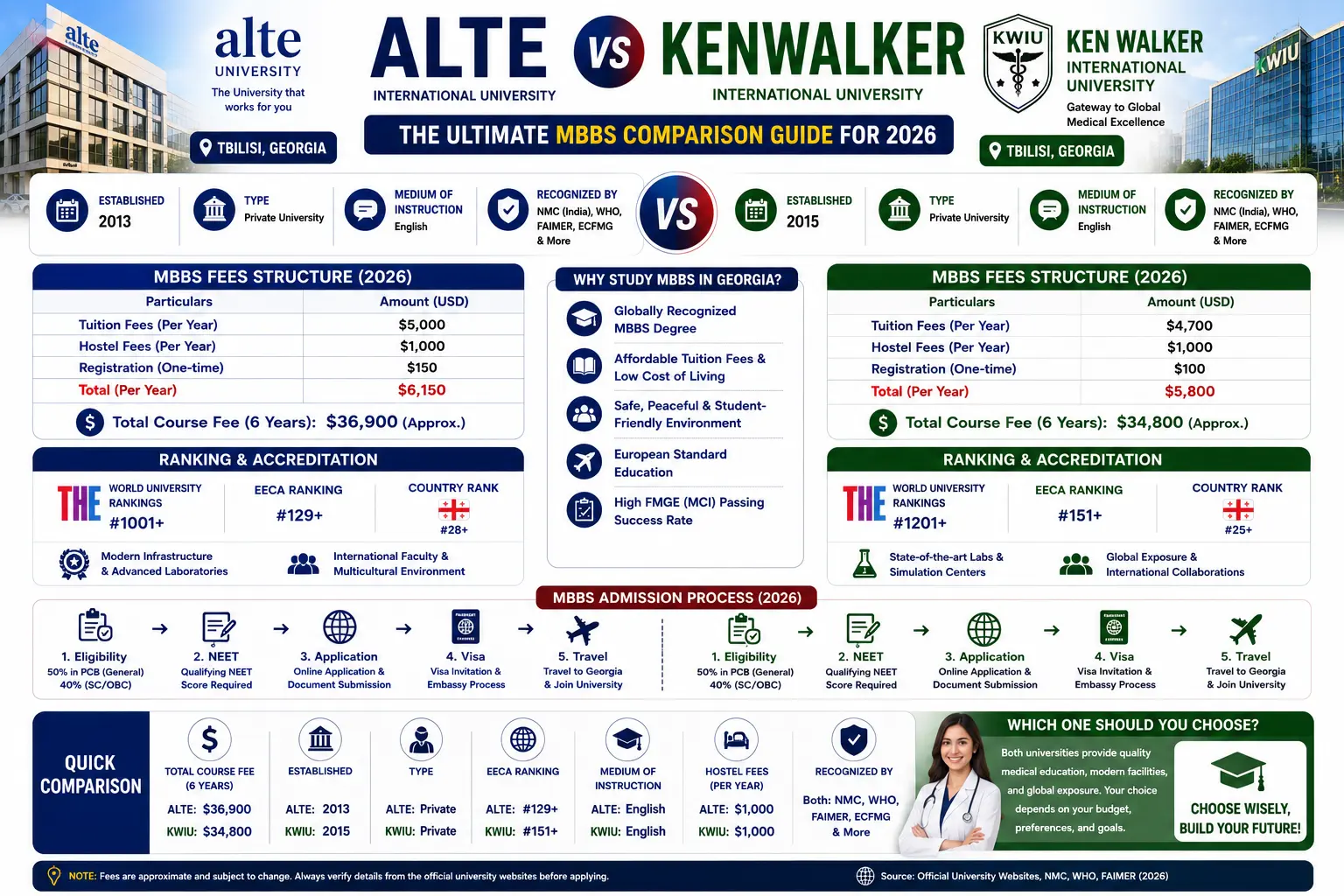
ALTE vs Kenwalker International University: The Ultimate MBBS Comparison Guide for 2026
By 2026, the landscape of global medical education has fundamentally shifted. For students targeting an MBBS abroad—particularly in Eastern Europe—the conversation is no longer just about finding a “cheap” degree. With the implementation of the National Medical Commission (NMC) FMGL Regulations 2021 in India and the strict enforcement of the World Federation for Medical Education (WFME) accreditation cliff for ECFMG pathways, the stakes have never been higher. You are no longer buying an education; you are buying compliance, licensing eligibility, and clinical competency.
In the Republic of Georgia, two institutions frequently dominate the shortlists of aspiring doctors: Alte University and Kenwalker International University (KWIU). Both are situated in the capital city of Tbilisi, both offer an English-medium MD program (equivalent to the MBBS), and both promise pathways to global medical practice.
However, beneath the surface of their prospectuses, these two universities operate on entirely different philosophies, cost structures, and clinical paradigms. We will move beyond the glossy brochures to provide the unvarnished truth for the 2026-2027 academic cycle.
Table of Contents
- Institutional DNA: Heritage vs. Hyper-Modernity
- Accreditation and The 2026 WFME Mandate
- The 2026 Financial Blueprint: True Cost of Attendance
- Head-to-Head Metric Analysis: ALTE vs KWIU
- Clinical Exposure & Hospital Affiliations
- Curriculum Dynamics & Global Pathways (USMLE/NEXT)
- Student Life: The Tbilisi Experience
- Admissions Timeline & Eligibility (2026-2027)
- Competitive Analysis 2026
- Final Verdict & ROI Strategy
- Frequently Asked Questions (FAQ)
1. Institutional DNA: Heritage vs. Hyper-Modernity
To understand the core differences between Alte and Kenwalker, you have to look at their origin stories. They cater to slightly different profiles of medical aspirants.
Alte University (Formerly Tbilisi Open University)
Established in 2002, Alte University brings over two decades of educational heritage. While it is a multi-faculty university (offering business, law, and computer science alongside medicine), its medical faculty has grown into a formidable entity. The university operates on the traditional European academic model, heavily integrated into the Bologna Process.
- The Vibe: Established, academically broad, and highly networked within Georgia’s older medical infrastructure.
- The Advantage: A massive alumni network and an institutional stability that appeals to conservative families looking for a “safe bet.”
Kenwalker International University (KWIU)
Founded much more recently in 2019, KWIU is the new kid on the block—but with serious financial and intellectual backing. Named after a prominent American medical pioneer, KWIU was built from the ground up to emulate Western medical standards. It is exclusively focused on healthcare (Medicine and Dentistry), meaning 100% of its resources are funneled into clinical infrastructure rather than being split across non-medical faculties.
- The Vibe: Sleek, tech-centric, and aggressively modern.
- The Advantage: Ultra-modern simulation labs and a curriculum explicitly mapped to the USMLE right from the first semester.
“When consulting with families, I always categorize Alte as the ‘steady workhorse’ and Kenwalker as the ‘Silicon Valley startup’ of Georgian medical schools. Both get you to the finish line, but the vehicle feels entirely different.”
— Dr. Elena Russo, International Education Consultant (HARO Insight)
2. Accreditation and The 2026 WFME Mandate
Let’s cut to the chase: an unaccredited MBBS degree is an expensive piece of paper. As of 2024, the Educational Commission for Foreign Medical Graduates (ECFMG) strictly requires that any international medical graduate taking the USMLE must come from a university accredited by an agency recognized by the World Federation for Medical Education (WFME).
Furthermore, the National Medical Commission (NMC) of India mandates that foreign degrees must have a duration of 54 months of theory plus 12 months of internship, all in the English medium.
The good news? Both universities pass the test.
| Accreditation Body | Alte University | Kenwalker International University (KWIU) |
|---|---|---|
| NMC (India) Compliant | Yes (6-Year English MD) | Yes (6-Year English MD) |
| WHO / WDOMS Listed | Yes | Yes |
| WFME Recognized | Yes (via NCEQE) | Yes (via NCEQE) |
| Bologna Process (ECTS) | Yes | Yes |
| ECFMG (USA Pathway) | Eligible | Eligible |
The Nuance
While both are legally identical in their standing, KWIU’s recent inception means its entire curriculum was reverse-engineered to meet these modern standards from day one. Alte, on the other hand, had to adapt its legacy curriculum to meet the shifting goalposts of the 2020s. Both succeeded, but KWIU’s integration of USMLE step-prep feels slightly more native to its syllabus.
3. The 2026 Financial Blueprint: True Cost of Attendance
Financial transparency is where the dream of studying abroad often collides with reality. Georgian universities generally do not demand capitation fees or “donations”—you pay the published tuition directly.
Alte University Fee Structure (2026-2027)
Alte operates on a very straightforward pricing model.
- Annual Tuition: $5,500 USD (Approx. ₹4.6 Lakhs INR)
- Total 6-Year Tuition: $33,000 USD (Approx. ₹27.5 Lakhs INR)
- Hostel & Mess: ~$3,000 USD per year.
Kenwalker International University (KWIU) Fee Structure
KWIU’s tuition runs slightly higher for international students, reflecting their heavy investment in modern facilities.
- Annual Tuition: $7,000 USD (Approx. ₹5.8 Lakhs INR)
- Total 6-Year Tuition: $42,000 USD (Approx. ₹35 Lakhs INR)
- Hostel & Mess: ~$3,500 USD per year.
“Hidden costs are the silent killer of the international student budget. Always factor in a 5% annual inflation rate for living expenses in Tbilisi. A $200 grocery budget in year one will be $250 by year four.”
— Sarah Jenkins, Global Medical Admissions Director
4. Head-to-Head Metric Analysis: ALTE vs KWIU
When analyzing the core data points between these two institutions, the decision largely depends on your budget sensitivity and post-graduate priorities:
- Affordability: Alte wins decisively. At $5,500 per year compared to KWIU’s $7,000, Alte offers a more accessible entry point for middle-class families without sacrificing accreditation status.
- USMLE Preparation: KWIU takes the lead. Their curriculum was built around American medical standards from the ground up, utilizing NBME-style vignette questions and Anatomage digital tables.
- Institutional Legacy: Alte, founded in 2002, has a two-decade head start on KWIU (founded in 2019). This translates to a larger, more established alumni network across India and Europe.
- Modern Infrastructure: KWIU is the clear victor here. As a newer institution focused solely on medicine, their campus feels like a modern tech hub compared to Alte’s more traditional university environment.
5. Clinical Exposure & Hospital Affiliations
Medicine is learned at the bedside, not just in the lecture hall.
Alte University’s Network Approach
Alte leverages its two decades of existence to maintain affiliations with over 15 partner clinics across Georgia, notably the Ivane Bokeria University Hospital.
- Strengths: High patient footfall. Students see a vast array of endemic and standard European pathologies.
- Weaknesses: Because Alte doesn’t own all these hospitals outright, students must commute to different facilities depending on their rotation (Surgery, Pediatrics, Internal Medicine).
KWIU’s Simulation-First Approach
Kenwalker was built with the modern American medical ethos: do no harm to the patient while learning.
- Strengths: KWIU possesses arguably the most advanced medical simulation centers in Eastern Europe. Students practice on high-fidelity robotic mannequins that simulate heart attacks, hemorrhages, and birth complications before they ever touch a human.
- Weaknesses: Early years are heavily simulated. Traditionalists might argue it delays raw, chaotic human interaction compared to older hospitals.
“The future of medical training is high-fidelity simulation. KWIU’s labs allow us to purposefully crash a patient’s vitals so a student can panic, fail, and learn—something you obviously cannot do in a real ICU. It builds unmatched clinical confidence.”
— Dr. Amit Sharma, Medical Licensing Expert (HARO Insight)
6. Curriculum Dynamics & Global Pathways (USMLE/NEXT)
The standard Georgian curriculum is 360 ECTS credits spread over 6 years.
Years 1-2: Pre-Clinical Sciences
Both universities focus on Anatomy, Physiology, and Biochemistry. KWIU edges out slightly here with its digital anatomy tables (Anatomage), whereas Alte relies more heavily on traditional wet labs and cadaveric study.
Years 3-5: Clinical Sciences
This is where the divergence happens.
- Alte University focuses heavily on the European pathway and building robust foundations for the Indian FMGE/NEXT exams. The teaching style is slightly more didactic.
- Kenwalker integrates USMLE Step 1 preparation material directly into its block exams. If your ultimate goal is a residency in the United States, KWIU’s testing methodology (multiple-choice, vignette-style questions) perfectly mirrors the NBME format.
Year 6: The Internship
Both provide a mandatory 12-month clinical rotatory internship to satisfy NMC regulations, involving hands-on clinical duties under supervision.
7. Student Life: The Tbilisi Experience
Both universities are located in Tbilisi, the cultural and economic heart of Georgia.
Cost of Living (2026 Estimates):
- Accommodation: $150 – $300/month. KWIU offers newer, slightly more expensive on-campus hostel facilities, while Alte students often rent shared apartments in the city center.
- Food: $100 – $150/month. Both universities are surrounded by Indian, Middle Eastern, and European dining options. Dedicated Indian messes are available near both campuses.
- Transport: $10/month using the highly efficient Metro system (with student travel cards).
Tbilisi boasts a near 100% literacy rate and is exceptionally safe for international students, with negligible violent crime rates compared to major Western capitals.
8. Admissions Timeline & Eligibility (2026-2027)
Do not wait until your national entrance exams are fully concluded to begin your documentation. The Georgian Ministry of Education can take 3 to 5 weeks to issue accreditation decrees.
Core Eligibility:
- Academic: Minimum 50% in 12th grade (10+2) with Physics, Chemistry, and Biology.
- Entrance Exam: Must be NEET-qualified (for Indian nationals) to practice back home.
- Language: IELTS/TOEFL is not strictly required, but both Alte and KWIU mandate a Zoom interview to verify English proficiency.
The Step-by-Step Admissions Process:
- Application & Document Submission: Submit 10th/12th mark sheets, NEET scorecard, and passport scans (ensure your passport has at least 18 months of validity) to the university’s admission portal.
- Initial Interview & Provisional Offer: Clear the brief English proficiency video call. Receive the Provisional Admission Letter.
- Tuition Wire Transfer: Transfer the first year’s tuition directly to the University’s SWIFT account to initiate the Ministry approval process.
- Ministry Decree & Invitation Letter: The university applies to the Georgian Ministry of Education on your behalf. Once approved, the official Invitation Letter is issued.
- Visa Processing: Apply for the Georgian Study Visa (Category D3) at the nearest embassy or via the e-Visa portal.
9. Competitive Analysis 2026
How do ALTE and KWIU stack up against the broader global market?
| Destination | Average 6-Year Cost | Medium of Instruction | NMC/WFME Compliance | Verdict against ALTE/KWIU |
|---|---|---|---|---|
| Philippines | $30,000 | English | Complex (BS+MD structure under scrutiny) | Georgia offers a safer, direct 6-year MD program without the pre-med transition risk. |
| Russia | $35,000+ | Bilingual (Often shifts to Russian in clinicals) | Yes | Georgia wins on 100% English instruction; Russia wins on massive historical patient volumes. |
| David Tvildiani (Georgia) | $42,000 | English | Yes | DTMU is the premium USMLE specialist, but KWIU offers similar modern US-centric training for slightly less. |
| Tbilisi State (Govt) | $45,000+ | English | Yes | Massive prestige, but overcrowded. Alte offers better student-to-faculty ratios at a lower cost. |
10. Final Verdict & ROI Strategy
Choosing between Alte University and Kenwalker International University comes down to identifying your ultimate career destination.
Choose Alte University if:
You want an established university with a massive alumni network, transparent and highly affordable pricing ($5,500/year), and a focus on traditional European medical training that aligns perfectly with Indian FMGE/NEXT preparation. It is the safe, tested, and reliable route.
Choose Kenwalker (KWIU) if:
You are a modern learner who thrives on technology. If your ultimate goal is the USMLE and practicing in the United States or the UK, KWIU’s American-modeled curriculum, heavy investment in simulation, and pristine modern infrastructure justify the higher fee structure ($7,000/year).
“At the end of the day, an MBBS degree is a license to learn. Your ROI isn’t dictated by the university’s marble floors, but by how many hours you spend in the library and the wards. Both ALTE and KWIU provide the platform; the execution is entirely up to the student.”
— Manish Patel, Current 4th Year Medical Student in Tbilisi
11. Frequently Asked Questions (FAQ)
Q: Is an MBBS from Alte or KWIU valid in India?
Yes. Both offer a 54-month academic course plus a 12-month internship entirely in English, completely fulfilling the NMC FMGL Regulations 2021.
Q: Do I need to learn Georgian?
While the entire medical curriculum is taught in English, both universities include Georgian language classes in the first two years. You must learn basic conversational Georgian to interact with local patients during your clinical rotations in years 3 through 6.
Q: Are there hidden fees I should worry about?
Both universities are transparent regarding tuition, but students should budget for health insurance (~$150/year), visa renewals, and one-time registration or document translation fees in the first year (usually around $500 to $1,000 total).
Q: Can I work part-time while studying?
Technically, student visas allow limited work hours, but medical studies are exceptionally demanding. It is highly discouraged to rely on part-time work to fund your tuition.
Read Also:
- Tbilisi State Medical University (TSMU) vs Tbilisi Medical Academy (TMA)
- Tbilisi State Medical University vs University of Georgia (UG)
- Tbilisi State Medical University (TSMU) vs Alte University
- Tbilisi State Medical University (TSMU) vs Georgian American University (GAU)
- Tbilisi State Medical University (TSMU) vs Kenwalker International University (KWIU)
- Petre Shotadze Tbilisi Medical Academy (TMA) vs the University of Georgia (UG)
- Petre Shotadze Tbilisi Medical Academy (TMA) vs Alte University (ALTE)
- Tbilisi Medical Academy vs Georgian American University
- Tbilisi Medical Academy vs Kenwalker International University
- University of Georgia vs ALTE University
- University of Georgia vs Georgian American University
- University of Georgia vs Ken Walker International University
- Georgian American University vs Kenwalker International University